Familyology

Larsen & Limb

  • Welcome
  • Larsen Family
  • Limb Family
  • Database
  • Legal
  • Site Map

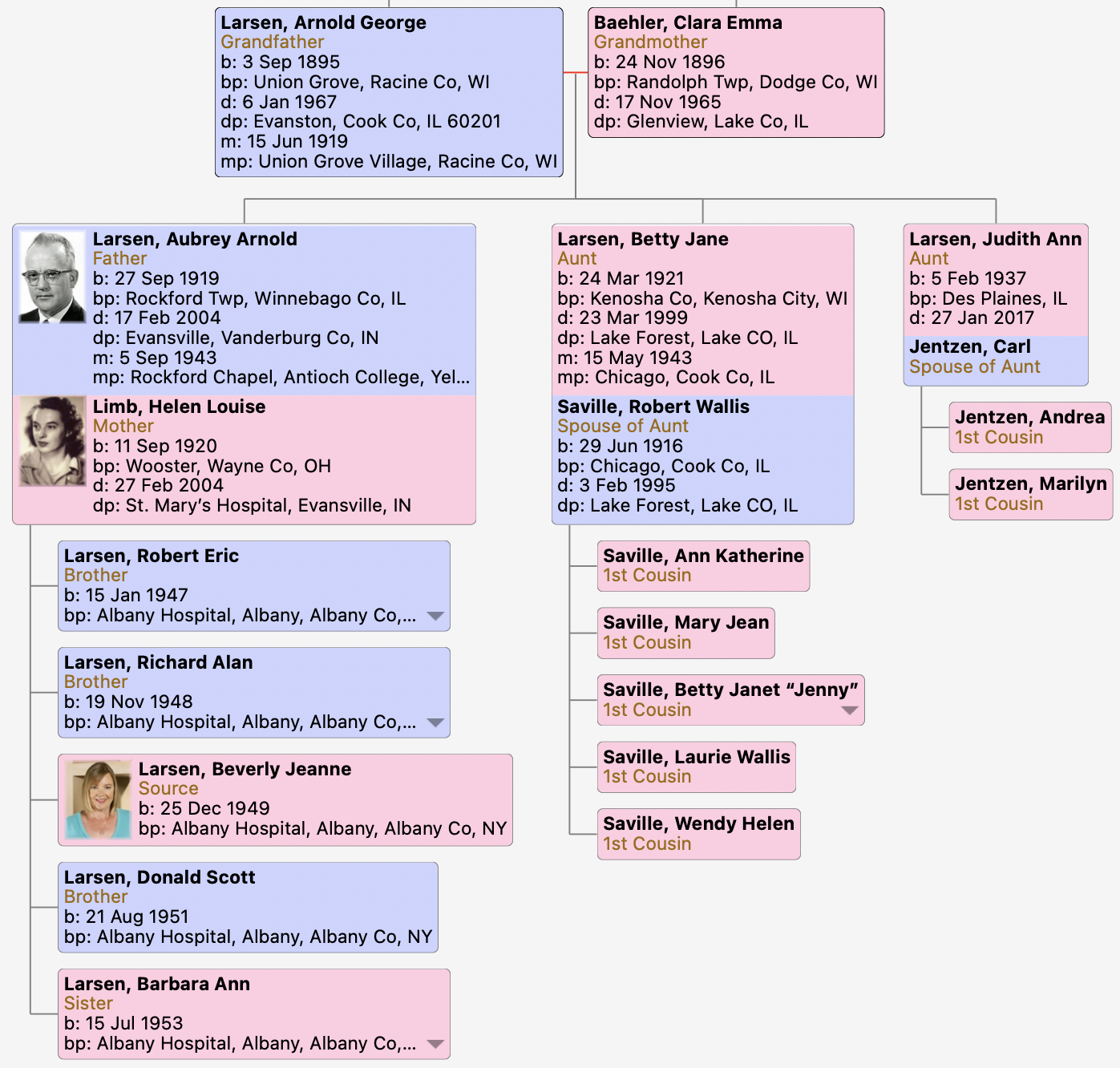
Children of Arnold G Larsen and Clara E Baehler

Aubrey Arnold Larsen

1919 ▸ June 15. Marriage to Arnold G. Larsen, in Union Grove, Racine Co, WI.
1919 ▸ September 27. Birth of son, Aubrey Arnold in Rockford Twp, Winnebago Co, IL.

1920 ▸ CENSUS. TBD
1921 ▸ March 24. Birth of daughter, Elizabeth Jane (Betty) in Kenosha Co, IL.

1930 ▸ CENSUS. April 18. Des Plaines, Maine Twp, Cook Co, IL. Household includes Arnold G (34) with wife Clara (33) and children Aubrey A (10) and Betty J (9).
1930 ▸ CENSUS. Occupation: Plasterer in the building industry.
1937 ▸ February 5. Birth of daughter, Judith Ann, in Des Plaines, IL.

1940 ▸ CENSUS. April 27. Des Plaines, Maine Twp, Cook Co, IL. Household includes Arnold (43) with wife Clara (41) and children Aubrey (20), Betty Jane (19) and Judith Ann (3).
1940 ▸ CENSUS. Occupation: Plasterer.
1943 ▸ May 15. Marriage of Betty Jane Larsen to Robert Wallis Saville in Chicago, Cook County, IL.
1943 ▸ September 5. Marriage of Aubrey Arnold Larsen to Helen Louise Limb, in Rockford Chapel, Antioch College, Yellow Springs, Ohio.

1950 ▸ CENSUS. Des Plaines, Maine Twp, Cook Co, IL. Household includes Arnold J (53) with wife Clara E (51) and daughter Judith Ann (13).

1965 ▸ November 17. Death of Clara in Glenview, Lake Co, IL. Buried in Ridgewood Cemetery, Des Plaines, Cook Co, IL.
1967 ▸ January 6. Death of Arnold G. Larsen in Cook Co, IL. Buried in Ridgewood Cemetery, Des Plaines, Cook Co, IL.


1937


Chicago Sunday Tribune
Chicago, Illinois
Sunday, 21 March, 1937
pg 39
200 Maine High Music Students Enter Contest
Winners Will Compete in District Event.
More than 200 vocal and instrumental music students at Maine will compete in the annual solo and ensemble contest to be held at 7:30 o’clock Tuesday and Wednesday evenings at the school. Pupils receiving first rating will be eligible to compete in the district solo contest scheduled for later in the school year. Judges from neighboring high schools will rate the contestants and award bronze pins to the winners.
The Maine Township high school junior class honor roll, which lists students ranking in the upper twenty per cent of their class in scholarship during the first two and a half years, includes 50 students.

Honor Roll Juniors.
The list is as follows:
Annetta Amling, Lucille Angsten, Arlene Balles, Rosemarie Broucek, Ruth Bus, Edward J. Conley, Jean Cooley, Charlotte Crowell, Jean Cooley, Charlotte Crowell, Violet Franzen, Alan Gernhardt, Eleanor Geuder, Werner Graaendorf, Paul Haake, Patricia A. Hickman, Mariod Hoglund, Richard Johnson, Frances Julius, Lucille Kolb, Eileen Kollman, John H. Landeck, Aubrey Larsen, Catherine Leibold, Joan Lewis, Virginia Loftus, and Norman Melzer.
Betty Jean Merrill, Elizabeth Mountford, Dorothy Peterson, Mary Jane Randolph, Fern Robinson, Karla Scierhorn, Shirley Schramm, Marguerite Seaman, Robert Shales, LaVerne Skeppstrom, Dorothy Smith, Rugh Spangler, Phyllis Spiers, Louise Sternberg, Tony Susen, Barbara Suster, Beverly Taylor, Lewis Twichell, Odette Vahrenwald, Irma Wagner, Bob Waarkentien, William L. Washington, Ruth Weber, Marvin Wells, and Ethelain Wurm complete the list.

Senior Play in May.
Justin Huntley’s “If I Were King” has been chosen for the senior play to be presented at Maine high on May 7 and 8. The stage settings are to be designed and made by the Maine Art club, which has been divided into three sections for specialized study in modeling, painting, and stage designing, under leadership of Jim Lunde, Alan Duncan, and Kenneth Evertson, respectively. The club plans an exhibit of student work later in the spring.


1957


NOTE: Not available digitally.
The Knickerbocker News
Albany, New York
Wednesday, 27 February, 1957
pg 22-B
Chemist Gets $1,000 Award
Dr. James O. Hoppe, on the staff of the Sterling-Winthrop Research Institute, is recipient of a $1,000 award from the Chilean Iodine Educational Bureau Inc. The award is presented annually for chemical and pharmaceutical research with iodine for use in medicine.
The award was presented to Dr. Hoppe for his contribution to the development of two new chemical compounds, used in the diagnosing of illnesses by x-ray. They are teleplaque and bypaque.
The executive committee of Sterling-Winthrop last week paid special tribute to Dr. Hoppe and the other members of the “radiopaque research team” at a dinner meeting in Duncan’s Inn. Among those who worked with Dr. Hoppe in the development of the compounds were Dr. Sydnay Archer, Dr. A.A. Larsen, John Ramano and Armand Brousseau.
The award will be presented to Dr. Hoppe at a meeting of the American Pharmaceutical Association in New York City in May. Dr. Hoppe has been employed at Sterling-Winthrop Research Institute since 1946. He lives at 41 Herrick Ave., Delmar.

NOTE: Not available digitally.
The Times-Union
Albany, New York
Saturday, 6 April, 1957
pg 2-page spread
Winthrop ‘Jugglers’ Perform for Science
These Medicine Men Are ‘Miracle’ Men
By Harvey Cobert
Words like ‘juggling’ and ‘wildcatting’ seem out of place in the complicated, but reserved vocabulary of the scientific research institution. But there are laboratory jugglers and wildcats, and their studies have been responsible for some far-reaching medical achievements.
If you once cringed at the thought of the dentist’s drill, but now relax knowing that Ravocaine will numb the pain, you can thank the laboratory jugglers. And many persons might not be alive today if the men of science didn’t get a wildcat idea once in a while.
Such words as “juggling” and “wildcatting” are common at the Sterling-Winthop Research Institute in Rensselaer. The institute, headed by Dr. M.L. Tainter, does all the research for Sterling Drug Inc., which has units in most of the free countries of the world.
Among Sterling’s divisions is Winthrop Laboratories. Rensselaer, at which, until seven years ago, most of the company’s research was done. In 1950, the new institute was opened on Columbia Turnpike.
Unlike some of the dramatic scientific discoveries of history, no one at Sterling-Winthrop has “stumbled” onto important developments. But hard work, plus juggling and wildcatting, have resulted in some important victories in the war against disease.
The 342 scientists and technicians at Sterling-Winthrop know first-hand that medical miracles aren’t performed overnight. Yet they have been responsible for some of the important “miracles” of our time. They have developed a drug used in the treatment of certain types of shock and acute cases of coronary disease; one which has proved highly successful against malaria, and another which has eased the pain of childbirth.
There is no set pattern to research at the institute, said Dr. George D. Wessinger, assistant director. “We try to work on compounds for those diseases which are most prevalent. We study morbidity and mortality rates, think up our own ideas and at times receive requests for certain projects from Sterling Drug.”
How does the development project start after an idea has been conceived, or a request received for a certain drug? “In many cases,” explained Dr. Wessinger, “we know that certain compounds have some very desirable qualities. The job is to rearrange the molecular structure of the compound, add or take out ingredients. “Sometimes we have to juggle the compound hundreds of ways in order to get what we want. With others, we finally have to admit defeat.”
One of the institute’s more important preparations, Demerol, was the direct result of juggling. Demerol, and analgesic, is used to relieve the pain of childbirth. The important fact about the compound is that compared to other analgesics there is much less depression on respiration.
Before Demerol was developed, there was a similar compound used to ease muscle spasms. Sterling-Winthrop found that by changing the molecular structure, the analgesic could be formed.
While juggling is an important factor, the real discoveries come from wildcatting in the laboratory, said Dr. Wessinger.
Wildcatting, he explained, means that the laboratory workers are starting from scratch. They make a compound just to see what it will do. If it isn’t effective, it is discarded and another made.
While this may sound like a haphazard system, wildcatting is one of the most important aspects of scientific research, said Dr. Wessinger.
“Had it not been for wildcatting, scientists would not have developed sulfanilamide,” he said. “After this was done, the researchers were able to develop the other sulfa drugs by juggling the original compound.”

Although the sulfa drugs were not developed at the institute, first production in the United States was at the Sterling-Winthrop plant in Rensselaer, the assistant director said.
Not every story has a happy ending to it. And this holds true for research. “We may get a request for a certain type of compound,” he said. “After we work for a long time, and realize that no progress has been made, we have to decide to scrap the project,” he said.
Scientists have to take disappointments in stride. “To be a scientist, you have to be the type of person who is not afraid of defeat,” Dr. Wessinger said. “There are far more defeats than victories. Out of several hundred compounds developed, we’re lucky to get one that is worthwhile.
The team spirit prevails in the laboratory. At Sterling-Withrop personnel work in small sections. For those impressed by titles, the institute has a large group of chemists, bacteriologists, pharmacologists, virologists, pharmacists and physicians on its staff.
And there is plenty of work for each team, or section. Before a compound can be used the scientists have to determine whether it will do the job, and then, whether it is safe to use on humans. For this reason, extensive toxicity tests are performed on animals.
On the basis of the animal studies, the compounds are administered to humans by outstanding independent physicians who report their results to a special Winthrop department in New York City. If these tests prove successful, the product is forwarded to the Federal Drug Administration, whose chief purpose is to protect the public from unsafe products.
“Sometimes we submit files which are several inches thick and include such data as the results of the biological and clinical studies,” Dr. Wessinger said.

An important part of the Rensselaer institute is a “miniature” factory in which various ways of making compounds are tried. The goal is to find the best, and most economical, way to manufacture the compound. When the most satisfactory way has been developed, the compound is then sent to another Sterling plant for mass production.
A sensitive nose is out of place in the factory where the chemical mixtures produce acrid odors. But the scientists don’t seem to mind the smells. One scientist, asked how he could work with all the “odd” odors answered:
“What smells? I don’t smell anything.”
There is no “grim” attitude at the institute. While the scientists are kept busy with testing, and retesting, they can mix business with pleasure. One bacteriologist, working on germ clusters, displayed a big cluster which he said was softer than felt.
“If this could be made into a fabric,” he said, “we would have the clothing manufacturers clamoring for it. Isn’t it beautiful?”
The scientists also play an active role in community affairs. One is a member of the East Greenbush Central School Board of Education and many are volunteer firemen. Members of the institute staff have published many books, articles, and scientific papers.

Through the years many significant developments have come from the institute. The drug Levophed, which is used in the treatment of surgical shock and acute attacks of coronary diseases, was developed there. Dr. Wessinger credited it with saving “thousands of lives.”
Another important contribution is Alevaire, which Dr. Wessinger said also has been a lifesaver. Alevaire is used on newborn babies whose lungs and respiratory tracts are clogged with mucus. The compound is used in spray form and its results have been excellent.
Perhaps the most interesting of the new compounds is mytelase, the drug which was recently flown to Spain to save the life of a woman suffering from myasthenia gravis. This is a disease characterized by extreme muscular weakness. In some cases, the person afflicted does not have enough strength to keep his eyelids open. While Mytelase is not a cure for the disease, it does relieve the symptoms.
Other developments include Plaquenil, an anti-malaria drug which does not discolor the skin, is less toxic and more effective than atabrine; Relepaque, which enables physicians to x-ray the gall bladder, and Hypaque, used to x-ray the kidneys and large blood vessels.
In addition, there are such household medications as Neo-Synephrine, nose drops used to alleviate some of the misery of the common cold, and Zephiran, a household and operating room antiseptic.
These important compounds were not developed in a short time. Some of them have taken as long as seven years, after much trial and error.
Inside the main entrance to the institute, written in Greek, is the statement: Research Is the Key to Knowledge.” It is research such as that carried on at the Sterling-Winthrop Research Institute which has led to the conquest of many dread diseases.

[photo w/caption: New Compound — Laboratory technicians fill sterile ampules with a new drug which is being used in clinical analysis. Working in a glass-incased room, the technicians are careful that no “foreign” germs make their way into the ampules.

[photo w/caption: Glass with Class — Intricate glass tubing is required for several of the research projects conducted at the institute. Dr. A.A. Larsen, an associate member of the institute staff, checks the results of a special distillation process. In addition to his laboratory work, Dr. Larsen finds time to be a member of the East Greenbush Central School Board of Education.]

[photo w/caption: No Easy Job — Being a scientist is not an easy job, says Dr. George D. Wessinger, assistant director of the institute. He explained that scientists have to take disappointments in stride as for every victory, there are countless defeats in the laboratory.]

[photos w/caption: Colony Counter — Dr. John H. Bailey uses a “colony counter” to check the number of bacteria colonies in an ordinary spoilage mold. Some of the colonies form beautiful patterns and have s soft, felt-like texture. At the left is a blow-up of colonies in which there are millions of bacteria. Dr. Bailey is treasurer of the Society of American bacteriologists.]

[photo w/caption: Fingerprint Compounds — Michael Priznar, right, physical chemist, works an intricate machine used for “finger-printing” compounds. The machine records infra-red absorption of compounds and transfers this absorption to lines on a graph. The line pattern of an unknown compound is then compared with the patterns of known ones for identification purposes.]

[photo w/caption: Technically Speaking — An important part of the Sterling-Winthrop Research Institute is a 15,000-volume technical library used by the scientists for research purposes. Dr. E.D. Homilles, director of the institute’s pilot laboratory, checks periodicals for new ideas concerning beneficial compounds.

NOTE: Not available digitally.
The Times-Union
Albany, New York
Sunday, 7 April, 1957
pg G1 & G4
Pictorial Review
Albany Among Pioneers In Chemical Industry
[Photo w/caption: PREPARING FOR THE FUTURE — Sharon Edwards, Loudonville, and Joseph Armento, Albany, work on an experiment in a chemistry lab at Albany High as part of the claass looks on. A correlated science training program through the grade and high school has encouraged more than one-third of school enrollment to take advanced science courses, preparatory to college training, according to Joseph M. Loudis, chemistry teacher who heads the Albany Public School Teachers’ Association.]

[photo left w/caption: Research And Development — In the Sterling-Winthrop Research Institute, Dr. A.A. Larsen, East Greenbush, explains a point to Margaret Stevens, Albany, left, and Charlene Moore, Troy. All three are chemists doing pharmaceutical research. The complex apparatus is a molecular still. It has removed all but one-millionth of the air originally in the test sample. This rarity of air is akin to that in outer space, beyond the earth’s atmosphere.]

[photo right w/caption: CHIEF CHEMIST — Carl Gordon, chief chemist at Albany Felt Company, directs a research program to improve paper machine felts, and heads up the company’s plant control and customers’ service activities. Chemists in industry have varied and interesting assignments.]

By John Maguire, Times-Union Staff Writer

Chemists are “a strange class of mortal impelled by an almost insane impulse to seek their pleasure among smoke and vapor, soot and flame, poisons and poverty.”
This is how one chemist saw himself and his colleagues back in 1669, and maybe he was right. Today’s idealized picturization of the “strange class of mortal” usually shows a clear-eyed, handsome, white-frocked young man with a test tube in one hand, a beaker in the other, and a slightly pained expression meant to signify dedication. It may be right, too.

NATIONAL OBSERVANCE
Chances are, though, that neither representation gives the average non-chemist an accurate picture of just what a chemist does to earn his living. And to remedy that lack of knowledge of what it’s like to work in the chemical field, Albany area members of the American Chemical Society are going all-out to spread news about their profession this coming week.
Their efforts are part of a national observance of Chemical Progress Week, a commemorative event in which the Manufacturing Chemists’ Association, Inc., plays a major sponsoring role. Locally, the Albany Chamber of Commerce is collaborating with the Eastern New York Section of the American Chemical Society in promoting the week in this area.

WEEK PROCLAIMED
Already, Governor Harriman has issued a proclamation pointing out that New York State not only has been a pioneer in chemical research and industry, but is one of the nation’s largest chemical producers as well as the largest industrial market for chemical products.
All over the country, chemists individually and through their scientific organizations are seeking to explain their field to the layman. But there is special reason for celebrating the event in this area, say the chemists hereabout, for Albany and environs have seen the birth of some of the world’s largest chemical industries, notably including dyestuffs and plastics.
Back in 1848, for one instance, a man named Arthur Bott fathered the dyestuffs industry in the United States in a small long-vanished structure on Chestnut Street. in Albany, Bott founded the
…Continued on Page 4… which I do not have

[photo bottom left w/caption: CHEMICAL MANUFACTURE — Industrial chemistry often operates on a big scale, as Dick Colbert is demonstrating in this picture at the Rensselaer Central Aniline Works. He shovels paste dyestuffs into a huge kettle to be “slurried up” before going through a filtering process to remove liquid waste.]

[photo bottom right w/caption: AROUND THE CLOCK — The bigger chemical manufacturers often work night and day to turn out enough of their product to meet the large and constantly growing demand. This night shot of the 38-building General Aniline Works gives a good idea of the round-the-clock operations of a modern chemical giant. The dyestuffs and plastic industries were originally launched in Albany.


1960


The Evansville Courier
Evansville, Indiana
Tuesday, 8 November, 1960
pg 9
American Way Announces Watchers At City, Township Polling Places
The American Way, Inc., volunteers certified as watchers at polling places Tuesday are:
WARD 1: Precinct 10, Lewis Rhiver and Rosy Siesky; Precinct 14, Albert keller, Charles Thuman, and William Chreste; Precinct 16, Robert Ashcraft and Mrs. Robert Ashcraft.
WARD 2: Precinct 2, Richard D. Ettensohn; Precinct 4, Dr. Aubrey Larsen; Precinct 5, Lewis Watts and James H. Jacobi; Precinct 6, Earl Kiehn; Precinct 8, Delbert Uhde; Precinct 10, Thomas Whitsell; Precinct 11, Jack Lenfers; Precinct 13, Fred Creech; Precinct 14, Robert Overfield; Precinct 17, Herbert Ashby and Donald Berning, and Precinct 18, Herbert Troyer.
WARD 3: Precinct 2, Don Phillips; Precinct 3, James Bramble; Precinct 4, Mrs. Woodrow Wilson; Precinct 5, Robert McAtee and Harold Rigg; Precinct 7, Harold Tillman; Precinct 8, Fred Kagel; Precinct 14, Stanley Miles and Clifford Coke; Precinct 15, Paul Joiner and Dr. Lloyd Pressel; Precinct 16, Walter R. Jackson and C. Jerry Bergman; Precinct 17, Robert Vaughn and John H. Grant.
WARD 4: Precinct 1, Gene McConnell and J. Lelugas; Precinct 2, Victor Coleman and William Milne; Precinct 4, Albert Stevenson and Steve Robards; Precinct 5, Roscoe DeVillez; Precinct 6, Thomas J. May; Precinct 7, Lewis Otterson; Precinct 9, Hugh K. Field; Precinct 10, Evarts Jensen; Precinct 11, Robert D. Harris; Precinct 12, Edward W. Love; Precinct 13, George L. Thromarshaus and Kenneth Goad, Precinct 15, Samuel H. Haddan Jr.; Precinct 17, Arthur M. Guy and John W. Collier, and Precinct 18, Dr. Robert Majewski and Gene Wrinkles.
WARD 5: Precinct 1, Ralph Mallory; Precinct 2, Edwin A. Holder; Precinct 3, the Rev. Gene Crawford, and Precinct 18, Thomas Treichel.
WARD 6: Precinct 1, R.T. Curtis; Precinct 2, Herman L. Pointer and William K. Sonntag; Precinct 3, Robert Schoenenberger; Precinct 4, Dr. Robert Ziss; Precinct 8, Mrs. Trelbia Hayden; Precinct 11, Robert Uloth; Precinct 14, James Fowler; Precinct 18, Miss Nancy Austin and Dr. James Garrison.
Center Township: Precinct 3, Mr. and Mrs. Edgar Meier; Precinct 4, Jesse Witherspoon and George Scott, and Precinct 5, Ray Pritchett.
Knight Township: Precinct 7, Dr. William T. Scholl Sr.; Precinct 9, Mrs. Albert Horman, and Precinct 10, Ed Skeels and William Herndon.
Perry Township: Precinct 4, Leon Hulse and Loye Deer.
Pigeon Township outside the city: Precinct 1, Mr. and Mrs. Jack G. Jackson and Paul R. Kinney.

The Evansville Press
Evansville, Indiana
Tuesday, 8 November, 1960
pg 3
2 Groups Assign Volunteers As Election Day Watchers
Two non-partisan citizen groups — the American Way, Inc., and the League of Women Voters — fielded a corps of volunteer watchers for today’s election.
Watchers for The Press, assigned by the League of Women Voters, included: Mrs. Gilbert Hemebaugh, Mrs. Joe VolButt, Mrs. I.W. Miller, Carl Shrode, Mrs. Richard Werner, Mrs. Edward Fehn, Mrs. Darwin Balding, Mrs. Lawrence Miller, Mrs. George Carter, Mrs. Ralph Legeman, Mrs. Dwight Bushey, Mrs. Anthony Oates, Mrs. L.A. Bernardin, Mrs. Paul Lynch, Mrs. A.H. Cox, Mrs. A.G. Spindler, Mrs. James McCummings, Mrs. John E. Steckler, Bernard Wathen, Mrs. Earl Miles and Mrs. B. Anderson.
The American Way watchers were: Lewis Rhiver, Rosy Siesky, Albert Keller, Charles Thuman, William Chreste, Mr. and Mrs. Robert Ashcraft, Richard Ettensohn, Dr. Aubrey Larsen, Lewis Watts, James H. Jacobi, Earl Kiehn, Delbert Uhde, Thomas Whitsell, Jack Lenfers, Fred Creech, Robert Overfield, Herbert Ashby, Donald Berning, Herbert Troyer, Don Phillips, James Bramble, Mrs. Woodrow Wilson,, Robert McAtee, Harold Rigg, Harold Tillman, Fred Kagel, Stanley Miles, W. Clifford Coke, Paul Joiner, Dr. Lloyd Pressel, Walter R. Jackson, C. Jerry Bergman, Robert Vaughn and John H. Grant.
Also, Gene McConnell, Joseph J. Lelugas, Victor Coleman, William Milne, Albert Stevenson, Steve Robards, Roscoe DeVillez, Thomas J. May, Lewis Otterson, Hugh K. Field, Evarts Jensen, Robert D. Harris, Edward W. Love, George L. Thromarshaus, Kenneth Goard, Samuel H. Haddan Jr., Arthur M. Guy, John W. Collier, Dr. Robert Majewski, Gene Wrinkles, Ralph Mallory, Edwin A. Holder, the Rev. Gene Crawford, Thomas Treichel, R.T. Curtis, Herman L. Pointer, Wiliam K. Sonntag, Robert Schenenberger, Dr. Robert Ziss, Mr. Trelbia Hayden, Robert Uloth, James Fowler, Nancy Austin, Dr. James Garrison, Mr. and Mrs. Edgar Meier, Jesse Witherspoon, George Scott, Ray Pritchett, Dr. William Scholl Sr., Mrs. Albert Horman, Ed Skeels, William Herndon, Leon Hulse, Love Deer, Mr. and Mrs. Jack G. Jackson and Paul R. Kinney.


1961


The Evansville Press
Evansville, Indiana
Friday, 26 May, 1961
pg 22
Ace in 3 Years
William Gould, 28, who has been playing golf for about three years, scored a hole-in-one Thursday on the eighth hole of Evansville Par 3 golf course, Harms Field.
Goulc, of 118 Petersburg Road, used a nine iron on the 102-yard hold for his first hole-in-one. James Garrison and Aubrey Larsen witnessed the shot.


1962


The Evansville Press
Evansville, Indiana
Tuesday, 24 July, 1962
pg 7
Bridge Winners
Duplicate bridge winners Friday night at the McCurdy are: North-South, Dr. and Mrs. Duane Gallo; second, Mr. and Mrs. Dewey Harris of Mt. Vernon; third, Dr. and Mrs. A.A. Larsen; East-West, Dr. William Comer and Steve Vogel; second, Dr. and Mrs. Homer Stavely and Mr. and Mrs. Rudy Bauer.


1963


The Evansville Courier
Evansville, Indiana
Wednesday, 13 February, 1963
pg 20
[4 large photos: Dr. Russell E. Lux, Dr. Aubrey A. Larsen, Robert H. Miller, Dr. Winston S. Ogilvy]
[2 smaller photos: Jamison, Herrell}
8 Mead Johnson Employees Receive $60,000 In Awards
Eight Mead Johnson & Company employees have received President’s Awards totaling $60,000 for outstanding contributions in their various areas of activity with the local nutritional and pharmaceutical firm.
Announcement of the awards was made Tuesday by President D. Mead Johnson.
The top award of $20,000 went to Dr. Aubrey A. Larsen, director of synthetic organic chemistry in the Mead Johnson Research Center “for exceptional contributions in medical chemistry.”
An award of $10,000 was made to Dr. Russell E. Lux, director of product planning for outstanding contributions in new-product planning.
ANOTHER $10,000 award went to Dr. Winston S. Ogilvy, director of nutritional product planning at the research center, and a third to Robert H. Miller, director of special products of Mead Johnson Laboratories. Miller’s award was for “significant contributions in connection with the Beniflex disposable nurser system.”
A $5,000 award was shared equally by Charles R. Jamison, director of production control, and Orris V. Herrell, director of purchasing, for developing a cost-saving purchasing plan.
In the International Division, $5,000 was shared by William B. Ogilvie, Caribbean area manager, and Hugh L. Rose, sales supervisor of Jamaica, for a marketing “innovation: in the overseas areas.
The President’s Awards instituted last year, are given annually to executives who have made exceptional contributions to the success and progress of the company. The purpose is to reward outstanding achievement and motivate superior performance.

The Sunday Courier & Press
Evansville, Indiana
Sunday, 11 August, 1963
pg 20
At Research Parley
Evansville will be represented by a chemist and a pharmacologist at the Columbia University Industrial Research Conference.
They are:
Dr. A.A. Larsen, director of Organic Chemistry Department, Mead Johnson Research Center, and Dr. Paul M. Lish, director of the Department of Pharmacology, Mead Johnson and Co.
Conference will open today, in Sterling Forest Research Park, Tuxedo, N.Y.


1964


The Evansville Press
Evansville, Indiana
Wednesday, 8 April, 1964
pg 9
Chemists Working on Drugs That End Blues, Fight Arthritis
By John Troan
Scripps-Howard Science Writer
Philadelphia — Chemists are cooking up:
— An anti-worry pill which would permit you to swallow your blues in one gulp.
— Souped-up anti-arthritis drugs up to 75 times as potent as super-cortisone.
— A medicine that would shield vulnerable parts of the body from radiation so cancer patients might take X-ray treatments powerful enough to burn out deep-seated tumors.
— A new family of drubs, capable of slowing or speeding nerve action, which may prove useful against ailments as varied as a stuffy nose and a sluggish heart.
— New drugs to fight cholesterol, the fat-like substance suspected of causing heart attacks and strokes.

Developments along all these lines were described before the American Chemical Society, now in session here.
Dr. John Krapcho, of the Squibb Institute for medical research in New Brunswick, N.J., said one new anti-worry drug is being tested on humans and two others are being checked out on animals.
Technically called anti-depressants, these compounds are aimed at jolting a person out of his blues quickly enough to head off possible suicide.
Dr. Krapcho said the most exciting thing about the one undergoing human trial is that a single pill produces “a good anti-depressant effect within an hour” — which could make it a valuable anti-suicide weapon.
He said the fastest-acting blues chaser now available for general use takes at least three days to do this.
Dr. Krapcho added the new anti-depressants also show promise of being useful in treating “shaking palsy.”
At Merck Sharp and Dohme Research Laboratories in Rahway, N.J., scientists have uncovered “a novel class” of potent drugs for possible use against arthritis.
At Collaborative Research, Inc., in Waltham, Mass., chemists are trying to perfect a drug that would settle in the bones and intestines to cushion these vital areas of the body against radiation damage.
At Mead Johnson and Company in Evansville, chemists have synthesized more than 40 compounds which exert potent effects on nerves. Some slow down nervous activity, others speed it up, all are experimental and none is ready to be marketed.
One such is being tested on humans as a nasal decongestant — to clear stuffy noses. Drs. Aubrey A. Larsen, William A. Gould and Robert H. Uloth said possibilities of other compounds include prevention of premature births, relief of asthma, treatment of shock, and a tonic for failing hearts.


1965


The Evansville Courier
Evansville, Indiana
Thursday, 28 January, 1965
pg 16
Social Highlights
Indiana Diamond Chapter of American Business Women’s Association is having its annual Boss Night dinner at 7:30 Tuesday following the cocktail hour at 7. A mardi gras theme — serpentine streamers, masks and confetti — will be used for the event which will be in the Pompeian Room of the McDurdy Hotel. Mrs. Robert L. Jarrett heads the committee in charge of arrangements and Mrs. B.L. Whitt will be mistress of ceremonies.
The program will be presented by Rev. Rice Kello, and Dr. A.A. Larsen, of Mead Johnson Company, 1964 Boss of the Year, will crown this year’s boss.

NOTE: Proverbs 26:17 –
“He who passes by and meddles in a quarrel not his own Is like one who takes a dog by the ears.” King James version.
“Like one who takes a dog by the ears, So is one who passes by and meddles with strife not belonging to him.”
The Evansville Press
Evansville, Indiana
Tuesday, 6 April, 1965
pg 15
Bish Says: Profits of No Interest To Magazine’s Editors
We were visiting in the home of Mead Johnson chemist, A.A. “Ole” Larsen, the other evening and exchanging a few pleasantries when the host excused himself for a moment and returned with the family Bible.
“I have a joke,” he announced, thumbing through the Book. When he found the place he began his story. As I recall it:
The President was touring through the hard-scrabble area of West Virginia and stopped at a shack by the highway. On a rickity porch an old codger was rocking and whittling.
“Sir,” said the President, “we are in a new Great Society. This means there’ll soon be a four-lane highway past your door. There will be funds to fix up your home, here, to put on a new roof, shore up this sagging porch, get it painted and spruced up, maybe even air-conditioned. There will be work for you at good wages; you and your family will soon be enjoying the good life.”
The old mountaineer called, “Betsy, bring me the Bible.” His wife did as he asked.
“Mr. President, sir, I mean no disrespect but I would like to read you a verse from the Good Book.”
Then he read Proverbs 26:17.
When he finished, the President departed without further comment.
And when you check the reference you’ll know why.

The Evansville Courier
Evansville, Indiana
Tuesday, 7 September, 1965
pg 9
Weekend Burglary Losses Total $850
Evansville police Monday were investigating thefts, burglaries and acts of vandalism over the weekend in which the total loss of property exceeded $850.
Jack Hughes, 7300 E. Blackford Ave., reported to police that all four wheels and tires were stolen from his car while it was parked at Third Avenue and Court Street. The loss was listed at $192.
A billfold containing $120 was stolen from Edward Stewart, 1013 E. Delaware St., by unidentified persons, the victim reported to police.
Two power mowers valued at $155 were stolen from the yard of A.A. Larsen, 953 Ravenswood Dr., he told officers.s

NOTE: Obituary for Clara E. Baehler, wife of Arnold G. Larsen.
Chicago Tribune
Chicago, IL
Tuesday, 16 November, 1965
pg B15
Death Notices
Larsen
Clara E. Larsen of 2024 Central road, Glenview, wife of Arnold G.; mother of Aubrey Larsen, Mrs. Robert Saville, and Mrs. Carl Jentzen; 10 grandchildren; eight brothers and sisters. Resting at the Wm. H. Scott Funeral Home, 1104 Waukegan road, Glenview, after 7 p.m., Tuesday, where services will be held 1:30 p.m., Thursday. Interment Ridgewood, in lieu of flowers, contributions may be made to Little City Foundation, Palatine, Ill.


1966


The Paducah Sun
Paducah, Kentucky
Sunday, 13 February, 1966
pg 2
Chemical Unit Will Meet At Murray College
The February meeting of the Kentucky Lake Section of the American Chemical Society will be held Wednesday in the ball room of the Student Union Building at Murray State College.
A buffet dinner will be served to ACS members, guests and student affiliate members from Murray College, University of Tennessee, Martin Branch, and other student affiliates.
Dr. A.A. Larsen, director of the department of organic chemistry of the Mead Johnson Research Center, will speak on “Andrenergic Drugs: Adrenaline and Related Compounds” at 7:30 p.m.
Dr. Larsen has made major contributions to pharmacology in the syntheses and development of certain radiopaques media, analgesics and anticoagulants. A number of patents and publications have arisen from his work on pharmacologically active compounds. Dr. Larsen earned his master’s degree at Michigan State College in 1944 and his doctoral degree at Cornell University in 1946.

NOTE: Not available digitally.
The Ledger & Times
Murray, Kentucky
Monday, 14 February, 1966
pgs 1 & 4
Joint Meeting Of Chemical Group To Be Held Wednesday
The Murray Chapter of Student Affiliates of the American Chemical Society will join with the Kentucky Lake Section of the American Chemical Society in a dinner meeting at Murray on Wednesday, February 16. A buffet style dinner will be held at 6:30 p.m. in the ballroom of the college Student Union Building followed by the formal program at 7:30 p.m.
Dr. A.A. Larsen, Director of Organic Research at the Mead-Johnson Research Center in Evansville, Indiana, will be the featured speaker, and his topic will be “Andreneric Drugs: Adrenaline and Related Compounds”. Dr. Larsen is a graduate of Antioch College and completed his master’s degree at Michigan State University and his Ph.D. at Cornell University. He served as a research chemist and group leader at Sterling-Winthrop Research Institute and has been associated with Mead-Johnson since 1959, becoming Director of Organic Research in 1961. Larsen has made major research contributions in the field of pharmacology and has numerous publications to his credit. He is the holder of several patents dealing with the synthesis of drugs.
The Murray chapter of Student Affiliates of the American Chemical Society has almost one hundred members and is probably the largest chapter in the country. Dr. Marshall Gordon is chief faculty sponsor for the group assisted by Professor Annette Gordon and Dr. B.E. McClellan, all of the Murray State College Chemistry staff.
The Kentucky Lake Section of the American Chemical Society is composed of approximately 125 professional chemists in the western Kentucky, west Tennessee, and southern Illinois area. Headquarters of the Section is at Murray and meetings are held at Murray, Paducah, Calvert City, and Martin, Tennessee.
Professor Howell Clark of the Murray State College staff is Secretary of the Section and Dr. Walter Blackburn, Head of the Chemistry Department at Murray State is the National Councilor.
Both the dinner and the program are open to the public. Reservations for the dinner can be made with Professor Clark.

NOTE: Not available digitally.
Sun-Democrat
Paducah, Kentucky
Tuesday, 15 February, 1966
pg 6
[photo w/caption: SPEAKER — Dr. A.A. Larsen, director of the department of organic chemistry of the Mead Johnson Research Center, will speak at the Kentucky Lake Section of the American Chemical Society Wednesday night at Murray State College. Dr. Larsen will speak on “Adrenergic Drugs: Adrenaline and Related Compounds.” The meeting will begin at 7:30 p.m., following a buffet dinner.

NOTE: Not available digitally.
The College News
Murray State College
Murray, Kentucky
Wednesday, 16 February, 1966
pg 5
Research Director Will Speak Tonight at Banquet for Chemists
Dr. A.A. Larsen, director of Organic Research at the Mead Johnson Research Center in Evansville, Indiana., will speak on “Andrenergic Drugs: Andrenaline and Related Compounds” tonight at 6:30 in the SUB ballroom.
Dr. Larsen will speak at a banquet for the Murray chapter of Student Affiliates of the American Chemical Society and the Kentucky Lake Section of the American Chemical Society.
Dr. Larsen has made major research contributions to the field of pharmacology and has numerous publications to his credit. He is the holder of several patents dealing with the syntheses of drubs.
Both the dinner and the program are open to the public. Reservations for the dinner can be made with Prof. Howell Clark, chemistry department.

The Evansville Press
Evansville, Indiana
Tuesday, 6 December, 1966
pg 21
Chemical Group Elects Officers
Dr. Robert E. Carnahan, patent agent for Mead Johnson, is the 1967 chairman of Indiana-Kentucky section of American Chemical Society.
Other newly elected officers are Dr. A.A. Larsen, vice-chairman, W.M. Coates, treasurer and Dr. Y.H. Wu, secretary, all of Mead Johnson and Company.
Dr. R. Shores, Evansville College, will serve as a member-at-large, Prof. L.E. Weller, Evansville College, a councilor, and Dr. K. Hattori, Fiberfil, Inc., vice-chairman.
At a meeting Thursday in the Evansville College Union, Dr. Henry Freiser of the University of Arizona will speak on “Solvent Extraction of Metals or Chelates.”


1967


NOTE: Obituary for Arnold G. Larsen.
Chicago Tribune
Chicago, IL
Sunday, 8 January, 1967
pg F15-F16
Death Notices
Larsen
Arnold G. Larsen of the James C. King Home, Evanston, Jan. 6, 1967, husband of the late Clara E. Larsen; father of Aubrey A. Larsen of Evansville, Ind., Mrs. Betty Jane Saville of Glenview, Ill., and Mrs. Judith Ann Jentzen of Covington, Va./ 11 grandchildren. Memorial service 2 p.m. Tuesday, at the James C. King Home, 1555 Oak avenue, Evanston. Burial private. Please omit flowers. Memorials may be made to Little City, Palatine, Ill.

NOTE: Not available digitally.
The Evansville Courier
Evansville, Indiana
Wednesday, 22 February, 1967
pg ?
Cannelton Man Named Area Engineer-of-Year
The Tri-State Council for Science and Engineering Tuesday night honored Aubrey A. Larsen, Ph.D., of 953 Ravenswood Drive with its annual Science and Engineering Technical Achievement Award.
The award was made at the annual Engineer Week dinner in the Great Hall of the University of Evansville, at which the Indiana Society of Professional Engineers, one of the 15 units in the Tri-State Council, named Eugene C. Clemens of Cannelton, Ind., ass engineer of the year.
Dr. Larsen, director of chemical research for the Mead Johnson Research Center, was honored for “the development of a new concept which has resulted in a series of new drugs that act upon the nervous system.”
Clemens, president of Can-Tex Industries of Cannelton, was recognized by his fellow professional engineers for “contributions to the engineering profession and his community.”

Larsen’s Contributions
Dr. Larsen’s contribution was to recognize that certain molecules were similar to other molecules which played key roles in certain drugs. He theorized that a substitution would produce new and useful compounds.
Research with the new agents which resulted increased scientific understanding of the manner in which hormones affect various body organs and functions. Some of the new drugs show promise of aiding in respiratory, heart, venal and uterine problems.

Clemens was instrumental in developing the design of the largest continuous operational kiln in the United States at his Cannelton plant.

Background Given
Clemens, who received his bachelor of arts degree from St. Joseph College at Rennselaer, Ind., and his bachelor and master of science degrees from the University of Illinois, has served as chairman Structural Clay Products Division, and as trustee, vice president and member of the executive committee of the American Ceramic Society.
He also is a fellow of the American Ceramic Society, director of the National Clay Pipe Institute, vice president of the Clay Products Association, a member of the American Society for Testing Materials, and is a registered professional engineer and a member of the national and state societies of professional engineers. He also was the 1964 recipient of the “Ceramic Age” Man-of-the-Year Award.
He has been active in United Fund Drives in Cannelton and in St. Michael’s Catholic Church and the Knights of Columbus.
Dr. Larsen is a graduate of Antioch College and Michigan State University and received his Ph.D. from Cornell University. He joined Mead Johnson & Co. as a laboratory group leader in 1959 and in 1962 received the Mead Johnson President’s Award, which partially reflected the beginning of the new research program.
He is a member of the American Chemical Society, Research Society of America, Indiana and New York Academies of Science and American Association for the Advancement of Science. He also is a member of Central Turners and Philharmonics and attends St. Paul’s Episcopal Church.

The Evansville Press
Evansville, Indiana
Wednesday, 22 February, 1967
pg 6
Research Sub To Open Sea To Man’s Exploration, Use
The Aluminaut is the covered wagon of this planet’s last unexplored frontier — the sea.
It’s a true submarine, the only one of its type in the world, but it’s the first in a family of deep water vehicles which may make it possible for man to explore the source of his existence, the bottom of the ocean.
The Aluminaut is the brainchild of the Reynolds Metals Co., was built by the electric boat division of General Dynamics with the aid of four other engineering firms and has been under test since 1964.
The sixth annual Engineering Week dinner of the Tri-State Council for Science and Engineering heard about the sub at the University of Evansville last night from its project director, Edward E. Ellwood of Reynolds Metals.
Aside from arousing man’s scientific curiosity about the major part of this planet — the three-fourths beneath the sea — the ocean is a source of untold resources for the benefit of man, not the least of which may prove to be food for an exploding population, he says.
To appreciate the significance of the Aluminaut, it must be remembered the cruising depth of military submarines still is measured in hundreds of feet. The Aluminaut was designed and built to cruise 15,000 feet below the surface.
The Aluminaut is 51 feet long, has a hull 6-1/2 inches thick, will accommodate a crew of three or four plus 6000 pounds of scientific instruments and can remain below normally for 32 hours and under emergency conditions for 72 hours.
In its present form, the Aluminaut can explore 60 per cent of the sea bottom. Ellwood says man can expect to find oil, minerals, gems, food, an entirely new geography and possibly the remnants of civilizations that existed before written history.
“Remember,” he said, “we know less about the bottom of the ocean than we do about the surface of the moon.”
The Tri-State Council for Science and Engineering presented its Technical Achievement Award to Dr. A.A. Larsen of 953 Ravenswood, director of Mead Johnson and Co. chemical research, for his development of a concept that opened the way for a new series of drugs.
The Southwestern Chapter of the Indiana Society of Professional Engineers presented its “Engineer of the Year” award to Eugene C. Clemens, president of Can-Tex Industries at Cannelton, based partly on his design of the nation’s biggest continuous-operation ceramic kiln.

The Tell City News
Tell City, Indiana
Thursday, 23 February, 1967
pg 1
Eugene C. Clemens Is Engineer Of Year
Eugene C. Clemens, president of Can-Tex Industries of Cannelton, was honored at the Tri-State Council for Science and Engineering Tuesday night at the organization’s annual Engineer Week Dinner. The Cannelton industrialist was named Engineer of the Year. The award was made in the Great Hall of the University of Evansville.
Mr. Clemens was named to this honor by the Indiana Society of Professional Engineers, one of the 15 units in the Tri-State Council.
Aubrey A. Larsen, Ph. D. of Evansville was honored with the annual Science and Engineering Technical Achievement Award.
Clemens’ recognition by his fellow professional engineers was for “contributions to the engineering profession and his community.”
Clemens was instrumental in developing the design of the largest continuous operational kiln in the United States at his Cannelton plant.
He received his bachelor of arts degree from St. Joseph College at Rennselaer, Ind., and his bachelor and master of science degrees from the University of Illinois, has served as chairman of the Structural Clay Products Division, and as trustee, vice president and member of the executive committee of the American Ceramic Society.
He also is a fellow of the American Ceramic Society, director of the National Clay Pipe Institute, vice president of the Clay Products Association, a member of the American Society for Testing Materials, and is a registered professional engineer and a member of the national and state societies of professional engineers. He also was the 1964 recipient of the “Ceramic Age” Man-of-the-Year Award.
Mr. Clemens is a member of St. Michaels Catholic Church in Cannelton and the Knights of Columbus in Tell City.

NOTE: Not available digitally.
Drug Trade News
New York, New York
Monday, 13 March, 1967
pg 80
Personalities
Dr. Aubrey A. Larsen, director of chemical research for the Mead Johnson Research Center, Evansville, Ind., is the first recipient of the Technical Achievement Award of the Tri-State Council for Science and Engineering.

NOTE: Not available digitally.
Mead Johnson News
Evansville, Indiana
Sept. – Oct., 1967
pgs 1 & 2
New Vice Presidents Appointed For MJ Research Center Staff
Appointments of four new Vice Presidents for the Mead Johnson Research Center have been announced by James M. Tuholski, M.D., Group Executive Vice President.
Named as Vice Presidents of the Division are A.A. Larsen, Ph. D.; Paul M. Lish, Ph.D.; Herbert P. Sarett, Ph.D.; and Donald L. Timma, Ph.D.
The four vice presidential appointees and David J. Buddrus, M.D., Vice President, will head the division’s four primary research areas and quality control function.
Dr. Buddrus heads the Division of Development, Regulatory and Medical Affairs which consists of medical research, pharmaceutical development, Food and Drug Administration information and liaison, and foreign product search and license.
Dr. Larsen heads the Division of Physical Sciences encompassing chemical research and development.
Dr. Lish is in charge of a newly formed Division of Biological Sciences which includes biochemistry, pharmacology, toxicology, and human pharmacology.
Dr. Sarett is in charge of the Division of Nutritional Sciences which encompasses the company’s efforts in nutritional research.
Dr. Timma is responsible for the Research Center’s Control Laboratory which carries out the functions of quality control and physical analytical chemistry.
Dr. Larsen came to Mead Johnson in 1959 from the Sterling-Winthrop Research Institute in Rensselaer, New York, where he had worked as a chemist and group leader. In 1961 he was named Director of the Mead Johnson Research Division’s Department of Organic Chemistry, the position he held until his vice presidential appointment.
He received his B.S. degree from Antioch College in 1943, an M.S. degree from Michigan State College in 1944, and the Ph.D. from Cornell University in 1946.
A former medical educator, Dr. Lish came to Mead Johnson as a pharmacologist after serving as an instructor in this field from 1950 to 1955 at the University of Nebraska College of Pharmacy and the St. Louis University Medical School.
He rose with the Company to the position of Director, Pharmacology and Clinical Pharmacology, which he held prior to his latest appointment.
Dr. Lish received his B.S. degree from Idaho State College in 1949, the M.S. degree from the University of Nebraska in 1951, and the Ph.D. degree in 1955 from St. Louis University.
Dr. Sarett, who has been with Mead Johnson since 1951, was also a medical educator, having taught biochemistry at Duke University, Oregon State College and Tulane University School of Medicine. He was also a research associate in biochemistry at the Medical Research Laboratory of the Chemical Warfare Service, Edgewood Arsenal.
Dr. Sarett has held the position of Director, Nutritional Research during his tenure with Mead Johnson.
Educated at Brooklyn College and Cornell University, he received his Ph.D. degree from Duke University in 1942.
A native of Kansas, Dr. Timma joined Mead Johnson in 1957 from the Monsanto Chemical Company where he had been employed in atomic energy research for 11 years. With Monsanto, he was first at Oak Ridge, Tennessee, then at Mound Laboratory near Dayton, Ohio, and finally leader of a special group in the Inorganic Chemical Division in Boston, Massachusetts.
Dr. Timma received a B.S. degree from Kansas State in 1944, and later took graduate work at Ohio State University, receiving his Ph.D. degree in 1949.

The Evansville Press
Evansville, Indiana
Friday, 6 October, 1967
pg 21
Business Notes

M-J Names Four V-Ps In Research
[4 photos: Larsen, Lish, Sarett, Timma]
Four Mead Johnson Research Center executives have been advanced to vice-presidents, Dr. James M. Tuholski, Mead Johnson and Co. group executive vice-president, said today.
The four new vice-presidents are A.A. Larsen, Paul M. Lish, Herbert P. Sarett and Donald L. Timma, all of whom have their Ph.D. degrees.
Together with Dr. David J. Buddrus, already a Research Center vice-president, they’ll head the division’s four primary research areas and quality control function.
Dr. Buddrus heads the development, regulatory and medical affairs, including medical research, pharmaceutical develpment, Food and Drug Administration information, and foreign product search and license.
Dr. Larsen heads the physical sciences including chemical research and development; Dr. Lish is in charge of a newly formed department of biological sciences including biochemistry, Dr. Sarett is in charge of nutritional sciences, and Dr. Timma is responsible for the control laboratory.
Dr. Larsen came to Mead Johnson in 1959 from Sterling-Winthrop Research Institute at Rensselaer, N.Y.
Dr. Lish came to Mead in 1965 as a pharmacologist after five years as an instructor at Nebraska College of Pharmacy and St. Louis University Medical School.
Dr. Timma came to Mead in 1957 after 11 years in Monsanto Chemical atomic energy research.


1975


The Evansville Press
Evansville, Indiana
Thursday, 17 April, 1975
pg 32
Money
Mead Johnson has new research head
A.A. “Ole” Larsen has been appointed vice-president of research and development at Mead Johnson & Company, succeeding Dr. William Govier who recently resigned.
Dr. James M. Tuholski, president, said Larsen will be responsible for all pharmaceutical and nutritional research and development.
Larsen joined Mead Johnson in 1959 and was vice-president of physical sciences in 1970 when transferred to the international dividion of Bristol-Myers, Mead Johnson’s parent company.
For the past five years he has been scientific director and vice-president, Bristol-Myers International Corporation, directing research laboratories in France and Brazil as well as in the U.S.
Larsen is a native of Rockford, Ill., and received a Ph.D. in chemistry from Cornell University.


1977


The Evansville Courier & Press
Evansville, Indiana
Thursday, 16 October, 1977
pg18
IU Opera Buffs
[photo w/caption: Mr. and Mrs. John B. Breckinridge of Evansville, left, Mr. and Mrs. Thomas Tarzian of Bloomington, center, and Dr. and Mrs. A.A. Larsen of Evansville chat before curtain time of “Tosca” which opened the IU Opera Theatre season this month. Mrs. Tarzian arranged a pre-opera reception and dinner for 170 members and guests of the Society of the Friends of Music of Indiana University, at which Breckinridge, vice president of the society, presided. The society was formed in 1964 to provide additional financial support for the School of Music.

The Evansville Courier & Press
Evansville, Indiana
Friday, 21 October, 1977
pg 25

Mead Johnson shifts five in reorganization
Mead Johnson has announced five appointments as part of the reorganization of company operations into separate pharmaceutical and nutritional divisions.
Frederick M. Brubaker has been named vice president of marketing. John M. Bullock vice president of sales and A.A. “Ole” Larsen vice president of research and development in the new pharmaceutical division, which will be headed by Donald G. Harris.
Donald W. Powell will be vice president of sales and Winthrop W. Hamilton vice president of marketing in the nutritional division.
Appointments of both a president and a vice president of research and development for the nutritional area will be announced later.
Brubaker, a University of Michigan graduate, joined the company in 1965 and was named vice president of pharmaceutical marketing last year.
A Florida State graduate, Bullock started as a medical sales representative in 1961 and in 1975 was promoted to national sales manager for Mead Johnson Laboratories.
Larsen, a veteran executive scientist with both Mead Johnson and its parent organization, Bristol-Myers, was responsible for Bristol-Myers international research and development before becoming vice president of research and development at Mead Johnson in 1975.
Powell, a University of Denver graduate, came to MeJo as a medical sales representative in 1953 and was promoted to vice president of sales in 1967.
Hamilton, with a master’s degree from The University of Pennsylvania, joined the company in 1976 as vice president of nutritional marketing.

The Evansville Press
Evansville, Indiana
Friday, 21 October, 1977
pg 25
Mead Johnson reorganizing operations
[6 photos} A reorganization of Mead Johnson & Company’s marketing, sales and research operations into two separate divisions — one for nutritional products, the other for pharmaceuticals — was announced yesterday by President Wayne A. Davidson.
Davidson said the reorganization was undertaken to “enhance company plans for expanding product lines and introducing new products in each division during the next few years.”
In addition, the company plans to add more than 100 persons to its field sales staff.
Donald G. Harris, who has been president of the company’s marketing operations, was named to head the new pharmaceutical division. A division president for nutritional products, as well as a vice-president of nutritional research, are to be named later.
Harris has headed the company’s marketing operations since early 1975 when he returned to Evansville after serving three years as president and chief executive officer of Bristol Laboratories, which, along with Mead Johnson, is a subsidiary of Bristol-Myers Co. He began his career with Mead Johnson as a marketing analyst.
In the new pharmaceutical division Frederick M. Brubaker will be vice-president of marketing, John M. Bullock vice-president of sales and Dr. A.A. “Ole” Larsen vice-president of research and development.
In the nutritional division, Donald W. Powell was named vice-president of sales and Winthrop W. Hamilton, vice-president of marketing.
Mead Johnson was founded in 1905 as a maker of nutritional products for infants and only moved into the pharmaceutical field in the early 1950’s. Now its pharmaceutical products account for about 40 per cent of the company’s business.


2004


Copyright © 2026 · Enterprise Pro Theme on Genesis Framework · WordPress · Log in