M.R. Limb and his two sons, Marcus George and Frederick Carl (Fritz) all served in Europe during WWI. See for articles relating to WWI and beyond. Limb senior had just returned with Co. D, O.N.G., from serving in the Mexican border dispute stationed on the southern border of Texas.
Marcus Robert Limb (1870–1937)
1891: March 30, Private, Company D, 8th Regiment, O.N.G.
1891: December 30, Corporal.
1892: July 6, Sergeant.
1892: September 19, First Sergeant.
1894: March 30, discharged. Re-enlisted same date and warrant continued in force.
1894: July 20, discharged to accept commission as Second Lieutenant.
1894: July 20, 2d Lieutenant.
1895: November 29, married Lucille Bradshaw and went south to study dentistry and establish a practice.
1896: February 10, resigned Co D.
1901: Returned to Wooster with wife, Lucy, and son, Marcus George.
1902: June 30, reappointed 2d lieutenant, Co D, 8th Regiment, O.N.G.
1903: May 16, Captain, Co D.
1903: Purchased the armory in Wooster.
1916: June, Mexican Border service in El Paso, TX.
1917: June 15, War with Germany (WWI). Captain Co D, 146th Infantry.
1917: August 5, Captain 146th Infantry from O.N.G.
1917: November, Adjutant 146th Infantry.
1918: June 11, Major, 146th infantry, Wooster, O.
1918: Camp Sheridan, Ala.; Camp Lee, Va.; American Expeditionary Forces.
1918: June 13, overseas.
1918: June 15, departure date from Hoboken, N.J. on the USS Leviathan. (Son, Fritz, age 15, also on the Leviathan, as a Private.)
1918: October 9-15, hospital (gassed in the Argonne battle).
1918: October 15-November 8, C.O. St. Dizier.
1918: 11 November Armistice signed at Compiegne.
1919: Ordered to report to 146th Inf. Transferred to 358th Inf. 90th Div. G.H.Q. Inspector Feb. 23rd to March 6th.
1919: March 8, reported at Gerolstein, Germany, to 90th Div., assigned to 2nd Battalion 358th Inf. Station Daun, Germany.
1919: May, awarded French War Cross.
1919: June 8th, left France.
1919: June 28 Treaty of Versailles.
1919: August 20, Honorable discharge Camp Pike. 15% disability.
Both of MR Limb’s sons were ready for action, although only in their teens at the time. Fritz (1903–1955) and George (1899–1944).

Marcus Robert Limb – Captain/Major, US Army
George Schaible Limb – First Lieutenant, US Army
Marcus George Limb – Electrician 1st Class, Naval Radio Service
Frederick Carl Limb – 957783, US Army
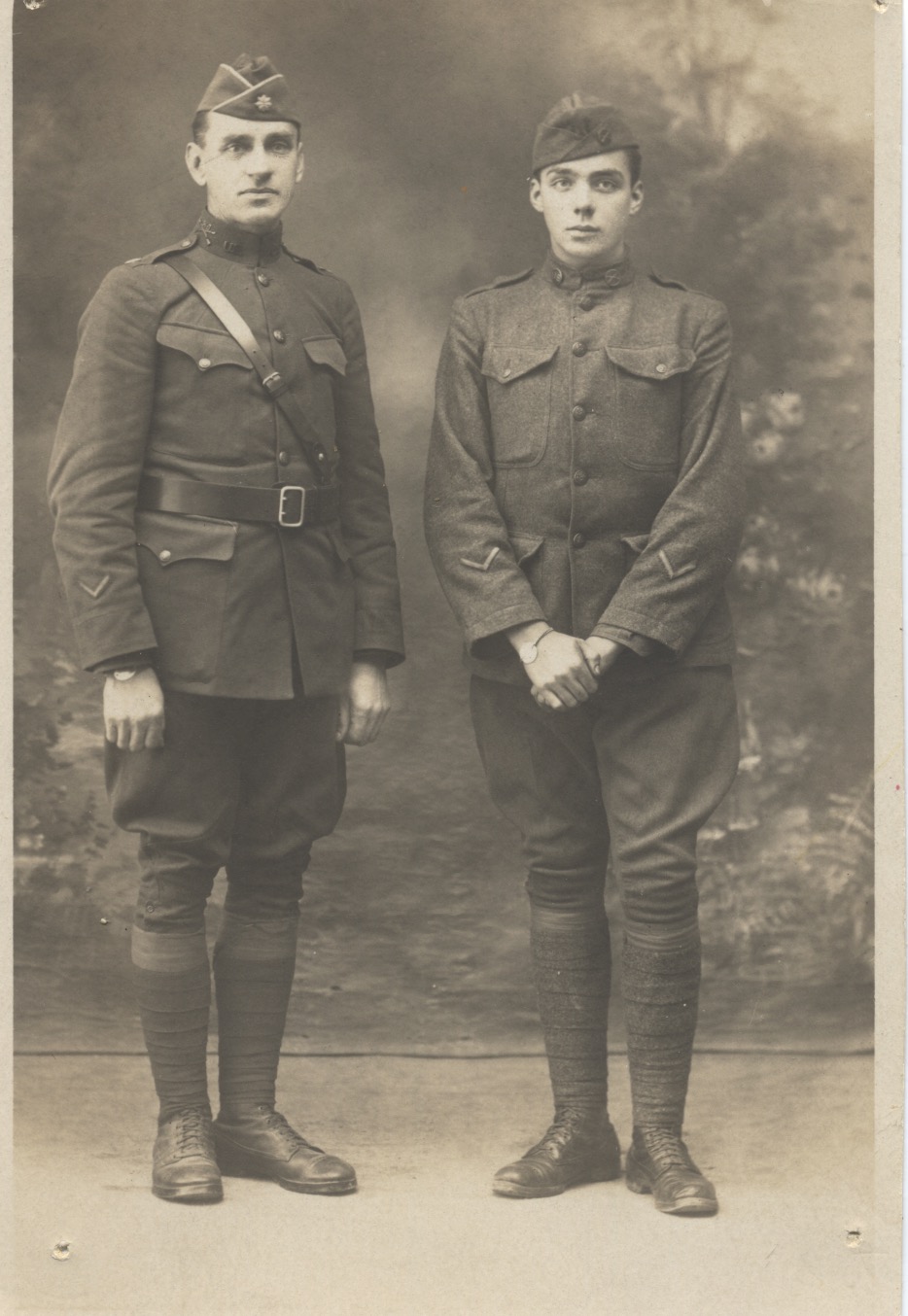
Marcus Limb and his son, Fritz (Frederick Carl), WWI.
1917
The Bucyrus Evening Telegraph
Bucyrus, Ohio
Friday, 17 August, 1917
pg 5
General Vollrath Assigned To Coast.
His New Duties Lie at Palo Alto, Calif.
Gerlach May Succeed Him.
Newly Commissioned Brigadier Has Not Yet Received Commission Nor Instructions, But Washington Dispatch Puts Him in Charge of 66th Depot — Changes in Eighth.
Colonel Edward Vollrath of Bucyrus, commander of the Eighth regiment, has been assigned to the 66th depot at Palo Alto, Calif., according to a dispatch from Washington this morning.
When his commission as brigadier-general of the United States army arrives, he expects to receive instructions as to the assignment, and orders to report at Palo Alto.
As army affairs are moving rapidly now, it is probable that within a few days, the commission and instructions will be here and General Vollrath will be arranging for departure.
His command will be in the 41st army division of Camp Fremont, Palo Alto, Calif., Major-General H. Liggent commanding. The division includes the 78th brigade, Brigadier General G.H. Cameron commanding with Lieut. Colonel M. Craig, chief of staff; 80th infantry, Brig. Gen. Wedgewood commanding; 81st infantry, Brig. Gen. R. Cutler commanding; 66th depot, Brig. Gen. Edward Vollrath commanding and 66th field artillery, Brig. Gen. H. Jervey commanding. The troops of the division are from Washington and Oregon.
General Vollrath will have as his staff and entourage, one adjutant, with the rank of major; two aides with the rank of first lieutenant and 15 enlisted men, including one regimental sergeant major, acting as clerk; one stable sergeant, one wagoner, one cook and eleven first class privates.
Gerlach First In Line.
When the matter of a successor to Colonel Vollrath as commander of the Eighth is discussed, some surprise is felt that the transfer of Col. Weybrecht from the Tenth to the Eighth has been suggested. Col. Weybrecht received his command only three months ago and the talk of his transfer seems to come entirely from his friends. His own wishes in the matter do not appear to have been expressed.
The most natural appointment, it is felt in the Eighth, would be the commissioning of Lieut. Colonel Frank C. Gerlach of Wooster as colonel and his assignment to command the Eighth. Lt. Col. Gerlach served in Cuba and has been closely associated with the guard ever since. He was assigned to the superintendency of the Lancaster industrial school and served a couple of years in that capacity, and his commission as lieutenant colonel of the Eighth dates rom May 21, 1917, when he was assigned to succeed Lt. Col. Weybrecht.
Lt. Col. Gerlach reached Bucyrus today and as Col. Vollrath is shaping up things for an early departure, expects to remain at regimental headquarters as the command of the regiment falls on him with the departure of the colonel. Lt. Col. Gerlach is a popular officer and his assignment to command the Eighth would meet with popular approval.
More Promotions Ahead.
Should Lt. Col. Gerlach be advanced to the command, it will create a vacancy which may mean a step up along the line. Major Ralph G. Sayre of Galion is now senior major and Major Willis Bacon of Tiffin and Major W.E. Walkup of Akron are the other two battalion officers. Captain M.R. Limb of Wooster is senior captain.
Future developments in the Eighth will be awaited with interest.
Lt. Col. Gerlach and Lt. Warren J. Keister, battalion adjutant, reached Bucyrus this morning and were in conference with Col. Vollrath at headquarters on regimental matters.
The Mansfield News Journal
Mansfield, Ohio
Saturday, 18 August, 1917
pg 5
Gen. Vollrath to be Assigned to Coast.
Question of His Successor as head of the Eighth Regiment Is Discussed.
Col. Edward Vollrath, of Bucyrus, commander of the Eighth Ohio infantry, has been assigned to the Sixty-sixth depot at Palo Alto, Cal., according to dispatches from Washington. When his commission as brigadier general of the United States army arrives, Gen. Vollrath expects to depart at once for his new station.
Lieut. Col. Frank C. Gerlach, of Wooster, arrived in Bucyrus yesterday and made arrangements to take active charge of the Eighth regiment until such time as a colonel is appointed. The headquarters of the regiment will be removed temporarily at least to Wooster when Lieut. Col. Gerlach assumes charge.
When the matter of a successor to Colonel Vollrath as commander of the Eighth is discussed, some surprise is felt that the transfer of Col. Weybrecht from the Tenth to the Eighth has been suggested. Col. Weybrecht received his command only three months ago and the talk of his transfer seems to come entirely from his friends. His own wishes in the matter do not appear to have been expressed.
The most natural appointment, it is felt in the Eighth, would be the commissioning of Lieut. Colonel Frank C. Gerlach of Wooster as colonel and his assignment to command the Eighth. Lieut. Col. Gerlach served in Cuba and has been closely associated with the guard ever since. He was assigned to the superintendency of the Lancaster Industrial school and served a couple of years in that capacity, and his commission as lieutenant colonel of the Eighth dates from May 21, 1917, when he was assigned to succeed Lieut. Col. Weybrecht.
Should Lieut. Col. Gerlach be advanced to the command, it will create a vacancy which may mean a step up along the line. Major Ralph G. Sayre of Galion is now senior major and Major Willis Bacon of Tiffin and Major W.E. Walkup of Akron are the other two battalion officers. Capt. M.R. Limb of Wooster is senior captain.
Future developments in the Eighth will be awaited with interest.
Bucyrus Journal
Bucyrus, Ohio
Friday, 24 August, 1917
pg 7
General Vollrath Assigned To Coast.
His New Duties Lie at Palo Alto, Calif.
Gerlach May Succeed Him.
Newly Commissioned Brigadier Has Not Yet Received Commission Nor Instructions, But Washington Dispatch Puts Him in Charge of 66th Depot — Changes in Eighth.
Colonel Edward Vollrath of Bucyrus, commander of the Eighth regiment, has been assigned to the 66th depot at Palo Alto, Calif., and left on Tuesday for his duties there.
His command will be in the 41st army division at Camp Fremont, Palo Alto, Calif., Major-General H. Liggent commanding. The division includes the 78th brigade, Brigadier General G.H. Cameron commanding with Lieut. Colonel M. Craig, chief of staff; 80th infantry, Brig. Gen. Wedgewood commanding; 81st infantry, Brig. Gen. R. Cutler commanding; 66th depot, Brig. Gen. Edward Vollrath commanding and 66th field artillery, Brig. Gen. H. Jervey commanding. The troops of the division are from Washington and Oregon.
General Vollrath will have as his staff and entourage, one adjutant, with the rank of major; two aides with the rank of first lieutenant and 15 enlisted men, including one regimental sergeant major, acting as clerk; one stable sergeant, one wagoner, one cook and eleven first class privates.
Gerlach First In Line.
When the matter of a successor to Colonel Vollrath as commander of the Eighth is discussed, some surprise is felt that the transfer of Col. Weybrecht from the Tenth to the Eighth has been suggested. Col. Weybrecht received his command only three months ago and the talk of his transfer seems to come entirely from his friends. His own wishes in the matter do not appear to have been expressed.
The most natural appointment, it is felt in the Eighth, would be the commissioning of Lieut. Colonel Frank C. Gerlach of Wooster as colonel and his assignment to command the Eighth. Lt. Col. Gerlach served in Cuba and has been closely associated with the guard ever since. He was assigned to the superintendency of the Lancaster industrial school and served a couple of years in that capacity, and his commission as lieutenant colonel of the Eighth dates rom May 21, 1917, when he was assigned to succeed Lt. Col. Weybrecht.
More Promotions Ahead.
Should Lieut. Col. Gerlach be advanced to the command, it will create a vacancy which may mean a step up along the line. Major Ralph G. Sayre of Galion is now senior major and Major Willis Bacon of Tiffin and Major W.E. Walkup of Akron are the other two battalion officers. Capt. M.R. Limb of Wooster is senior captain.
Future developments in the Eighth will be awaited with interest.
Lt. Col. Gerlach and Lt. Warren J. Keister, battalion adjutant, reached Bucyrus this morning and were in conference with Col. Vollrath at headquarters on regimental matters.
The Creston Journal
Creston, Ohio
Wednesday, 12 September, 1917
pg 4
Creston Young Man Leader
Harley Coffey Leads First Contingent.
A regular Military Farewell was given the eight young men from Wayne county that left Wooster Friday noon for the training camp at Chillicothe, Ohio.
This was the first contingent from Wayne county for the new National Army and a large number were present to see the boys off. The new soldiers were escorted down Liberty street to the Pennsylvania depot by the Eighth regiment band, Company D, commanded by Capt. M.R. Limb, the headquarters company, commanded by Capt. G.C. McCoy, and Col. Gerlach and his staff.
The list was as follows:
Glen R. Brenneman, Orrville.
Harley A. Coffey, Creston.
Elmer E. McAdams, Orrville.
John B. Schmid, Wooster.
Edwin C. Schumacker, Rittman.
Clarence Fisher, Wooster.
David A. Heron, Jr., Wooster.
Ellis G. Sigley, Applecreek.
The Wooster Republican says “Harley A. Coffee, of Creston, the first man drawn to start in Uncle Sams’s conscripted army, from the county, was appointed leader of the Wayne county men who went to Chillicothe Friday.
The Daily Times
New Philadelphia, Ohio
Monday, 1 October, 1917
pg 6
Talk of the Town.
Mrs. M.R. Limb of Wooster, who has been visiting two weeks with her parents, Mr. and Mrs. George Wagner, Southside, left Sunday evening for Oklahoma City, Okla., where she will join her husband, Dr. Limb, who is captain in the officers’ medical corps of the U.S. army.
The Montgomery Advertiser
Montgomery, Ala.
Monday, 22 October, 1917
pgs 2 & 3
Complete List Of Commissioned Officers Of The 37th Division
The Committee on Camp Activities has completed the following complete list of commissioned officers of all commands composing the 37th Division, now encamped at Camp Sheridan. This list is corrected to October 20.
Division Staff. [list follows]
134th Machine Gun Battalion. [list follows]
73rd Infantry Brigade. [list follows]
135th Machine Gun Battalion. [list follows]
145th Infantry. [list follows]
146th Infantry.
Regimental Officers and Chaplain — Col. Charles C. Weybrecht, Lieut. Col. Frank C. Gerlach, Major William A. Atkinson, Chaplain; First Lieut. A.L. Frazer, Chaplain.
Headquarters Company — Captain Orville E. Clark, Regimental Adjutant; Captain Grove G. McCoy, Second Lieut. John A. Stanley, U.S.R.; Second Lieut. Charles S. Trump, U.R.R.; Second Lieut. Reuben R. Hotchkiss, U.S.R.
Supply Company — Captain J. Earl Ports.
Battalion Officers — Major Ralph G. Sayre, Major Willis Bacon, Major William E. Walkup, First Lieut. George Davenport, Adjutant; First Lieut. Warren J. Keister, Adjutant.
Machine Gun Company — Captain Ralph L. Randall, First Lieut. Eaton W. Kiplinger, Second Lieut. Ralph Jackson, Second Lieut. Raymond E. Day, Second Lieut. Frank Knutt, U.S.R.
Company “A” — Captain Dean F. Blair, First Lieut. C. Victor Vollrath, Second Lieut. Charles I. McNeal, Second Lieut. Stanley C. Butler, U.S.R.
Company “B” — Captain Samuel J. Cole, First Lieut. Thomas D. Weaver, Second Lieut. Daniel Webster, Second Lieut. Fred Sherrer, U.S.R.
Company “C” — Captain Herve W. Miner, First Lieut. William G. Sutzman, Second Lieut. James G. Graham, Second Lieut. William C. McConnell, U.S.R.
Company “D” — Captain Marcus R. Limb, First Lieut. Fred C. Redick, Second Lieut. Walter Yost, Second Lieut. Edward Hinman, U.S.R.
Company “E” — Captain Jesse B. Blue, First Lieut. Miles D. McCarty, Second Lieut. William Chalmers, Second Lieut. Owen R. Rittenhouse, U.S.R.
Company “F” — Captain William G. Yontz, First Lieut. Charles P. Ustine, Second Lieut. Michael Dierdorf, Second Lieut. Frederick W. Koehler, U.S.R.
Company “G” — Captain Frank C. Hilliard, First Lieut. Fenton L. Miller, Second Lieut. Ralph A. Schad, Second Lieut. Reed Forsnight, U.S.R.
Company “H” — Captain Emmett W. Eddy, First Lieut. Harry H. Kerr, Second Lieut. Lewis G. Crawford, Second Lieut. Don Bonnat, U.S.R.
Company “I” — Captain Alton A. Drinkwater, First Lieut. Perry J. Funk, Second Lieut. Lawson F. Smeltz, Second Lieut. Lewis E. McWhorter, Jr., U.S.R.
Company “K” — First Lieut. Fred Kochli, Second Lieut. William H. Bruce, Second Lieut. John M. McConihay, U.S.R.
Company “L” — Captain William D. Scarborough, First Lieut. Fred U. Nail, Second Lieut. Isadore Gottdiener, Second Lieut. William Hayward, U.S.R.
Company “M” — Captain Alfred I. Harrington, First Lieut. Robert L. Bride, Second Lieut. Judson J. Leary, Second Lieut. John D. Meyers, U.S.R.
Sanitary Detachment — Major Harry B. Bertolette, First Lieut. Harold J. Gordon, First Lieut. Joseph H. Boutwell, First Lieut. Russell J. Caton.
Total enlisted men — 1,787
136th Machine Gun Battalion. [list follows]
147th Infantry. [list follows]
148th Infantry. [list follows]
62nd Field Artillery Brigade. [list follows]
112th Mortar Battery. [list follows]
134th Field Artillery. [list follows]
135th Field Artillery. [list follows]
136th Field Artillery. [list follows]
112th Engineers. [list follows]
112th Field Signal Battalion. [list follows]
112th Train and Military Police. [list follows]
112th Ammunition Train. [list follows]
112th Supply Train. [list follows]
112th Sanitary Train. [list follows]
112th Engineer Train. [list follows]
Camp Sheridan Depot Brigade. [list follows]
1st Ohio Infantry (Now the 5th and 6th Training Battalions. [list follows]
7th Infantry (now the 7th, 8th and 9th Training Battalion.) [list follows]
2nd Ohio Infantry (now the 1st, 2nd and 3rd Training Battalions.) [list follows]
10th Training Battalion. [list follows]
CAMP SHERIDAN CAMP UNITS. [list follows]
Camp Quartermaster. [list follows]
The Montgomery Advertiser
Montgomery, Ala.
Thursday, 8 November, 1917
pg 3
Final Report Shows Camp Sheridan Had Per Capita of $62.38 on Liberty Loan
Fifty-eight Per Cent of Troops Here Made Subscriptions For Bonds
The summary of the Liberty Loan campaign of the 37th Division at Camp Sheridan, indicates that the honors were carried off by the Field Artillery. The 135th Regiment, commanded by Col. Dudley J. Hard, standing first with a subscription of $150,150. It was, however, crowded close by Colonel Mitchell’s organization with $144,000. The highest per capita of any unit was at Division Headquarters, where a few single subscribers very greatly raised the average.
One Buys $14,500.
The largest single subscription was that of Major Otto Miller of Cleveland, $14,500. The deficit between the amount undertaken to be raised, $1,500,000, and the amount actually subscribed was underwritten by Major Otto Miller, Major R.C. Norton, Col. P.L. Mitchell, and Judge Advocate Hubert J. Turney, in addition to their other subscriptions. The total of subscriptions was $1,500,000. The total number of officers and soldiers in the division, constitution its numerical strength was 24,048. The actual number of subscriptions was 13,898.
Per Capita Was $62.38.
The per capita subscription for the entire division was $62.38. Fifty-eight per cent of the division participated in the subscription. The following made initial subscription of $500 or over:
Division Headquarters.
Brig. Gen. Wm. R. Smith.
Lieut. Col. Byron L. Bargar.
Judge Advocate Hubert J. Turney.
Major Otto Miller.
Lieut. R.L. Black.
62nd Field Artillery Brigade. [list follows]
74th Infantry Brigade. [list follows]
Motor Truck Company. [list follows]
Remount Station. [list follows]
73rd Infantry Brigade.
146th Regiment, Captain Orville E. Clark, Colonel Charles C. Weybrecht, Lieutenant Stanley C. Butler, Captain Marcus R. Limb.
Total of Each Unit. [list follows]
Committee in Charge.
General W.R. Smith, commanding division, pursuant to directions from the war department, reported that the Liberty Loan campaign within the Division ha been under the administration of the division judge advocate, Hubert J. Turney, and reported that within the organizations the campaign had been conducted by the following named officers:
74th Infantry Brigade. [list follows]
73rd Infantry Brigade. [list follows]
62nd Field Artillery. [list follows]
Depot Brigade. [list follows]
Unbrigaded Organizations [list follows]
Keen Rivalry Existed.
A keen rivalry existed throughout the campaign between the 134th and 135th Regiments of Artillery, and it was not until the final tabulation that it was exactly known which organization stood first. An apt illustration of the character of the men of which the 37th Division is composed was manifested by a single incident in this campaign thus brought to such a satisfactory conclusion. When the final returns began coming in and it became apparent that an immense amount of clerical work must of necessity be done to verify and tabulate the individual subscriptions, the judge advocate called a single organization and asked that three bank clerks be detailed to assist in the work, picking an organization at random. Within thirty minutes three bank clerks reported, and the report as tabulated developed the results here stated. They were Private Edward R. Welch, Battery E, 135th F.A.; Private James Bissell, Battery E, 135th F.A., an Private Charles I. Kamerer, Battery A, 135th F.A.
The Cincinnati Enquirer
Cincinnati, Ohio
Tuesday, 27 November, 1917
pg 9
Ohio Commission
Finds Men at Camp Sheridan in Good Condition and Spirits.
Special Dispatch to the Enquirer.
Montgomery, Ala., November 26.—“The commission headed by William Cooper Procter, sent to Camp Sheridan by Governor James Cox, completed its inspection to-day, and the members are very favorably impressed with what they have seen. The commission wound up its inspection to-day when the outfits of the division passed in review over the parade grounds at division headquarters. The marching troops were reviewed by General Smith, the three Ohio Brigadiers, Speaks, McMaken and Zimmerman, and the members of the Governor’s Commission.
“We have been through the camp from end to end, and have talked to officers and men,” Governor Cox’s secretary said. “And everywhere have found the men satisfied with army life. They are in fine physical condition, are well fed and well-clothed, and rapidly are being whipped into first-class fighting men. Ohio always has had reason for being proud of her military forces, but to-day the Buckeye Division represents the cream of Ohio’s manhood and the state is heart and soul with the Ohioans who are in uniform.”
The commission Monday morning met the ten French and eleven English officers who are here as instructors.
It was announced Monday that the Central Department, Chicago, has been requested to send immediately 3,000 more draft men from Camp Sherman, Chillicothe, to be used in filling the outfits to full war strength. One thousand draft men came in to Camp Sheridan about two months ago, but requests for more men were delayed until the camp was in shape to receive them. The camp is ready now and it is believed the 3,000 will reach here within the next few days.
Officers of the One Hundred and Forty-sixth Infantry are proud of the trench system which has been constructed by Captain M.R. Limb, of Company D, graduate of the Field Fortification School at Ft. Sill, Okla. The system arranged by Captain Limb has elicited high praise from the French and English officers.
Colonel S.B. Stanbery, of Cincinnati, who succeeded Colonel Davis in command of the One Hundred and forty-fifth, has his men hard at work, and Monday asserted that the men were rapidly rounding into shape for their part in the war.
Lieutenant Fred Kochli, Company K, One Hundred and Forty-sixth Infantry, Alliance, Monday was ordered to Ft. Sill to take the course in hand grenades.
Athletic Director George Trautman is busily engaged in selecting the two football teams which Thursday will clash in big games, one team playing the eleven from Camp McClelland and the other going to Pensacola to battle the team from the aviation school.
Major J.N. Baker, of Montgomery, Monday morning was assigned to the base hospital as surgeon in charge, relieving Major A.H. Schade, who becomes Assistant Sanitary Inspector of the division. Major Baker recently was named as medical advisor to Governor Henderson and was slated to have charge of the medical work in the selection of the next quota of draft men from this state.
Captain Potter Smith was elected Chief of Police of Montgomery by the Board of Public Safety Monday, succeeding Chief Henry D. Long, who resigned because of differences with the Ohio military police. One member of the Safety Board favored William H. Taylor, who was ousted by Long, but the other two favored the elevation of Smith, who has been a member of the Police Department 18 years, having started as patrolman.
The Lima News
Lima, Ohio
Tuesday, 27 November, 1917
pg 9
Commission Said Impressed With Camp Sheridan.
Inspection of Montgomery Encampment Is Completed By Ohio Men.
Central Department, Chicago, Notified To Send Three Thousand Men.
Montgomery, Ala., November 27.—“The commission headed by William Cooper Procter, sent to Camp Sheridan by Governor James Cox, completed its inspection to-day, and the members are very favorably impressed with what they have seen. The commission wound up its inspection today when the outfits of the division passed in review over the parade grounds at division headquarters. The marching troops were reviewed by General Smith, the three Ohio Brigadiers, Speaks, McMaken and Zimmerman, and the members of the Governor’s Commission.
“We have been thru the camp from end to end, and have talked to officers and men,” Governor Cox’s secretary said. “And everywhere have found the men satisfied with army life. They are in fine physical condition, are well fed and well-clothed, and rapidly are being whipped into first-class fighting men. Ohio always has had reason for being proud of her military forces, but today the Buckeye Division represents the cream of Ohio’s manhood and the state is heart and soul with the Ohioans who are in uniform.”
The commission Monday morning met the ten French and eleven English officers who are here as instructors.
It was announced Monday that the Central Department, Chicago, has been requested to send immediately 3,000 more draft men from Camp Sherman, Chillicothe, to be used in filling the outfits to full war strength. One thousand draft men came in to Camp Sheridan about two months ago, but requests for more men were delayed until the camp was in shape to receive them. The camp is ready now and it is believed the 3,000 will reach here within the next few days.
Officers of the One Hundred and Forty-sixth Infantry are proud of the trench system which has been constructed by Captain M.R. Limb, of Company D, graduate of the Field Fortification School at Ft. Sill, Okla. The system arranged by Captain Limb has elicited high praise from the French and English officers.
Colonel S.B. Stanbery, of Cincinnati, who succeeded Colonel Davis in command of the One Hundred and forty-fifth, has his men hard at work, and Monday asserted that the men were rapidly rounding into shape for their part in the war.
Lieutenant Fred Kochli, Company K, One Hundred and Forty-sixth Infantry, Alliance, Monday was ordered to Ft. Sill to take the course in hand grenades.
Athletic Director George Trautman is busily engaged in selecting the two football teams which Thursday will clash in big games, one team playing the eleven from Camp McClelland and the other going to Pensacola to battle the team from the aviation school.
1918
The Montgomery Advertiser
Montgomery, Ala.
Sunday, 10 March, 1918
pg18
Reception to General Zimmerman—
To members of the Standard Club will compliment General Chas. X. Zimmerman and the officers of the 73rd Brigade, at a formal reception and dance, Wednesday evening, March the 15th at eight-thirty.
Those on the reception committee are M. Sable, President Norman Drum, L.J. Pake, B. Frank, C. Moritz, H. Strauss, Mr. Baum, Louis Loeb, L.R. Kohn, S. Coughman, Geo. Loeb, E. Mayer, Emmanuel Meertief, Harold Jacoby, Assisting these gentlemen will be Dr. B.C. Ehrenrigh, Leo Strassburger, Leopold Strauss, General Zimmerman will receive with these gentlemen.
Assisting General Zimmerman are, Colonel C.C. Weybrecht, Major H.J. Twelvetree, Captain Marcus R. Limb, Captain John J. Saslansky, Captain C.C. Chambers, Captain Francis R. McCook, First Lieutenant Fred G. Stafford and First Lieutenant Daniel Webster.
The Montgomery Advertiser
Montgomery, Ala.
Sunday, 14 March, 1918
pg6
Delightful Dance For Brigade Officers At Standard Club
The Lenten season which has been dull from a social standpoint, was broken Wednesday evening, when the Standard Club entertained at a delightful reception and dance in honor of Gen. Charles X. Zimerman and the officers of the 73rd Brigade. The reception committee was composed of General Zimerman, Mr. M. Sabel, president of the Standard Clug; Mr. Norman Drum, Mr. L.J. Pake, Mr. Bernard Frank, Mr. C.F. Moritz, Mr. Henry Strauss, Mr. Baum, Mr. Louis Loeb, Mr. Kohn, H. Kaufman, Mr. George Loeb, Mr. E. Mayer, Mr. Emanuel Meertief, and Mr. Harold Jacobi. Assisting were Dr. B.C. Ehrenreich, Mr. Leo Strassburger and Mr. Leopold Strauss.
Assisting General Zimerman were the following officers from Camp Sheridan:
Col. C.C. Weybrecht, Major H.J. Twelvetree, Capt. Marcus R. Limb, Capt. John J. Saslansky, Capt. C.C. Chambers, Capt. Francis R. McCook, First Lieut. Fred G. Stafford and First Lieut. Daniel Webster.
The wives of the members of the governing board also assisted. Dancing was enjoyed until a late hour, afte which the guests repaired to the dining room, where a delicious supper was served. The dining room was prettily decorated with wild flowers and spring blossoms. a large number of guests were present at the dance and it was a most enjoyable affair.
1918: June, M.R. Limb promoted from Captain to Major and is no longer commander of Company D.
News-Journal
Mansfield, OH
Monday, 17 June, 1918
pg4
Military News and Notes.
Major M.R. Limb, of Wooster, has received his commission as major, and has the distinction of being the first captain in the old Ohio National guard to be promoted from the rank of captain since the troops were mobilized last summer. Major Limb formerly commanded Company D of Wooster and is known in Mansfield.
The Bucyrus Evening Telegraph
Bucyrus, OH
Wednesday, 7 August, 1918
pg5
Bucyrus Boy First Landing In France
Lt. Davenport Believes Honor Is His
General Vollrath Writes
Tells of Meeting His Old Regiment on French Soil—Jumps Into His Car, Dismissing Troops He Was Reviewing, and Beats Train 15 Miles to Station—Gets Letters in Bunches—Regiment Probably Not in Big Push.
To a Bucyrus boy has fallen the honor of being the first member of the 146th regiment, 37th Army Division, to set foot on the soil of France. That honor fell to Lieut. George Davenport of the 146th regiment, according to his belief expressed in a letter to his parents here, which is given with this article.
A letter dated July 4th, written by General Edward Vollrath and received Monday, tells of his meeting with his old regiment, the 146th. This happened in France, and not in England as was previously assumed because his cablegram telling of meeting his son, Lieut. Victor Vollrath, was dated in England.
Are In Training Sector.
Judging from General Vollrath’s letter, the 146th was not in the big push which began July 15th. “The regiment is in a training sector not so far from my own troops,” writes the general, “and I expect to see the men often.”
General Vollrath was reviewing his own command when he saw a heavily loaded troop train passing. On inquiry he learned that it was the 146th, of whose presence on the ocean he had learned only the day previous. Turning over the command to his next in rank, General Vollrath jumped into his car and raced ahead, beating the train into a station 15 miles away where the train stopped an hour.
“I met Colonel Weybrecht, Lt. Col. Gerlach, Major Sayre, Major Limb, Captain Bair and other officers (all his own former officers) he writes. “We were very glad to see each other,” he says of himself and the regiment, and “the men looked very well and were quite stylish in their new “over-seas” caps.
In explanation it may be said that on reaching “overseas” the American soldiers doff their campaign hats and don the overseas cap, which fits close and has ear-tabs.
General Vollrath took his son, Lt. Victor Vollrath, out to his station. “We were awfully glad to see each other,” he says. Then they dashed back in the car to permit Lt. Vollrath to join his command.
Papers come very irregularly. General Vollrath says he did not get a letter from home for a month, then the next day after he had written of this fact, he got eleven in one bunch.
Lieut. Davenport’s Letter.
Somewhere in France, June 30, 1918
Dear Folks:
Hello—
Yes, we arrived all O.K. Everybody happy and full of “Pep.” We are getting all set for our trip to Berlin but don’t know when we start.
We had a most wonderful trip across the pond, fine weather, a smooth sea and one of the finest ships on the seas to cross in. Was not the least bit seasick at any time and enjoyed every minute of the trip.
We made a very fast trip over and did not at any time see anything that looked like a sub except a couple of whales.
We were for a few days at a rest camp, but I had a detail at a sorting yard and did not get much rest. We have moved now and are at our new location where we expect to stay for a little while at least. We can at times hear the murmur of the big guns but not often.
We passed through some of the most beautiful country; all under an intense state of cultivation, the like of which is not even equalled on a small truck farm in the States. The women of France along with the children and men too old to serve are responsible for this or at least it would seem so as we saw them engaged in this operation.
We have received a wonderful welcome wherever we have been and you would be amused to see the conversations that are carried on by our men and the native people. I say see the conversations because most of it is by signs and they are really comical to watch.
Things in this country seem queer to us here; the two wheeled cards, the harness, the dress, the wooden shoes, which nearly everyone wears, the houses and buildings which are of stone, the railroads and all. Of course it is only because they are new to us that they seem queer and we will become used to them in a short time.
We have been and still are busy and expect we will be for some time to come. Days come and go and we lose all track of the day and date unless it happens to be brought to our notice. Apparently Sunday has been dropped from the calendar for we don’t seem to be able to notice the difference. It may be that we will be able to notice it soon.
I think that I was the first officer of the 146th infantry to land on French territory. I landed on French soil at about 4 a.m. one foggy morning and was glad to stretch my legs.
You no doubt received a card telling of my safe arrival on this side, if you did not you should have as I sent one. Do not be surprised if you do not get more than two letters a month from me. Whatever you do, don’t worry about me for unless you hear different you can make up your mind that I am all O.K. You will be notified if anything happens to me at any time so DON’T WORRY.
Has Aubert come over yet, and is Guy still in the U.S.? Things have gone so fast with us in the last month that I couldn’t keep up with anything outside of what my job calls for.
We are living as good as can be expected and that is fine. I expect that we get even more than a great many people at home get.
The people here get meat and bread on tickets. Eggs are only 75 cents per dozen and a chicken is worth about $3.
This is a beautiful place, down in a valley with wooded hills all around. The climate is just about the same as ours. It is daylight here from four until ten-thirty.
I can think of nothing else to write, except to keep the letters coming. We have received no mail since our arrival here, but it should reach us sometime soon. Give my best to all the folks and tell them my address and write to me.
Ever,
George.
George Davenport, 1st Lt. 146th Infantry, American E.F., via New York, France.
Akron Beacon Journal
Akron, OH
Saturday, 21 December, 1918
pg 1
Weybrecht No Longer Head of Old 8th Ohio
Many Ohio Militia Officers Transferred When Division Reaches France
Gerlach Is Promoted
Changes, Long Concealed by Censorship Are Gradually Becoming Known
Columbus, Dec. 21.—Ohio will have trouble recognizing its 37th division which was made up out of the Ohio National Guard.
One after another the old militia officers have been displaced by regular army men, the “benzine board” in this country and the “S.O.S.” overseas being the means used to remove them from command.
The “benzine board,” or as it is otherwise called the “efficiency board,” combed out many of them at Camp Sheridan. When the division reached France many of those who had escaped in the first combing out, were “S.O.S’d.” this set of initials referring to removing the men from the firing line to the service of supply, back of the lines.
That Brigadier General Charles X. Zimmerman, of Cleveland, Col. C.C. Weybrecht of Alliance, Brigadier General R.M. Vollrath were among the high officers of the old guard organization to be “S.O.S.’d” is the word that has just reached here through the men who have returned from overseas.
Bridagier General S.B. Stansberry, Col. F.W. Balbraith and Col. C.J. Gerlach are among the northern Ohio men to survive the sifting out process.
Had Nine Regiments.
When the war started, Ohio had eight regiments of infantry under the then peace footing of about 1,000 men to the regiment, a colored battalion called the Ninth Ohio, three batteries of artillery and three troops of cavalry. Shortly afterwards C.C. Weybrecht, former adjutant general, organized the 10th Ohio regiment.
The change in the size of regiments from 1,000 peace footing to 3500 as the new war strength, first threw the old order of things into confusion.
Governor Cox’s effort to have an Ohio man as major general of the division was overruled, and Major General Treat, U.S. army man, formerly stationed at Honolulu, took command.
And the slaughter commenced.
Brigadier General McMaken of Toledo was the first to go. Then the well loved Brig. Gen. John C. Speaks was retired. Col. Zimmerman of the old Fifth was promoted to brigadier general. Col. Vollrath of the Eighth was also promoted to brigadier, and sent to a western brigade, then to a South Carolina camp and thence overseas. Lt. Col. Davis of Norwalk succeeded Zimmerman as commander of the old Fifth, absorbed into the new 145th, but didn’t remain long, while Col. Weybrecht, whose new Tenth regiment had been swallowed up, landed command of the old Eighth, now become the 146th infantry.
Stansberry, former guardsman and before the war a contractor in Cincinnati, organized the ammunition train for the division but was soon moved over to command the line regiment.
When the division went overseas the changes continued. Zimmerman went down among the first. Vollrath was moved over to the S.O.S. Weybrecht was detached from command just before his regiment went into action, being succeeded by Col. Pickering, a regular army man.
When Stansberry became brigadier commander, Lieut. Col. Gerlach, of the old Eighth, landed command of the 145th, formerly the Fifth regiment, largely recruited from Cleveland.
To show how the reorganization affected a single regiment, the 146th may be cited. The history of its colonel’s, Vollrath, Weybrecht and Pickering, has been cited. Gerlach moved up. One of its old majors, Bacon, Walkup or Lind, is still in that position. Bacon and Walkup were discharged before the division left for France. Capt. Lind, who became major at Camp Sheridan, was transferred. Major Limb, who succeeded Bacon, is still with the outfit. Capt. Turner was made acting major, following Lind.
The “casualties” extended to captains and lieutenants. Capt. Ralph Randall of the machine gun company was sent home from Camp Lee shortly before the departure for the other side. Capt. Yontz, of Akron, had spent one night on shipboard when he was transferred to another company, and set to instruction work at Camp Lee. Only Capts. Sam Cole of the original Akron officers remained to go into active service with his men.
The necessities of censorship resulted in Ohio’s losing track of the personnel of the old national guard division, and it is only as this has been lifted that the news has filtered back.
1920
For an excellent brief of the Ohio National Guard in WWI, see The Ohio Adjutant General’s Department, Ohio National Guard News, “Commemorating the centennial of the U.S. entering World War I; many connections to state of Ohio, Ohio National Guard” by Sgt. 1st Class Josh Mann, Ohio Army National Guard Historian.
Wooster Daily Record
Wooster, Ohio
Wednesday, 10 March, 1920
pg 3
Legion Opens Drive For 600
Seeks Double Membership of Wooster Post During Next Month.
The Wooster Post of the American Legion has started its drive to double its membership by April 6. At present there are about 300 members in the Post and M.R. Limb, the chairman of the membership committee has set 600 as the goal to be reached in one month.
The local drive is a part of the state wide drive to increase the American Legion of Ohio to 100,000 and every local post throughout the state is making a similar drive. Many of them have not, however, set such a high mark as their aim and the members of the local post realize the size of their task have begun work in earnest.
Letters are being sent to every man who was in the service, inviting them to join the Legion immediately. These letters explain the benefits and advantages to be derived from membership in the Legion, as well as the added prestige and influence that a large membership would give to the local organization.
A list of all the men in Wooster and the vicinity who saw service in the Army, Navy or Marine Corps during the period between April 6, 1917 and November 11, 1918 and who are eligible to membership in the Legion has been received from state headquarters at Columbus by the local committee and these letters will be sent to all the men whose names appear on the list.
It has been explained by the membership committee that it is possible that there are men living in Wooster who are eligible but whose names, through some oversight, do not appear on the list and it is the desire of the committee to enroll these men as well as the others.
Since the organization of the Wooster Post the members have on more than one occasion had reasons to be grateful to the residents of Wooster for their good will and support. The membership committee has again enlisted the support of the friends of the Legion and many Wooster citizens have expressed their willingness to aid the membership campaign in every way possible,
With every member of the Legion working and with the support of the friends of the Legion it is believed that the campaign will be more than a success and that the mark will be reached before April 6.
Wooster Daily Record
Wooster, Ohio
Wednesday, 10 March, 1920
pg 8
Here’s Blank To Join American Legion
Shows form to fill in and at bottom – Address all applications to M.R. Limb, Chairman, Booster Committee, Wooster, Ohio.
The above coupon is for the use of anyone who served honorably with Uncle Sam in the late war. These men are eligible to membership in the American Legion and the form is an authentic copy of the American Legion application blank.
The All-American principles of ??? are the ideal which have resulted in the great growth of the organization has enjoyed during the few months since it was instituted.
Wooster Post No. 68 is now conducting a campaign for membership and while the Post has enrolled a great many of the men in the community who saw ????.
Wooster Daily Record
Wooster, Ohio
Friday, 12 March, 1920
pg 1
Here’s Blank To Join American Legion
Shows form to fill in and at bottom – Address all applications to M.R. Limb, Chairman, Booster Committee, Wooster, Ohio.
Wooster Daily Record
Wooster, Ohio
Tuesday, 16 March, 1920
pg 4
600 Letters Go To Veterans
The membership committee of the Wooster post of the American Legion has just completed the task of sending out more than 600 letters to veterans of the World war in Wooster and vicinity, inviting them to become members of the Legion. These letters are part of the campaign throughout Ohio to increase the membership of the Legion, ? to 100,000 before April 6.
The membership committee exhausted every means to obtain the name of every man living in or near Wooster who was in the World war and is eligible to membership but this was impossible and it is probable that letters were not sent to come men who desire to be enrolled.
Members of the Legion have been instructed to extend invitations to men with whom they are acquainted and are eligible to membership and other means are being taken to get men. The Wooster Post has extended a general invitation to veterans of the World war who live in or near Wooster to become members and those who do not receive letters may make use of the blank form in the Daily Record.
The letters are already bringing some responses and it is believed that the membership of the Post which is now about 200 will be nearly doubled by the end of the drive.
The letter reads as follows:
Wooster Post No. 68
American Legion of Ohio
Wooster Ohio
Comrade,
The state wide leadership drive of the American Legion to increase members in the State of Ohio is now on and the local Post of Wooster has started out to enroll every man who lives in or near Wooster and is eligible to membership. The drive will end on April 6th. The Wooster Post has at present a membership of about 300 and it is hoped that by the end of the drive it will be doubled. In order to do this we need your name on our membership roll and that is one reason why we are asking you to join immediately.
Another reason is that you will receive benefits and advantages through membership in the American Legion which you cannot afford to miss. Just a year ago this month the Legion was organized in Paris. From a membership of a thousand it has grown to nearly two million, and has gained in prestige and power proportionally. It is a civilian organization of the World War, and is in itself an honor to belong to such an organization and as time goes on it will become even a greater honor.
Aside from that there are individual advantages which the Legion member has over his comrade who has not yet joined. Being officially known and sanctioned by the various commissions and bureaus of the National Government, the American Legion has been and will continue to be of great assistance to its members in adjusting war risk allotments, allowances, quartermaster and navy allotments, compensations, insurance back pay, bonus and other legitimate claims to which the service man is or may become entitled.
A further benefit that comes from membership in the American Legion and especially in the Wooster Post is the spirit of real fellowship that you will be able to enjoy. There are weekly meetings and occasional smokers and get-togethers at which the members meet informally and exchange stories of their experiences and discuss present conditions and events that concern them.
Any person is eligible to membership in the American Legion who was regularly enlisted, drafter, inducted or commissioned and who served on active duty in the Army, Navy or Marine Corps of the United States at some time during the period between April 6, 1917 and November 11, 1918 and who has an honorable discharge from such service.
The membership dues in the Wooster Post are $2.35 a year. These dues are lower than those of most other posts, and are exceedingly low when you consider the benefits you will gain by becoming a member. These dues in addition to giving you membership in the Legion for a year, will entitle you to the American Legion Weekly, the official publication of the organization through which you will be able to keep posted on events that concern those who took part in the World War, to the official recognition button of the Legion and to an official Membership Card.
The American Legion needs you and you need the American Legion. Let’s get together.
Fill in the enclosed bland form, and enclose with $2.35 in the addressed envelope. Drop the letter in a mail box and you will receive your membership card, which will entitle you to a year’s membership in the Legion. Please print your name.
M.R. Limb,
Chairman Membership Committee,
Downing Block, Wooster, Ohio.
Wooster Daily Record
Wooster, Ohio
Friday, 30 April, 1920
pg 3
Van Valien Has Store In Ohio
Former Cook for Co. D, Once Reported Dead, Writes to a Former Comrade
Homer E. Walton, of Wooster, after some correspondence with the Red Cross, has been able to locate Teddy Van Valien, former cook for Co. D, who on several occasions has been reported dead. Van Valien did not go overseas with the local volunteers, but was transferred to another branch of the service. At present he is conducting a store at 249 Grant street, Youngstown, O. In replying to Mr. Walton’s letter, he writes:
Mr. Homer E. Walton,
422 W Liberty street,
Wooster, Ohio
Dear friend and comrade — I am the man you are looking for but not in very good health but I hope this will find you and the rest of the boys well.
I have thought of them a good many times and wonder if they have enough to eat and well cared for – I tried to give them the best I could while in camp.
I have spent many lonesome days without them for I sure did like the boys. If I live until fall I will be with them at the reunion.
Tell Capt. Reddick, Lt. Yost and Capt. Limb that I would like to see them and also tell Bricker I haven’t forgotten him and that I remember them all with love and respect. I will never forget the day I was transferred. It surely did hurt. While at Camp Gordon Georgia, I had charge of the cook’s school and while I was there I had 36 sent across and besides the school I had the officer’s mess to look after.
Will try and see you all some day. Tell the boys to write me. Well good-bye for a while. From one who cannot forget the boys. Yours,
A. Van Valien,
249 Grand St., Youngstown, Ohio.
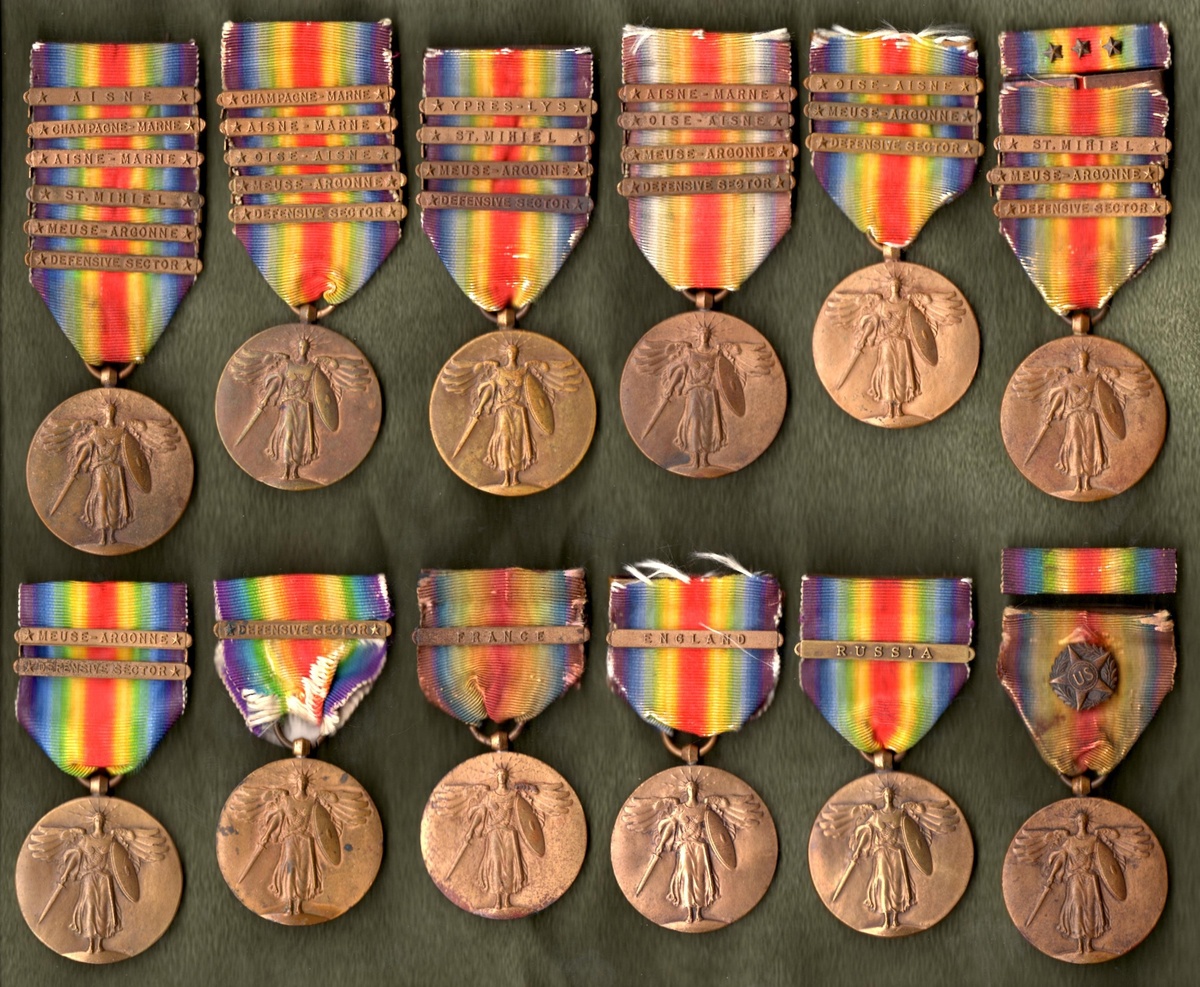
NOTE: The following article does not mention M.R. Limb. I have never seen the Victory Medal that M.R. Limb would have received. This photo shows various examples of what the medal would have looked like.
Wooster Daily Record
Wooster, Ohio
Monday, 28 June, 1920
pg 4
Yanks Can Get Victory Medals
Full Instructions on What is to Be Given and How They Can Be Procured is Announced.
Wooster Post, No. 68, American Legion, have received word that victory medals are now ready for distribution to men and women who saw service with the army during the war. Full instructions have been received at the recruiting station at Cleveland.
Navy and marine corps men will be cared for separately. In brief these instructions are:
1—Apply for a form at the nearest army post, camp or main recruiting station. If a former soldier or nearest kin of a deceased soldier to the adjutant general. If a field clerk to the surgeon general, if a nurse, to your commanding officer, if still in the service.
2—Forms for enlisted men will be white; for officers, blue; for nearest relatives of deceased, salmon; for nurses and field clerks, specially numbered 740-f A.G.O. and 740-g A.G.O., respectively.
3—If you apply in person, carry with you your discharge papers or a true copy thereof either sworn before a notary or certified before a commissioned officer. A true copy must be a full literal copy of everything on both sides of your final paper.
4—If you are applying by mail, you will forward the form as soon as it is filled out, through the army office which supplied it to you, that is, the nearest one. In this case, you will mail with your completed form your discharge papers or a true and certified copy thereof. Arrangements have been made whereby original papers will be sent back to you.
5—Within a reasonable time after you file your application you will receive a notice from the officer in charge of the station that it has either been approved and forwarded to the depot officer at Philadelphia, or that it has been forwarded to the adjutant general of the army for further consideration.
6—If you have been told your application was approved and you do not receive the medal within three months, write the depot officer at Philadelphia. If your application has been sent to the adjutant general, do not expect an answer until four months have passed.
7—All letters with regard to your victory medal should be marked “Victory Medal” plainly on the outside.
The war department promises as much speed as possible in getting out the medals, but states some delay will be inevitable since each man’s record must be carefully verified.
This will be true particularly in the case of men who served overseas and are entitled to the clasps for various actions and battles, as follows:
a. Cambria. Between 12th of May and 4th of December, 1917.
b. Somme defensive. Between 21st of March and 6th of April, 1918.
c. Lys. Between 9th of April and 27th of April, 1918.
d. Aisne. On the Chemin des Dames and northeast of Rheims. Between 27th of May and 5th of June, 1918.
e. Montdidier-Noyon. Between 9th of June and 13th of June, 1918.
f. Champagne-Marne. Between 9th of July and 18th of July, 1918.
g. Aisne-Marne. Between 18th of July and 6th of August, 1918.
h. Somme, offensive. Between 8th of August and 11th of November, 1918.
i. Oise-Aisne. Between 18th of August and 11th of November, 1918.
j. Ypres-Lys. Between 19th of August and 11th of November, 1918.
k. St. Mihiel. Between 12th of September and 16th of September, 1918.
l. Meuse-Argonne. Between 26th of September and 11th of November, 1918.
m. Vittorio-Veneto. Between 24th of October and 4th of November, 1918.
Defensive sector clasps will be awarded to all men who were in France, Italy, Siberia, European Russia or England, but did not get into action.
On the service ribbon of the medal will be bronze stars, one for each battle clasp awarded, and silver stars, one for each citation for gallantry in action for which no medal was awarded. Stars are not permitted with defensive sector clasps.
All men and women who saw service whether in the camps at home or in any capacity overseas, are entitled to the medal. The same type of medal will be issued to all, whether commissioned or enlisted.
The medal is similar to the medals which will be issued by all the other allied and associated powers. The colors of the ribbon on the medal are the battle colors of the powers who fought Germany.
The “buck” who gat over may have a medal with five stars and clasps. The major who didn’t even see Hoboken will get just a medal. And incidentally, the war department states, this is the first time that medals have ever been rationed after men and women had left the service. Civil War veterans had to buy theirs after they were discharged.
NOTE: The following article does not mention M.R. Limb.
Wooster Daily Record
Wooster, Ohio
Tuesday, 10 August, 1920
pg 6
Victory Medal Commemorates All Campaigns
One of the first Victory medals to reach Wooster came today for Harry Tawney. The medals are issued by the government in recognition of military service by Americans in the great war.
The medal is suspended from a ribbon in the top of which is a clasp pin. Each medal bears across the ribbon a number of bars upon which are inscribed the names of the campaigns taken part in by the veteran receiving the medal. Upon Mr. Tawney’s medals are bars bearing the names of Champagne, Marne Aisne, Oise, Aisne, Meuse and Argonne. At the bottom of the campaign bars is another bar bearing the words “Defensive Service.”
The medal is about the size of a silver dollar. On one side is an emblem of victory and on the other the inscription, “The great war of civilization.”
Then follow the names of the nations associated with the United States of America. The names are: France, Italy, Serbia, Japan, Montenegro, Russia, Greece, Great Britain, Belgium, Portugal, Rumania and China.
Wooster Daily Record
Wooster, Ohio
Monday, 30 August, 1920
pg 1
Company D Will Be Reorganized; Meeting Called
Wooster’s Company D, which for many years was numbered among the great military organizations of Ohio,is to be re-formed during the autumn months.
The success of the new organization is assured because Col. F.C. Gerlach, Major M.R. Limb, Capt. Redick, Lieut. Walter Yost, Lieut. Clifford Foss and other members of the old Company D and veterans of the world war, have volunteered their services to again have Wooster represented in the military affairs of the state.
Some of the veterans of the war interested themselves a few months ago in the project. A few days ago Major Limb received from the adjutant general’s office at Columbus the necessary papers to form the company. Since then he has consulted with other army officers in the city and the result is that a meeting has been called for Wednesday evening at 7 o’clock in Major Limb’s dental office in the Downing block.
The meeting is not intended alone or veterans. It is hoped that the veterans will be associated with a number of citizens and with a large number of young men of the city and county who desire to renew their military training. The citizens are asked to attend so that the military organization may have the wise counsel of men prominent in business affairs.
The aim of the veterans backing the movement is to make this new military organization a credit to Wayne county in every way. Cooperation is needed on the part of the citizens as a matter of encouragement of the young men who will join the new organization. Several of the former members intend to join the new company, but it is realized that as the years go on the company must be maintained by young men who were not members of the former organization.
Several veterans were mentioned today as possible candidates for the position of captain of the new company. The name of Lieut. Clifford Foss appeared to be the one that appealed to a large number of persons interested in the new organization.
The armory is available at present, the first time in many months and it is very likely that the new military organization will go into the quarters given up by the members of old Company D when they answered the call for service and left for camp, later going to Europe and taking part in some of the most bloody campaigns.
The history of the old Company D will ever be a glorious page in the history of Wooster. The men now organizing the new company want to make the new one just as glorious.
Wooster Daily Record
Wooster, Ohio
Wednesday, 1 September, 1920
pg 8
Meet Tonight For Company D
Veterans of the World war, friends of the old Company D, and citizens of the city and community are urgently requested to be present tonight at the dental offices of M.R. Limb, Downing block, where preliminary steps will be taken to reorganize Co. D.
NOTE: The following article does not mention M.R. Limb.
Wooster Daily Record
Wooster, Ohio
Thursday, 2 September, 1920
pg 4
Wooster Post Plans Cleveland Excursion
At a meeting last night of the local Post of the American Legion plans were started to conduct an excursion by the Cleveland & Southwestern to Cleveland during the national Convention of the American Legion to be held September 27, 28, and 29, on the second anniversary of the battle of the Argonne in France. Wooster Post expects to attend in a body and participate in the big parade on Monday, September 27th. Cleveland is making elaborate preparations for a big parade of 30,000 World War veterans, all soldiers are invited to turn out in their uniforms during the parade.
Colonel John R. McQuigg, recently elected Department Commander of Ohio American Legion, has charge of the arrangements for the parade.
The local post is considering the plan of securing for its members as well as all service men the victory medal given by the government to all soldiers and preserving them on the occasion of an Armistice Day celebration with appropriate ceremonies.
Plans will be made public soon in regard to how applications can be made for the medals through the local Post.
Wooster Daily Record
Wooster, Ohio
Thursday, 2 September, 1920
pg 8
Who Will Head New Company D?
A committee composed of Lieut. Julius Start, Geo. Bloom, Ralph Harpster, Martin and Merle Conrad, was named last night to select a captain for the new Company D. About a score of world-war veterans and interested citizens were present last evening. Capt. F.C. Redick, who commanded Co. D when it was overseas, will be asked to organize the new command, but it was not known today whether or not Capt. Redick would get “back in the harness.” Major M.R. Limb has been advised that he will be authorized to swear the recruits into service. Enlistment papers are already here.
NOTE: The following couple of articles do not mention M.R. Limb.
Wooster Daily Record
Wooster, Ohio
Tuesday, 7 September, 1920
pg 3
Names Of Men In Co. D In 1882
Wooster’s old company D was formed 9 years ago and its history was a vital part of the city until the organization was called into the world’s war. Now the veterans of the war are interested in again establishing the military unit in the ?. Young men are being asked to take up the life that adds safety to the community. The Daily Record printed last Saturday the names of the men who joined the organization thirty-nine years ago. Today the names of those who joined thirty-eight years ago are printed. The company was under the guidance of Capt. Clark, First Lieutenant Ogden and Second Lieutenant Hard. The men who joined thirty-eight years ago, or in 1882, are:
Frank Maize, Daniel W. Shives, Charles H. Clark, David H. Peffer, Wm. H. Spittler, George Hutton, Forbes Alcock, George L. Rover, Frank K. Smith, Rawson K. Pinkerton, James B. Miner, Thomas D. Brown, Sherman Lundy, Austin W. Koch, John S. Potter, John Russell, Hugh M. Annat, Charles A. Wehrley, Frank D. Morris.
NOTE: The following couple of articles do not mention M.R. Limb.
Wooster Daily Record
Wooster, Ohio
Wednesday, 8 September, 1920
pg 3
… Thirty-Seven Yrs Ago
Thirty-seven years ago Wooster’s Co. D was flourishing and during the year a number of young men joined the organization. Capt. Ogden was in charge and was assisted by Lieuts. Hard and Cameron. The privates who joined in 1883 were:
Charles P. Shipley
Joseph E. Grey
Logan Snyder
James C. Peppard
Wilber D. McClure
Ross W. Funk
Frank F. Ball
Howard W. Hurst
Joseph W. Sweeney
NOTE: The following couple of articles do not mention M.R. Limb.
Wooster Daily Record
Wooster, Ohio
Thursday, 9 September, 1920
pg 2
Company D Flourished Thirty-Six Years Ago
Thirty-six years ago, or in 1884, Wooster’s Company D was a live military organization. It had been in existence three years and was under command of Capt. Ogden and Lieuts. Hard and Cameron. The young men who joined the company in 1884 were: Louis H. Cook, Frank M. Shivley, Charles Zimmerman, Charles A. Hurst, Albert W. Roth, Wilber W. Miller, Albert C. Banker, Frederick E. Faber, Wesley E. Conn, Jesse B. Wilhelm, Chas. E. Ehrig.
NOTE: The following couple of articles do not mention M.R. Limb.
Wooster Daily Record
Wooster, Ohio
Friday, 10 September, 1920
pg 3
Three Recruits For Company D In 1885
Thirty-five years ago, Company D of Wooster spent a busy year under the leadership of Capt. Ogden and Lieuts. Kimber and Cameron. Three men joined the company that year. The 1885 recruits were William C. Burroughs, Harvey F. Osborne and Frank Hummer.
NOTE: The following couple of articles do not mention M.R. Limb.
Wooster Daily Record
Wooster, Ohio
Monday, 13 September, 1920
pg 4
Men Who Joined Co. D Thirty-Four Yrs. Ago
Thirty-four years ago, or in 1886, Company D of Wooster received during the year a number of enlistments. The company was under command of Capt. Clemens and Lieuts. Cameron and Alcock. The men who enlisted that year were: Julius A. Proger, Charles M. Taylor George M. Hummer, Frederick Yingling, Finale Luce, James M. Shellenbarger, William C. Jackson, William H. Allis, Henry W. Eckenroth, Edward Bates, James E. Truesdale, Wm. M. Caruthers, Crofton C. Adams.
Wooster Daily Record
Wooster, Ohio
Tuesday, 14 September, 1920
pg 4
Thirteen Is The Lucky Number For Company D
“Enlistments for the new National Guard company for Wooster are coming along nicely. Thirteen is our lucky number, but it was not Friday, I am sorry to say, it was Monday the thirteenth that we signed up thirteen for the new company. As soon as we get between fifty and sixty the fact will be certified to the Adjutant General of the state and he will send an inspector to see all requirements have been fulfilled, when the equipment will be forwarded. We need the assistance of all the old men and officers of the organization. Many of them speak of the reorganization and seem anxious that it should be accomplished. Col. Gerlach and myself have secured the necessary information and authority, and we are anxious that more should help in securing enlistments,” said Major M.R. Limb. Tuesday.
“Wooster has been represented by a company in the National Guard for almost forty years. The company participated in prize drills at Washington, D.C., Philadelphia, Pa., St. Louis, Mo., Cleveland, Toledo, Crestline, Newark, Galion and Columbus, Ohio, and has always been considered as one of the very best organizations in the Ohio National Guard. We have the material and officers, it is simply a matter of digging in. Seven of the new enlistments are World war veterans and with this proportion continuing, the company should start off in fine shape. Enlistment can be made any evening from seven to nine p.m., at the office of Major M.R. Limb in the Downing block,” said Major Limb.
All men entitled to Victory medals can secure the necessary information at the office of Major M.R. Limb, in the Downing block. Take your discharge papers.
Wooster Daily Record
Wooster, Ohio
Wednesday, 15 September, 1920
pg 1
More Are Needed To Form New Company D
Wooster’s new Company d received a few more recruits Tuesday evening. Recruiting is being done at the office of Major M.R. Limb in the Downing block each evening between 7 and 9 o’clock. A number of more recruits are needed to bring the list to the point of securing the organization papers.
Wooster Daily Record
Wooster, Ohio
Thursday, 16 September, 1920
pg 2
Company D Is Now Assured
Wooster is soon to have a new Company D. This much has been assured by the enlistments that have taken place thus far under the direction of the world’s war veterans who have taken up the subject. A few more enlistments were received last evening. The recruiting office is in Major M.R. Limb’s office in the Downing block and the office is open each evening from 7 to 9 o’clock.
“We need a few more recruits to bring the number to the required minimum limit and we will reach that point in a few days,” said one of the officers today.
NOTE: This article does not mention M.R. Limb.
Wooster Daily Record
Wooster, Ohio
Saturday, 18 September, 1920
pg 6
Fine Growth Of Co. D Thirty-Three Years Ago
While Wooster’s new Company D is being formed, much interest is being shown in the names of the men who years ago made the organization a flourishing one. Company D was commanded by Capt. Clemens and Lieuts. Camerin and Alcock thirty-three years ago, or in 1887. In that year the following privates were recruited:
Herbery F. Ebinger, Fred A. Flohr, George P. Ferguson, Henry B. Christine, John S. McClure, Edwin McMillen, Cary E. Taggart, Guy E. Teeple, Alfred B. Peckinpaugh, Wm. F. Morgan, Frank A. Gaut, Samuel S. Bissell, Wm. A. Moore, Frank B. Mowrer, Morris L. Ogan, Joseph McPherson, Joseph Fisher, Will F. Parker, John T. Smith, Frank Fletcher, Bert F. Taggart, Frederick E. Allis, Charles Curry, William A. Reed.
NOTE: This article does not mention M.R. Limb, who enlisted the following year, 1889, as per article below dated 9/2/1920. According to Annual Report above, M.R. Limb enlisted March 30, 1891. I do not have information to account for the different dates.
Wooster Daily Record
Wooster, Ohio
Tuesday, 21 September, 1920
pg 6
Names of Privates in Company D Here in 1888
In 1888 Company D of Wooster, which was merged into the federal army during the recent war, was a flourishing organization under command of Capt. Clemans and Lieuts. Cameron and Alcock. The privates who enlisted that year were:
Charles H. Dice.
James G. Glass.
Edgar P. Goodman.
Wm. W. Yoder.
Jacob J. Keister.
Jess E. Woodland.
Dudley J. Hard.
John A. Cameron.
John T. Nielson.
Sylvester H. Scovel.
Wooster Daily Record
Wooster, Ohio
Wednesday, 22 September, 1920
pg 4
More Recruits Needed For Military Company
More recruits for Wooster’s new Company D have been received during the past few nights at the office of Major M.R. Limb in the Downing block. To the veterans of the world’s war, who are trying to reorganize the military unit for the city, one of the encouraging signs is that most of the recruits are young men who were unable to go overseas during the war because of their age. They have the right spirit and are desirous of learning military tactics.
The veterans are willing to again take up the burden of organizing a new Company in Wooster, but they feel that it will be only a short time until all the veterans will drop out of the organization and turn the military affairs of the city over to the young men who are now enlisting.
“There will be only enough veterans in the new company to get things started,” said an officer today.
Thirty-one years ago the privates who enlisted during the year of 1889 were:
John S. Spear; Jesse B. Marshall; Harry Gorges; Harry E. Kramer; Andrew W. King; Wm. E. Shivley; Jesse W. Spear; Marcus R. Limb.
Wooster Daily Record
Wooster, Ohio
Monday, 18 October, 1920
pg 3
Invite Public To Go Tonight
Wooster’s New Company D Will Be Mustered in at the Armory.
Wooster’s new Company D, but Second Infantry this time instead of the more familiar Eighth Ohio, will be mustered in tonight at the armory, on East North street.
Major M.R. Limb who has been one of the chief workers in bringing about the reorganization of the volunteer organization, received definite assurance yesterday that Col. Herron and Major Volka of the adjutant general’s department of Columbus, would be here to muster in the company. They were expected to reach Wooster during the afternoon by automobile.
The commissioned officers of the company will be:
Captain — Walter R. Yost
First Lieut. — Julius Stark
Second Lieut. — Ed Ross
All of these are overseas veterans of the World war and were former members of Co. D.
Capt. Yost stated today that 54 men have signed the company roll and that several more are expected to sign this evening.
The general public is invited to be present for tonight’s ceremony.
Wooster Daily Record
Wooster, Ohio
Tuesday, 19 October, 1920
pg 6
New Company D Is Mustered In; Has Sixty Officers And Men
Company D, Second Infantry, Wooster’s new army unit, was mustered in last night at the armory by Col. Herron, of the U.S. army, assisted by Major Lawler and Major Volka, of the adjutant general’s department.
The ceremonies took place at the armory, in the presence of a number of former officers and enlisted men of Co. D, and friends and relatives of the enlisted men, including a considerable number of ladies.
The company starts off with a member ship of sixty officers and enlisted men, with Walter R. Yost as captain.
“The peculiar hold military organizations get upon one cannot be explained,” Major Lawler said in addressing the newly enlisted men. The fact that it does get a hold upon men, however, was evidenced by the number of men formerly connected with Co. D who were in the armory. Among them were Col. F.C. Gerlach, Major M.R. Limb, Capt. Fred Redick, “Jerry” Naftzger, Carey Grossenbaugh, Lieut. Warren Keister, William Conrad, Louis Grossenbach, Harve Jolliff, William Jolliff, W.A. Kerr, Chas, Clark, Lieut. James Rahl, Arthur Hard, Emil Krause, Chas. Weber and W.E. Barnard.
After the men had been lined up and the roll call completed, Col. Herron welcomed them into the army.
“The army appreciates your spirit and your energy,” he told them. “You are fortunate in having officers who saw service overseas in the world war. You will find that this military service will take a great deal of your time, and will mean some hard work, but I know you will enjoy it. You deserve credit for joining this organization. The next time we have a “show” we don’t want to wait a year before we are ready to fight but we want to be able to give a punch right away.”
Major Lawler, besides welcoming the men into the army, stated that the companies now being formed are to take the place of the 7th division which had such a glorious record of service in France. He declared that it was up to the new organization to work hard and bring itself up the the proficiency of the 37th.
Capt. Yost, in a brief address to his men, pointed out that Company D in the past had been one of the crack units of the Ohio national guard.
“The people of Wooster will expect you to sustain the reputation of the old organization, and you must do it,” he cautioned them.
Four American flags, one at each side, and one at each end of the room, constituted the interior decorations. There was also a flag at the entrance.
The company plans to use the armory for drill, and the drill night will be Monday night, just as it used to be. Capt. Yost, in announcing this fact, declared that Monday night was the best night of the week because there was “less church and less girl” on that night than on any other during the week.
A considerable amount of barracks equipment will be needed by the new company, and plans for securing this are now being worked out.
The personnel of the new company is as follows:
Captain, Walter R. Yost.
1st Lieut. Julius A. Stark.
2nd Lieut. Edward W. Ross.
1st Sgt., Abraham Brenner
Mess Sgt., Edward Imhof.
Sup. Sgt., Ernest P. Martin.
Sergt., Ralph L. Harpster.
Sergt., Joseph Lucci.
Sergt., Paul D. Lyon.
Corps—
Cyril M. Coles.
George W. Bloom.
Merle Patterson.
Merle Conrad.
Otto B. Merkle.
Mechanic, Owen J. Weiser.
Cook, John L. Lichtenberger.
Cook, William H. Grouver.
Bugler, Pvt., Charles E. Conrad.
Privates, 1st Class—
Lester E. Crow.
Arthur W. Detrick.
Frank H. Ginther.
David C. Harris.
Gorden C. Johnson.
Fredrick H. Rice, Jr.
Henry J. Schaan.
Miles A. Shamp.
Roy E. Stauffer.
Privates—
Lawrence G. Abbott.
Harold J. Ackerman.
Vance M. Andrews.
Clark W. Bartram.
Paul T. Bechtol.
Philip H. Blakeway.
John W. Blough.
Pezin E. Collins.
Wallace H. Crow.
Clark Davenport.
Franklin C. Ewing.
Earl D. Franks.
Ercell D. Gammerstfelter.
Roy H. Gauweiler.
Arthur C. Holmes.
Gleen R. Jolliff.
Harris Johnson.
Ralph Johnson.
Albert D. Litchtenberger.
Harry E. Long.
Roy A. Markel.
Willis E. Markley.
James R. McComas.
Vernice C. Odell.
George A. Rittenhouse.
Harry Ray.
Frad Shank.
Cloyd D. S?
Edward N. Swartz.
John G. Spitler
Harrold H. Swartz.
Perry W. Weiser.
Wooster Daily Record
Wooster, Ohio
Friday, 22 October, 1920
pg 6
Fine Report By Colonel On Company D
Col. J.S. Herron, who was here Monday evening to muster in Co. D, in his report to the chief of the militia bureau, had the following to say of the new company here:
“The officers and about seven enlisted men served in the world war. The men were above the average in appearance, intelligence and physique. Great interest is shown by the men and the citizens of the community in the company.
Inspection Exercises
“Brief remarks addressed to the assembled company by the undersigned stating the bright prospects for the company’s future under the new laws, and the encouragement the guard is now receiving from the government and welcoming the men into the service on behalf of the army and the 5th corps commanding general. The conclusions of the inspector, as to the discipline and efficiency of the organization: excellent, and unusually promising.”
Co. D can still enlist several men before the maximum is reached,” said Capt. Yost today. “Anyone wishing to join may do so upon application to Major Limb or one of the officers of the company. We are anxious to have the maximum strength at once so that all may receive the benefit of the preliminary training.”
Wooster Daily Record
Wooster, Ohio
Thursday, 28 October, 1920
pg 4
Graven Gives Soldiers Talk
Co. D, 2nd infantry O.N.G. will hold its next drill at the armory at 7:15 p.m., Friday, Oct. 29.
Several drills have been held since the company was mustered in October 19. The attendance has been good.
The men respond to the new work in fine style and show good interest.
Dr. Graven gave a lecture on Wednesday evening, subject Hygiene and First Aid to the Injured. He will give another one on Friday evening.
M.R. Limb has started workmen to putting the armory in first class condition for use.
New enlistments to date are Everett McConkey, Oct. 19, Henry W. Schaller, Oct. 26, Blaine Bonar, Oct. 26.
The total strength of the company is 63 officers and men. A couple more can be enlisted.
W.R. Yost, Captain
NOTE: Early in 1919 Major Limb was transferred from the Ohio 146th Infantry to the Texas & Oklahoma 358th Infantry, 90th Division, GHQ Inspector from 2/23/1919 – 3/6/1919; then assigned to the 2nd Battalion at Daun, Germany.
See Carleton College, “Remembering Native Service in World War I and II”
Dixon, referred to in the article, was Dr. Joseph K. Dixon (1856-1926), who documented Native Americans, including those who served in WWI.
Wooster Daily Record
Wooster, Ohio
Monday, 1 November, 1920
pg 2
Personals
Captain James Sheedy, who has been the guest the past week of Dr. M.R. Limb and family, Beall ave., left the city Monday for Philadelphia and New York. Captain Sheedy has just returned from Germany where he has been stationed with the regular army along the Rhine. During the war Captain Sheedy was part of the … comprised of Texas and Oklahoma troops and many Indians. He has collected considerable data from the Indians for Dixon, the writer. Captain Sheedy was with the division that fought in the second battle of the Marne. Major Limb spent some months along the Rhine before his return to the states. Captain Sheedy reports that conditions there are about the same along the Rhine as during the war. The Germans are well satisfied with the American troops and get along exceptionally well together.
NOTE: Armistice Day, commemorated every year on 11 November to mark the armistice signed between the Allies of WWI and Germany at Compiègne, France at 5:45am, for the cessation of hostilities on the Western Front of WWI, which took effect at eleven in the morning—the “eleventh hour of the eleventh day of the eleventh month” of 1918. (Wikipedia)
Wooster Daily Record
Wooster, Ohio
Tuesday, 9 November, 1920
pg 1
Make Plans For Armistice Day
Committee is Named to Meet at Mayor’s Office Tonight—Other Features.
Mayor Geo. A. Fisher today announced the appointment of a committee of five men who will meet at the mayor’s office this evening at 7:30 with the mayor for the purpose of making some plans so that Armistice Day, (Thursday) will not be passed unnoticed from the standpoint of the city in general.
The committee is composed of the following:
Col. F.C. Gerlach, Capt. Fred C. Redick, Herman Freedlander, William F. Barnard and James Rahl.
“I have not seen all of these men personally, but I ask them to meet tonight and I know they will come,” the mayor said today.
Although the mayor stated it was too late to attempt any great celebration, he believes the committee will be able to work out a plan by which the anniversary of the armistice will be brought to the attention of the city as a whole. Any action of the committee will not interfere in any way with what has already been done to observe Armistice Day.
Members of the World war Co. D, for instance, will hold their annual reunion here on that day, and a considerable number of men who served with the organization are expected to come here for the event. All men of the company are requested to meet Wednesday evening at 7:30 pm at the office of Major M.R. Limb for the purpose of making final arrangements for the banquet which will take place at Memorial Hall in the evening.
General Order No. 22, which has been issued by the adjutant general, instructs all new national guard organizations to participate in any celebration of Armistice Day that may be planned by the older organizations. The order also states that flags shall be displayed on Armistice Day on all armories owned by the government or leased.
Major Limb has also received word that the federal government has extended recognition of the new Co. D recently mustered into service here.
Besides the Co. D reunion two other events have been planned here for Armistice Day. Manager Mohr of the Wallace theatre has arranged through Wooster Post American Legion to show the official war pictures of the 37th Division which includes views of Co. D, Co. H and the Headquarters Co. These pictures were shown to soldiers only at the Cleveland American Legion convention, but have not previously been shown to the general public.
Wooster Post has also arranged for an armistice ball to be given at Miller’s Hall Thursday night.
These events, together with the plans that will be worked out tonight at the mayor’s office will constitute Wooster’s celebration of Armistice Day.
At Canton a gigantic parade will be one big feature of an elaborate program. Fourteen bands are to participate.
Plan Celebration
at Wooster College
Armistice Day at the college will be marked by a patriotic service in the chapel commencing at 9:20 a.m. and continuing for one hour, President Wishart announced this morning. Since the day has not yet been appointed as a legal holiday the students will not be excused from their classes Thursday, but an hour of appropriate patriotic service, including the unrolling of the college service flag, will mark the eleventh of November for Wooster college students. President Wishart stated that on the day when the honor was paid to the sixteen Wooster men who gave their lives for their country, it would be fitting and proper that all should be at their posts of duty rather than in idleness.
Morning classes will be shortened to allow for the special chapel service.
Wooster Daily Record
Wooster, Ohio
Wednesday, 10 November, 1920
pg 2
Have War Souvenirs
The Wooster show window that attracted more attention than any other one today was that of the Electric Service Co., opposite the city hall. The management has secured from Major M.R. Limb and Capt. F.C. Redick the great majority of the war souvenirs brought back from France by these officers. The souvenirs are nicely displayed, so that the window makes an interesting half hour’s study.
NOTE: M.R. Limb is not mentioned in this article; however, it specifies the distinction between Company D (Gerlach, Redick et al) and Headquarters (M.R. Limb).
Wooster Daily Record
Wooster, Ohio
Friday, 12 November, 1920
pg 2
37th Division Pictures
Considerable local interest was attached to the showing of the 37th division official war pictures at the Wallace theatre last night. Large crowds saw the pictures, and quite a number of local men were recognized. The pictures showed the place where Fred Meahl was killed, and the grave of Ben Stoudenheimer, also of Wooster. Two or three times in the picture Captain John McSweeney was recognized. The pinning of a Belgian war cross on Capt. F.C. Redick showed the Wooster man smiling happily. There were several good views of Col. F.C. Gerlach. Sergt. Edward Ross recognized himself walking down the street of a Belgian village. The locations of Companies D, H and Headquarters in the Argonne Forest were shown, and also their places of abode when the armistice was signed.
NOTE: Article is very faint type.
Wooster Daily Record
Wooster, Ohio
Tuesday, 30 November, 1920
pg 3
Eloquent Talk And Athletics
American Legion Enjoys Several Real Treats, Monday Evening.
The purpose of the American Legion is to pro protect the principles of American ? in accordance with the constitution of our country, said Col. J.R. McQuigg of Cleveland at the smoker given by the American Legion’s ? post at Memorial Hall, last evening.
Col. McQuigg gave an eloquent talk. He went over the points of the preamble of the constitution of the American Legion and told how they fit into the ?? of American ?? and agreed with all the fundamental doctrines of our constitution. Col. McQuigg urged the soldiers of the World war to become members of the Legion for the reason that they each belong to an organization that can ? great and wonderful work for the country.
Col. F.C. Gerlach presided with his usual grace and dignity. Others who were called on for remarks were Mr. Rickabaugh of the G.A.R., Mr. Winkler of the Spanish war veterans, and Mr. Manon of the Sons of Veterans. John McSweeney, ? Funk and M.M. Van Nest also made appropriate remarks.
Athletic Routs
Were a Feature
A feature of the evening was a ? of athletic ? that had been arranged by John McSweeney and a committee. H.M. Doyle wrestled Robert Wallace. Robert Critchfield wrestled with Harry Harper and there were four two minute rounds at boxing ?? Ben Za?bengo and Frank Anderson. Major M.R. Limb was the referee.
There was an ? past at the conclusion of the festivities this consisting of sandwiches, oysters, pickles, coffee and other good things. All these were greatly enjoyed. A capable committee ? the ? of Veterans served.
NOTE: Article is very faint type.
Wooster Daily Record
Wooster, Ohio
Thursday, 3 December, 1920
pg 3
M’Sweeney New Post Commander
The annual election of officers of Wooster Post No. ?8 American Legion of Ohio was held at the regular meeting of that organization last night at Memorial Hall. The following officers were elected
Post Commander, John McSweeney ?? Vice Commander ?? Markley.
?? Vice ??? ????
Post ??? Officer ?? W. Blough
Post Historian, ? E.? Graven
Post Chaplain, ?? ??
The following new ? ? ? was also elected: ??, ?? Brown, M.R. Limb, J.M. Quinby, ???, ????.
The next ??? will be ??? the Post. The date is to be held will be announced later.
1921
NOTE: This article does not specifically mention M.R. Limb.
Wooster Daily Record
Wooster, Ohio
Wednesday, 27 July, 1921
pg 3
Body of Sergeant Fred Meahl is Now in Hoboken
Word has been received by Amos Meahl of Canton, formerly of Wooster and Ashland, that the body of his son, Sergeant Fred Meahl, who as a member of company D in the war, has arrived at Hoboken, awaiting shipment to Ashland. The body will be buried in Ashland, beside the grave of Sergeant Meahl’s mother.
Sergeant Meahl was born and raised in Wooster and enlisted in the Wooster company when the war broke out. He was wounded in the last drive in which the company participated and died later in an army hospital.
Wooster Daily Record
Wooster, Ohio
Saturday, 30 July, 1921
pg 4
Headline unreadable
Major M.R. Limb and a number of other American Legion veterans intend to go to Ashland Sunday to attend the funeral services over the body of Sergeant Fred Meahl, overseas veteran, who enlisted in Wooster at the armory under Major Limb before the Wooster company went to Camp Sheridan in war days.
Sergeant Meahl died in France while a member of the A.E.F. The body reached New York a few days ago and was expected to reach Ashland Saturday night or Sunday morning.
Sergeant Meahl was a member of the 146th infantry of the 37th division and was a son of Amos Meahl of Ashland.
NOTE: This article does not specifically mention M.R. Limb.
Wooster Daily Record
Wooster, Ohio
Monday, 8 August, 1921
pg 2
Wooster Service Men Attend Meahl Funeral in Ashland
A firing squad from Company K of the national guard and a delegation of former service men from Wooster who served in company D during the war went to Ashland on Sunday afternoon to participate in the funeral services over the body of Sergeant Fred Meahl, former member of Company D.
Several ex-service men from Wooster made the trip to Ashland last Sunday finding that the the soldier’s body did not arrive when he was scheduled to come.
Among the men who went to the funeral yesterday were Captain Fred Redick, Captain Walter Yost, who were Sergeant Meahl’s captain and lieutenant, respectively, in France.
Wooster Daily Record
Wooster, Ohio
Monday, 29 August, 1921
pg 2
This Happened 10 Years Ago
Members of company D, under the command of Captain M.R. Limb are ? for Steubenville for a ? camp.
NOTE: This article does not mention M.R. Limb, who was a participant in the funeral services on Sunday, 11 September.
Wooster Daily Record
Wooster, Ohio
Friday, 9 September, 1921
pg 1
Argonne Battle Killed Two To Be Buried Sun.
Braunck and Stoudenheimer Killed Within Two days of Each Other; Dennis Killed Early in War.
[with photos of Dennis & Stoudenheimer]
Two of the three soldiers whose bodies are to be buried in Wooster Sunday were killed in the Argonne battle, the greatest battle of the world war and they were killed within two days of each other.
Corporal Ben Stoudenheimer was instantly killed by a German sniper on September 27, 1918, on the second day of the great conflict launched by the American armies. Corporal Stoudenheimer met death exactly one year to the very day after he left Wooster with Company D.
Corporal Harry Brauneck, of Wooster, killed on September 29, Braunick was among the younger soldiers of the 146th infantry. Brauneck landed in France on his 20th birthday, June 20, 1918.
The bodies of Corporals Stoudenheimer and Brauneck and that of Priv. Dennis will be buried in Wooster following triple funeral services in three churches. The Brauneck funeral will be held in the German Evangelical church, the Staudenheimer services in the First Presbyterian church and the Dennis service in the Methodist church.
Following this the three processions will meet and march to the cemetery, headed by the Board of Trade band and ex-service men in uniform.
Members of the American Legion have been asked to meet at the Legion rooms at 1 o’clock. The services in the three churches will begin at 2:00 o’clock.
Private Dennis killed
early in the war
Private France E. Dennis was the first young man born and raised in Wayne county to make the supreme sacrifice for the cause of democracy on the field of battle. He was killed in action on June 6, 1918 being 23 years of age.
A letter, written by his commanding officer, Lieut. Charles D. Roberts, to the deceased soldiers mother, showed that Dennis was frail physically but that in spite of that deficiency he was a real fighter. The letter follows –
Mrs. F.N. Dennis
Burbank, Ohio
I received your letter in regard to France’s death several days ago and am answering it at the first opportunity. Please accept my sincere sympathy as I fully realize what the death of such a fine boy means to you. France was killed while he and his comrades were rushing a most deadly machine gun position in the Bois Belleau (Belleau Woods) about 6 p.m. on the 6th day of June. At the same time and with France, Private James Simpson of Kansas City was killed and Privates Bendetta and Collins were seriously wounded. I mention their names because they were all chums of France.
It was one of the most heroic acts committed in Bois Belleau, those three or four chums attacking a position which had caused so many of us to fall back with heavy losses.
France was a member of my platoon and I have known him well ever since I joined the company in Quantico, Va.
At the time we were ordered to France I examined him physically and was afraid he would not be able to stand the work, but the way he pleaded to go changed my mind, as did the way he soldiered after he reached France. I can proudly say that not one of my platoon thought of fear in the whole attack and France was one of the first to “get in” on the Boche. How I do wish every man in the company was the fighter he was; you certainly have all the ground in the world to be proud of him. There was not a man in the company who was not his friend. He was full of ambition to learn. I have given him my military texts to read many times. It was a pleasure to work with him because we all knew his heart was in the thing.
Again let me extend my sympathy and the sympathy of all the men and others of this company.
Very sincerely yours,
Charles D. Roberts, 1st Lieut.
Wooster Daily Record
Wooster, Ohio
Monday, 12 September, 1921
pg 6
Rain Interferes With Impressive Sunday Burials
Bodies of Corporals Stoudenhiemer and Brauneck and Private Dennis Laid to Rest With Appropriate Ceremonies.
Rain interfered with the triple military funeral in Wooster Sunday afternoon but with very little delay and lacking only in some of the impressiveness which the services would have had if the day had been bright, the bodies of Corporals Ben F. Stoudenheimer and Harry Brauneck and of Private France E. Dennis were laid to rest in the Wooster cemetery. The man paid the supreme sacrifice on French battlefields.
It was raining when the three processions entered the three churches at 2 o’clock. It was still raining when, the church services over, the three processions joined at the square and proceeded to the cemetery.
Spectators huddled under umbrellas on the square, watching the impressive procession. The three flag-draped caskets were carried on three regular gun caissons, each drawn by four horses, the three caissons being drawn three abreast. The caskets were preceded by Captain Fred Reddick and his staff, the colors, the Board of Trade band and American Legion and es-service men in uniform and were followed by a long line of automobiles, also three abreast.
Services in the three churches, held at 2 o’clock, were in charge of the pastors of the three churches. Rev. V.W. Wagar had charge of the services over the body of Private Dennis in the Methodist church. Rev. S.M.F. Nesbitt was in charge of the services over the body of Corporal Stoudenheimer in the Presbyterian church and the services over the body of Corporal Brauneck were conducted by Rev. H.M. Doerres. Delegations of Legion and ex-service men visited each church in charge of Clifford Foss, Wayne Markley and Ralph Wile.
At the cemetery the caskets were lowered from the caissons to the graves, then the friends gathered between the graves where the American Legion ritual was observed, Major M.R. Limb acting as chaplain. Captain John McSweeney also spoke in behalf of the Legion. After that private services were held at each grave and at a signal the salute was fired by members of company K and taps were blown by a company K bugler, as the three bodies were lowered into their final resting places.
The pall bearers were as follows
For Corporal Stoudenheimer – Messrs Newstetter, Johnson, Pinnick, Post, Martin and Markel.
For Corporal Brauneck – Messrs Lucci, Johnson, Condy, Fair, Diorio and Hagarman.
For Private Dennis – Messrs Bowman, Bryan, Patterson, Metz, Silver and Wiggins.
Members of the color guard were [first line at top of next column is unreadable] … Campbell. Those in charge of the horses were: E. Smith, in charge of teams; Messrs. Alexander, Troy, Stauffer, Canankamp, Johnson, Oscar Bell and Rittenhouse.
Approximately 110 Legion and ex-service men turned out for the funeral, in addition to members of Company K who made a fine showing.
Legion men Monday expressed their appreciation of the co-operation shown by everyone. They called attention to the fact that Roy Shilling, Troy Stauffer and Bill Charlton spent all of Saturday night in the rain bringing the three caissons from Canton. The truck for the purpose was furnished by the Minglewood Coal Co. Teams were furnished by Roy Stair, Bell Brothers, Charles Alexander and George Rittenhouse.
Legion officers also thanked Chief of Police Leiner for his help in arranging for the funeral procession and the Board of Trade band for the generous spirit and excellent service.
Following the services at the cemetery the service men marched back to the square where they were reviewed by Captain Fred Reddick and his staff.
Wooster Daily Record
Wooster, Ohio
Monday, 10 October, 1921
pg 3
Bodies Of Two Men Killed By Same Shell Come Home For Burial — Funeral Of Forest Schaaf
Forest Schaaf of Shreve, who was killed in the Argonne battle Sept. 28, 1918, was laid to rest in Moreland cemetery Sunday afternoon. The funeral services were held in the Methodist church in Shreve where Mr. Schaaf was a member. Rev. Ferguson was assisted by Rev. Adamson and Rev. Mansfield, other Shreve pastors, and Rev. C.T. Goodwin, pastor of the Methodist church at Moreland. Mr. and Mrs. L.S. Miles sang beautiful duets.
In the line of march led by the Shreve K. of P. band were the firing squad from the Shreve company, Shreve post American Legion headed by Post Commander L.C. Crawford, Wooster Post No. 68 American Legion, ex service soldiers, G.A.R., and Spanish war veterans. An escort of six young soldiers walked by the hearse and served as pall bearers.
While the national colors and banner of Wooster Post American Legion ?? shadows, across the open grave bereaved relatives and hundreds of friends drew closer to witness the final impressive military ritual. Post Commandery McSweeney representing the Wooster Post addressed the audience in his usual masterful way. Major Limb participated in the service. Rev. Goodwin, who was a chaplain in the army officiated at the grave. The firing squad fired three volleys and Thomas Betty, of Shreve, blew taps which closed the service.
Mr. Schaaf was a young man of exceptional qualities and was retarded as an ideal example to emulate. He was a Christian gentleman. He was the son of Mr. and Mrs. F.A. Schaaf of Schreve.
The same exploding shell that instantly killed him also killed Marcus Shoudt of Loudonville whose body reached that place today. There was not a mark on either body but Capt. L.C. Crawford of Shreve, who was between the two when the shell exploded, was struck by a piece which penetrated his hip and left him lame for months afterwards.
Wooster Daily Record
Wooster, Ohio
Wednesday, 2 November, 1921
pg 5
Planning Great Armistice Day
Legion Committees Are Hard at Work and Are Getting Fine Co-Operation
Committees of the American Legion are making plans for a great Armistice Day celebration in this city on November 11th. The following committees are at work:
Transportation Wayne Markley, Ab B?
Invitation, M.R. Limb chairman, Chas Weber, James Greslean
Ushering Merle Conrad, chairman, Ron Johnson
Committees have announced the following plans.
The Auxiliary are planning a wonderful dinner for the Legion, the band Co. K and old company D to be held at Kauke Hall on the college grounds. The mayor and Mr. Freedlander have promised theirs and the help of the business men which makes this dinner possible. Mr. Ruhl and his committee have been very kind and with the help of Miss McKenna they are getting word to all the business men asking them to close at noon Friday, Nov. 11.
The Legion requests that everyone even the mothers getting the noon day meal, stop work and face the east for two minutes at 12 p.m. in memory of America’s soldier dead.
The Ministerial Association has generously planned for services at 12 p.m. and the ringing of the church bells.
The Legion is planning a large parade, which will form on North street facing east. It will march to Beall Avenue down Beall avenue to Liberty west on Liberty to the square, the parade will be halted here to decorate the soldier’s monument then move up Market to the high school where a funeral service will be held in honor of our soldier dead and the unknown soldier. After this service Col. Ralph Cole, former officer of the 37th division will deliver an address. If the weather is fine this address will be given from east steps of high school but in case of bad weather service Director Miller has kindly offered the opera house to the Legion. Everyone is invited to march in the parade, all civic and patriotic orders, school children and college students. Prof. Bennett has kindly offered all assistance and cooperation from the college and has urged us to use the chapel in case of bad weather. These plans will be completed later. Please watch the papers. Everyone is urged to create an interest. The Legion especially requests that service flags be displayed as well as the American flag. Let us make this a great day. Talk it up to your neighbors and friends. Be sure to be out. We owe this slight tribute to America’s soldier dead.
Wooster Daily Record
Wooster, Ohio
Saturday, 5 November, 1921
pg 1
‘This Is Not A Bonus’—McQuigg
Defines Difference Between Compensation and Bonus in Arguing For Soldier Aid.
“This is adjusted compensation: it is not a bonus,” declared Brigadier General J.R. McQuigg last night in a forceful address at the opera house in which he made a plea for a ‘square deal for the soldier.’
“The soldier is not asking for a gift,” the speaker continued. “A bonus is a gift. What the soldier wants is compensation. He wants this because he thinks he earned it.”
General McQiugg pointed out that the movement for adjusted compensation did not originate in the American Legion, but that, following the war, when it was apparent that the soldier had suffered greatly financially in comparison with the man who remained at home, a flood of bills was introduced into congress in an effort to remedy this condition. Finally, Mr. McQuigg said, the American Legion was asked to formulate a plan that would meet the situation.
“So after being asked to take charge of this proposition,” the general said. “The Legion is now asking that the men who were in service be paid $10 per month for each month of service, as compensation in addition to what they received while in the army.”
The speaker pointed out that all war workers at home received high wages during war time, jumping from job to job, in many cases, to get higher pay.
“The soldier was the only man whose wages were fixed by the government,” he declared. “He didn’t get a square deal.
“The common soldier, making 85 per cent of the American army, is the man who won the war. He was paid $30 a month. Carpenters at Camp Sherman, erecting the barracks to house the soldiers, drew $70 a week, more than twice as much in a single week as the soldier received in a whole month. The government paid men in the arsenals $15 a day to make rifles, and paid the soldier $1 a day to carry these same rifles, and to offer their bodies as targets for the Hun.
“But the soldier didn’t get to keep all of his pittance of $30 a month. If he had any dependents—and nearly all of them had—$15 was turned back in the form of allotments. That took half of it each month. If he bought a Liberty bond—and he was practically forced to do so through the method used to sell bonds in the army, he paid $5 more. His insurance premiums averaged $6 per month. That left his $4 for himself and if he should happen to forget to salute an officer or commit some other little misdemeanor, he was probably brought before a summary court and fined $3 or $4, taking the rest of his money.
“When you vote on the compensation proposition next Tuesday, just remember that the soldier, when he was overseas fighting your battles, never put a cross before the “no” on any proposition.”
Dr. Wishart Urges All To Support Compensation
Dr. Charles F. Wishart, President of Wooster college, laid stress, in his address, upon the fact that compensation is not a bonus, and that voting for compensation now is only “making good on our pre-war and mid-war declarations.”
“The soldier has had a lot of sympathy,” he said, “but sympathy doesn’t go very far. The fellow who went across the water was financially penalized, and this is an opportunity to square things. It is a matter of common obligation.”
“We do not always maintain our standards of Americanism.” Dr. Wishart continued. “During the war I went around to many camps and I told the boys they were fighting for a great cause, for America, fighting a war that would end war. And then, a few months ago, our American Ambassador in the Court of St. James, declared we had not fought a war for humanity, a war to end war, but that we had fought to save our own skin, and that we had fought because we were afraid not to fight. It made me feel like going around individually to each one of the thousands of boys to whom I had talked and make an apology for what I had said.
“If we want to maintain our standard of Americanism in this case, we must make good on our pre-war and mid war declarations to ‘take care’ of our soldiers.”
Major M.R. Limb presided over last night’s meeting.
Capt. John McSweeney briefly outlined to the audience the plans for Armistice Day as mapped out by Wooster Post.
Wooster Daily Record
Wooster, Ohio
Saturday, 5 November, 1921
pgs 1 & 3
Are We Keeping The Promises We Made To Our Soldier Boys?
Editor’s Note—In response to the request of the Record, the committee in charge of the campaign being made to elect Democratic officials in the city of Wooster has submitted the following for publication:
The American people have many times shown their gratitude to their war veterans by elevating them to positions of trust and honor against men of equal merit who were not soldiers. Washington, Jackson, McKinley, Hayes, Garfield and Roosevelt have been made President. In Ohio, Brough, Hayes, McKinley and Bushnell were soldier governors. In Wayne county, General Wiley, Capt. McClure, Harry McClarran, Capt. Lemuel Jeffries and others with war records have been elected to public office. Col. Gerlach, a soldier recently has been made our post master. The voters of Wooster at the coming election will have the opportunity to vote for Major Limb for mayor and Capt. McSweeney for president of council. Assuming that their opponents are men of equal qualification it is our claim that the soldier should be shown the [illegible] all things being equal. [Final lines in column not legible.] … ward those who have given their services to their country in time of peril. We are satisfied that the voters two years ago would have followed this custom and elected Major Limb but at that time friends of Mayor Fisher made the argument that also by custom he was entitled to a second term to complete unfinished work, which resulted in his election by a small majority. As such argument can not be made in his behalf this time it would seem for the reasons stated that it is our plain duty to pass this office on to Major Limb.
Our Candidates
The Democratic city committee takes pleasure at this time, through the opportunity afforded by the Record, to present the following very brief statements of qualifications for office to the men on our ticket:
Marcus R. Limb
For Mayor
A life long resident of Wooster. A graduate of Wooster high school. Attended college of Wooster three years. Dental college graduate and [illegible] of the past and is a [illegible] re {continued on page 3] now a practicing dentist of this city. Was in the United States service with the American Expeditionary Forces over seas in the World War and honorably discharged with the rank of Major.
[The article continues with short bios for other candidates:
John McSweeney, For President of Council
Fred E. Faber, For Auditor
W.R. Leightner, for Treasurer
Walter J. Mougey, For Solicitor
L.C. Boles, For Councilman at Large
Harry E. Newman, For Councilman at Large
John E. Weiser, For Councilman at Large
Harrison Miller, For Councilman, First Ward
Henry Gerstenslager, For Councilman, Second Ward
Charles F. West, For Councilman, Third Ward
Harry W. Walter, For Councilman, Fourth Ward
Peter Ault, For Assessor, First Ward
G.A. Boone, For Assessor, Second Ward
Township Ticket, For Trustees, For Clerk, For Treasurer, For Constable]
Wooster Daily Record
Wooster, Ohio
Saturday, 12 November, 1921
pg 3
?? Kauke Dinner
Armistice Day Celebration Brought to a Close With Feast and Oratory.
The contrast between last night’s scene at Kauke hall when the American Legion Armistice Day dinner was given, and the one three years ago in Europe is great, yet in that contrast the same spirit of gratitude was apparent. As the Legion men sat around the banquet table with other war comrades and friends, it was also apparent that neither shell nor gas hd in any way marred the confident and happy-go-lucky air of American soldiers. It is certain that they were confident that a wonderfully delicious dinner awaited them at the end of a long march up the hill. Rousing military music by Wooster Board of Trade band announced the approach of the hungry men.
Efficiency is the word that describes the status of the Women’s Auxiliary to the American Legion. To perform so thoroughly the manifold duties involved in planning, preparing and serving an elaborate banquet to more than 275 men is in itself an art and the members of the auxiliary are going to be complimented for months to come on the manner in which they conducted the first Armistice banquet. Individual credit is impossible, though deserving.
The band played while the men found their places at the tables. Rev. Wagar said grace then for about thirty minutes the men divided their time between eating and talking which was a 50-50 proposition. Soldiers must not be superstitious for they indulged in a ? of song at the table.
Toasts and Roasts
Round Banquet Table
John McSweeney presided as toastmaster and he has no peer in Wooster in this capacity. After the soldier gave three cheers for President Chas. F. Wishart and Coach Boles, Prof. Bennett extended greetings to the boys who protect the nation. Another three cheers were given for the Women’s Auxiliary and they were loud enough to be heard down town.
Col. F.C. Gerlach’s speech received the usual vociferous applause. Embodied in his remarks were congratulations to the American Legion for its progress under Commander McSweeney, for his influence in getting such a nationally prominent man as Col. Cole to come to Wooster and a suggestion that all non-members unite with the Legion.
Ross Weygandt, of Cleveland, representing old Co. D, told his “boss” that he wanted off Friday to see a bunch of live Legion men down in Wooster. He said he was more homesick when the 37th division left for overseas than when he left Wooster for he wanted to go along with his friends.
Merle Conrad responded to the toastmaster’s call with a few remarks about working with both the Legion and Co. K to make the day a success.
Easy to Get All In
Schools Interested.
Prof. G.C. Maurer said, “I never had such an easy time getting the teachers and children interested as I had for the Armistice day parade. It was one way of showing how they appreciated the service of the boys. The schools are ?? to help you any time.”
Jas. B. Rahl, also of the same association, was largely instrumental in securing the co-operation of the business men. He said, “We want the Legion to get back of civic improvements. We need your support and recognize your influence.”
S. Rickabaugh, commander of the G.A.R., was accorded the highest compliment of the evening when he arose to speak. He said in part, “This celebration reminds me of 50 years ago. I feel 10 years younger today than I did yesterday. I want to thank you for the respect you have shown the old soldiers.”
Daniel Funk, representing the American Legion, injected much mirth into the occasion. He was asked to tell something about the Legion. A part follows, “One of the things the Legion can do is to crystalize public sentiment. We can give our support to all national problems. We want no more wars.”
Capt. Jas. McSweeney, of Cleveland, said, “The place of the American Legion will be in civil life some time because wars must eventually cease. We hope the Legion will be as unified in civil life as it has been in military life.”
J.J. Keister said, “As long as the Legion needs the board of trade band we will be with you, rain or shine.”
Teddy Van Valien said, “It hurt more than you will ever know when they wouldn’t let me go across with the rest.”
Capt. Yost of Co. K had this to say about the National Guards, “We are at last in a very favorable light with the military powers. Though we are not so much a military organization now as men who want to perpetuate patriotism.”
Dr. Whitmore, a member of the pioneer Co. D, said, “You wouldn’t have a Co. K if there hadn’t been a Co. D. The Legion is a wonderful power that stands for law and order.”
Maj. Limb gave his place to H.M. Doyle, who said, “The man who was fortunate enough to get overseas has it over the fellow who didn’t get over and I knew no one here would sell his experience over there.”
After brief remarks by Dr. Graven concerning the welfare of disabled soldiers, Mr. McSweeney asked that every one arise and face the east, then salute the boys who remain on the other side. It was a beautiful and impressive finale to the splendid affair.
NOTE: M.R. Limb is not specifically mentioned in this article.
Wooster Daily Record
Wooster, Ohio
Saturday, 12 November, 1921
pg 6
?? Is Paid To All Veterans
Col. Cole Thrills Audience in Opera House Address on Friday Afternoon.
Col. Ralph D. Cole of Findlay was armistice day orator in Wooster at the exercises in the opera house Friday afternoon under the auspices of Wooster Post of the American Legion and to an audience that more than filled the auditorium he gave an address that thrilled his hearers, bringing cheers at times and tears at others. Col. Cole made a plea this great nation does not forget the disabled veterans of the world war, that it will not forget the widow and orphan of a veteran and that it will follow the advice of the immortal Lincoln in caring for “him who has borne the heat of battle and for his widow and orphan.”
He’s Proud
Of Old Ohio.
“I am proud that this grand old Buckeye state has voted for adjusted compensation for the world war veterans. I am not entitled to any of the compensation, but I do want the boys who are entitled to it to receive it,” said Col. Cole.
The exercises in the opera house followed the street parade and the ceremony around the statue at the high school grounds. The afternoon’s program was opened with a selection by the Wooster board of trade band. Then Capt. John McSweeney, commander of the American legion Post of this city, called upon Dr. J. Frank Jackson, rector of St. James Episcopal church, for prayer. Dr. Jackson asked the blessing of God upon the lives of the surviving veterans of the world war, upon the delegates at the Washington conference and upon all nations.
Capt. McSweeney
Is Chairman
Capt. McSweeney narrated instances connected with armistice day three years ago. On that day he and col. Cole were together in a little hotel in a French village and after the hour of the armistice they visited the graves of Wooster soldiers, who had given their lives in the heavy drive of the preceding weeks. He then introduced Col. Cole, who came to Wooster from Washington, where he spent Thursday, taking part in the day’s tribute to an American unknown soldier, who on Friday was buried in Arlington cemetery at Washington with tribute paid by a nation through its highest officials.
“Things are different today than they were three years ago, but not so different after all. It was raining and snowing then where we were and it is raining and snowing now. I have read of sunny France, but I never saw any sunny France. It was raining, getting ready to rain or had just finished all the time,” said Col. Cole in opening his address.
“To me the greatest thing when the armistice went into effect was the silence. From the day these veterans in front of me in this auditorium reached France until the armistice went into effect there was the continual boom, boom of guns. There was booming before breakfast, all day and all night. The silence that came with the armistice was appalling,” he said.
Col. Cole criticized the statement of Col. George Harvey, ambassador at the court of St. James, for saying that “America went into the war to save her own skin.”
Fought For
Nation’s Rights.
“America went into the war to save the integrity of the democracies of the world. That is why America entered the war. American lives were being taken on the high seas by Germany and America could not stand to see these lives sacrificed. America entered the war to maintain American rights and liberty,” stated Col. Cole, in answer to the ambassador’s statement in London on Pilgrim day.
Col. Cole told of the Kansas City convention and expressed the hope that the spirit that sent American boys to war in France will in the future be used to bring about peace between all nations, so that never again will American boys be called upon to settle the struggle between autocracy and democracy.
Col. Cole paid a tribute to the veterans of the civil war, saying that had they not fought for American liberty in that war there would have been no opportunity for the world war veterans to go to Europe to fight for the same principles. He said that he is writing a history of the war and that he will hand down to posterity in that history a statement that the Buckeye soldiers held the center of the American army line “and I want to say to you veterans today that the allies would not have won the war if they had not received help from America.”
Old and Young
In the Parade.
Military, civic and fraternal organizations took part in the parade in spite of a steady drizzling rain, which was mixed with a few snowflakes. The streets were sloppy and the gutters were filled with running water from the rain and meilting snow.
The line of march was formed on East North street, moved east to Bever street, south on the street, west on Liberty street to the square and north to high school grounds, where memorial services were held around the statue of an American overseas veteran. Because of the inclement weather the exercises at the statue were not so long as had been planned.
The parade was headed by Chief of Police Leiner and the patrolmen, Col. F.C. Gerlach followed and then came officers of ???, Board of Trade band, civilians, veterans, G.A. R. veterans in automobiles, Daughters of Veterans and Relief Corps in automobiles, Elks drum corps and members of Wooster lodge of Elks, Spanish American war veterans, Boy Scouts, college students, public schools pupils, parochial school pupils, Red Cross workers, citizens in automobiles and the city firemen on the fire trucks.
At the monument in the square the parade was halted for a short service of decorating the monument in honor of civil war and Spanish-American war veterans. At the high school grounds a number of veterans were decorated and a funeral service was conducted for the unknown dead of the world war.
The streets were lined with spectators as the marchers passed in review. The world war veterans were dressed in their army uniforms. In honor of the events of the day and especially of the events of the day three years before, all business places in the city were closed all day Friday.
NOTE: This is a look back at a well-known 1890 football game between Wooster college and Washington & Jefferson in which W. & J. mistook a time out call for the end of the game and so left the field in triumph. The referee motioned for Wooster players to continue to play because there was time left in the game. Wooster completed their touchdown and goal to win the game. The dig at M.R. Limb in the headline is from the Pittsburg point of view of the game.
Wooster Daily Record
Wooster, Ohio
Wednesday, 14 December, 1921
pg 4
Canton Wright Inspection
One of the biggest and finest inspections since the organization of Canton Wright No. 77, was held last night in their hall. The meeting opened in regular form and after the routine business, the election of Canton officers took place. Inspecting Officer Maj. L.E. Souers of Canton, Maj. P.D. Eberly, Capt. Wm. ?? [top line of next column is illegible].. Forbes Alcock was master of ceremonies. The leading address was made by Maj. Souers, and he was frank in his statement that the first prize in the competitive drill held in Toronto last year belonged to the Wooster team, and by a good margin. He said the drill by the Wooster men was perfect. The Canton visitors each gave timely talks and local members to make a few remarks were Lt. Limb, Attorney Jos. Fritz, R.T. Bechtel and Chevalier Baumgardner. A special courtesy was shown Mr. Baumgardner when his name was called. The entire body arose to its feet in recognition of the veteran’s station in the organization. He was largely instrumental in bringing about the organization of Canton Wright. An excellent lunch was served by the committee at the close of the meeting. Canton Wright voted to send Capt. Alcock to Toledo to attend the funeral of F. Fleschman of Canton Lucas. The following officers were elected last night.
Captain, Forbes Alcock, Sr.
Lieutenant, Maj. M.R. Limb
Ensign, F.E. Boigegrain
Accountant, A.C. McIntire
Clerk, C.A. Burris
December 16, 1921 Fire damages Wooster Armory, owned by M.R. Limb, resulting in damages to army equipment.
1922
NOTE: Articles below about the 4th annual reunion of the 146th do not mention M.R. Limb specifically.
Sadly, this article becomes impossible to read in large places.
Wooster Daily Record
Wooster, Ohio
Thursday, 17 August, 1922
pg 1
Let’s Stay In Wooster Labor Day To Honor Boys Of The 146th
On September 29, 19??, ..members of Company D the Headquarters company ? left Wooster and ???? Camp Sheridan. ??? great throng of people ?? Judge W.E. Weygandt ?? the farewell address from the ?? street in the public square.
In the name of ??? people of Wayne county ?? you goodbye. May God ?? you keep you and // he told the men.
Prior to going ?? had been feasted and ?? repeatedly. They were ??? at the All Wayne County picnic on August 29th ?? participated in a grand ?? Orrville. On September ?? the Moose lodge fed ?? special farewell dinner ?? were gaily decorated ?? grand departure.
At Camp Sheridan ?? put in a busy winter. On June 15, 1918 the Wayne county volunteers sailed from Hoboken NJ landing at Brest, France on June 22nd.
The months that followed saw them facing the German guns. They formed a part of the 146th infantry of the 37th division and they saw front line service in ?? St Mihael. The ?? in the great ?? effort ?? of late September and ??
In the ?? war ??? Wooster and Wayne county people couldn’t do enough ?? her soldiers. Old Wayne ??ked up the ?? ??concocted ?? ??
Now four years after their return from France the boys of the ??th ?? going to hold their reunion in Wooster. The date is Labor Day.
The great ?? of the world war veterans ?? ?? are physically ?? good ?? they ?? way to ??. But this is not true of all of them. There will be some boys who are blind some that have no arms, some with a leg missing, some who limp from wounds that will always bother them, some with scars as remembrances of those hours of terrible conflict. Some lie be?????
Let’s stay at home Labor day to show that the same spirit that carried old Wayne county so proudly through the war is still dominant.

37th Infantry Division ID Shoulder Sleeve Insignia
Wooster Daily Record
Wooster, Ohio
Wednesday, 23 August, 1922
pg 3
Pennants Show The Red Circle Of Division 37
Unique Decoration Plan For Wooster is Mapped Out For Reunion of the 146th Inf.
Plans to have Wooster gaily and uniquely decorated for the fourth annual reunion of the war veterans of the 146th infantry to be held here on Labor day were completed at a meeting of the publicity committee of the Board of Trade last night
The insignia of the 47th division is the red circle. ? the committee a number from which to work out novel decoration plans which they believe will meet the approval of residents of the city in general.
Pennants ?? the shape with the red circle printed in the center, and the words, “welcome, 146th Inf.” are being made in large quantities and will be offered for sale at three for a quarter.
The first ones of these to be finished were placed on display today in the window at the D Nice store. They may be purchased there. Other arrangements to stimulate the sale of the pennants will be announced later.
The committee believes that in offering these pennants to Wooster people at so low a price, a real bargain in decorations is being made. Any ordinary decoration novelty sells for more than this, committeemen determined.
It is the desire of those who are planning the reunion that residents in all parts of the city respond to the request to decorate. Flags and bunting may be used to good effect, but it is argued that the greater display of pennants, the more outstanding will be the impression that the whole city joins in welcoming the boys who fought in France.
During the time of the reunion here a great many automobiles will be placed at the disposal of veterans. Many of them will ? to ride about the city and ? charge of the reunion want ? street to show the welcome ? every home to be decorated.
Special plans are being ? out to decorate the down town section of the city and also ? roads coming to Wooster with “Welcome” signs for the 146th ?.
Wooster Daily Record
Wooster, Ohio
Wednesday, 30 August, 1922
pg 8
Adorn Poles In All Directions With Red Circle
Roads leading into Wooster from nearly all directions are heralding forth to all travelers the welcome sign to the 146th infantry veterans who will gather here next Monday for their fourth annual reunion.
A committee from the American Legion, headed by James Grosjean, was placed in charge of decorating telephone poles with the special red circle pennants. They began their work late yesterday afternoon and were at it again this afternoon, intending to finish by evening.
Members of the board of Trade publicity committee, together with a number of volunteer assistants, were busy shortly after the noon hour today, selling these pennants in the residence section of the city. Canvassers said they met with ready response. It is the desire of the committee that homes all over the city use these pennants in decorating, although they want residents of the city to also use flags and bunting.
Committees today did not call at every home in the city, each team going only far enough to sell its allotted quota. Persons where the canvassers did not call can get pennants at the D Nice store, or can place an order for them by telephoning the Wooster business men’s office No. 405.
Some committees, it was learned shortly before press time, exhausted their supply of pennants long before covering the whole territory assigned to them. Others had not reported. It was intimated that if the demand for additional pennants was sufficient, a fresh supply may be printed and delivered before Monday.
The same committee is in charge of the street decorations which will be put in place early on the morning of Labor Day. These will be confined largely to the section near the square.
The committee, headed by James B. Rahl, which had charge of the matter of procuring funds for a banquet, met with the most liberal response. The committee went something like $100 beyond its goal, receiving, it was stated, no refusals at all. Since indications are that attendance at the reunion will be larger than expected, the extra money will come in handy. Some of it is being used for other features in connection with the reunion.
NOTE: This article about the 4th annual reunion of the 146th does not mention M.R. Limb but was too interesting to pass up.
https://en.wikipedia.org/wiki/Grover_Cleveland_Bergdoll
Wooster Daily Record
Wooster, Ohio
Wednesday, 30 August, 1922
pg 8
Blinded Argonne Veteran Who Starts Move To Kidnap Bergdoll Will Be Here For The Reunion
Lieut. Raymond Day, blinded when he was struck down by a fragment of high explosive shell on the second night of the Argonne battle, will be here for the 146th Infantry reunion next Monday.
Lieut. Day was commander of a section of the 146th machine gun company attached to Company D, commanded by Capt. F.C. Redick, of Wooster, at the time he was wounded. He formerly lived at Akron, but now resides in Oklahoma.
In writing for hotel reservations requested that arrangements be made for a room for his mother, who is coming here with him for the occasion.
Lieut. Day, according to friends here who have kept in touch with him, is the man who started the movement to kidnap Grover Cleveland Bergdoll, Philadelphia draft dodger who escaped to Germany. Day is given credit for making the suggestion that was carried to Paris headquarters of the American Legion, where the expedition was financed. It will be recalled that American soldiers succeeded in actually kidnapping Bergdoll in Germany but that the draft dodger got away from them and that later the soldiers were arrested, convicted and given light sentences for alleged “offense.”
The effort of the soldiers to bring Bergdoll out of Germany was undertaken after all legal methods to bring him back to this country for trial failed.
Wooster Daily Record
Wooster, Ohio
Thursday, 31 August, 1922
pg 8
Pennants Sell Fast, 1000 More To Be Printed
The success of the sale of pennants to be used for decorations for the Labor Day reunion of the 146th Infantry caused the committee in charge to order an additional thousand printed. They are to be delivered on Friday afternoon.
Salesmen yesterday exhausted the supply long before covering their routes in most cases. Practically no part of North Buckeye street, only a few blocks on North Bever street, all of Quinby avenue, North Walnut street, North Grant street, West Liberty street, West North street, West Larwill street, and a considerable part of East North and East Larwill streets were untouched.
The work of putting the pennants on telephone poles on main roads out of Wooster has about been completed, the committee in charge announced today. These pennants sound out the welcome to the men of the 146th in all directions. It is presumed that a great many of those who come to the reunion will drive through in automobiles.
Local merchants report a considerable demand for flags which will be used along with the pennants Monday in decorating.
Since Monday is a holiday on which stores, for the most part, will be closed, the decoration committee is requesting business men to make some provision to have their windows and store fronts decorated, either before business stops or on Saturday night or early Monday morning.
The street decorations will be put in place by the committee early Monday morning.
Wooster Daily Record
Wooster, Ohio
Thursday, 31 August, 1922
pg 8
Local Soldiers Will Go To Dayton Reunion
Former service men from Wooster and vicinity, who go to Dayton for the state American Legion convention Sept. 9-14, will be present at the gigantic reunion of the Thirty-seventh, “Buckeye” division, which saw valiant service in France and Belgium under the command of General Charles S. Farnsworth.
Company D and the Headquarters company, 146th U.S. Infantry, will be represented at the reunion, as will numerous other units with men from this vicinity in service overseas with the division.
Major A.W. Reynolds, Columbus, president of the association, will call the meeting to order at 9:30 in the morning. Brigadier General John R. McQuigg and Major General Farnsworth are to give addresses and business will consume the remainder of the morning. In the afternoon, there will be a business session followed by a visit to the Soldiers’ home.
The Thirty-Seventh division was made up of the following units: division headquarters, headquarters troop, 134th machine gun battalion, the 73rd infantry brigade, comprising the 145th, 146th infantry and 135th machine gun battalion, the 74th infantry brigade and 136th machine gun battalion, the 62nd field artillery brigade, comprising the 134th, 135th and 136th field artillery, 112th trench mortar battery, 112th field signal battalion, 112th ammunition train, 112th supply train, 112th sanitary train and 112th military police.
The Buckeye division rendered distinguished service in the Baccaret sector, the Meuse-Argonne and in the Saint-Mihiel sector. The 37th was the receipt of generous French commanding officer, for its praise from General Degoutte, heroism, especially in crossing the Escaut river under heavy German fire.
NOTE: This article about the 4th annual reunion of the 146th does not mention M.R. Limb specifically.
Wooster Daily Record
Wooster, Ohio
Saturday, 2 September, 1922
pg 1
Stage All Set For Reunion Of 146th Labor Day
First Arrivals Will Reach Wooster Sunday and Will Find Real Welcome.
All plans have been completed to give a real welcome to the world war veterans of the 146th Infantry who will meet here Monday (Labor Day) in their fourth annual reunion.
Just haw many will be here for the occasion was uncertain today, but guesses ranged as high as five hundred.
American Legion committees and Board of Trade committees have joined in the work of arranging for the reunion.
A group of automobile drivers have promised to place their machines at the disposition of the soldiers.
All arrangements have been completed for the picnic supper at the park for visiting ladies, and for the banquet at Masonic Temple to be given for the men.
The decorations committee has been very well pleased with the outcome of the sale of special decoration pennants. The extra thousand ordered and delivered yesterday were quickly sold and a second extra consignment of five hundred was procured today. Several boys were selling them in certain districts of the city which had not been covered. The remainder will be at the D Nice store this evening, where they may be purchased.
“Now that they are sold we want to see them all up, said J.E Weiser, chairman of the committee on decorations. “We would like to see all Wooster people stay in the city Monday, view the parade and participate in the welcome to the soldiers. To those who intend to go away, however, we would suggest that they put out their decorations before going.”
Wooster homes Monday will not only display the pennants that were provided for the occasion. The American flag, and the service flag are to receive prominence equal to that of the special decorations.
It will be the first time in many months that the service flag will be on display.
Veterans of the 146th will begin arriving in the city tomorrow and the crowd will grow in numbers until Monday afternoon. The day’s exercises will begin late in the afternoon, the time prior to that being given over to the soldiers for conversing with buddies they have not seen for months.
The parade and line of march will be composed of the following:
Platoon of police
Chief marshal and aides
Canton Wright, I.O.O.F.
Grand Army
Spanish War Veterans
American Legion
146th Infantry
The parade will move promptly at 4 p.m., assembling at the armory at 3:30. The parade will move east to Bever street, south to Liberty street, west to Walnut street and counter march to the square where there are to be exhibition drills.
Canton Wright and Co. K have both been requested to give special drills, and the famous Eighth regiment band is to give a concert in connection.
The day’s program was announced today, as follows:
Reception of Veterans, registration, payment of annual dues etc. during the morning.
Luncheon by the American Legion at their club rooms 11 to 1 p.m.
Auto trip for the visiting ladies visiting the college and Experiment Station, 1:45 p.m.
Business meeting at the ? building, 2 p.m.
Parade, (assemble at the armory at 3:30 p.m.) 4 p.m.
Exhibition drills by Co. K, O.N.G. and Canton Wright, I.O.O.F. after parade at Court House, 4:30
Band concert, 5:00 p.m.
Picnic supper for the visiting ladies by the Wooster ladies of the 146th regiment at the city park, 5:00 p.m.
Banquet for 146th Veterans at the Masonic Temple, 5:30 p.m.
Public Dance at the city park pavilion. Veterans with badges and ladies free, 8:00 p.m.
Headquarters — American House.
The Bucyrus Evening Telegraph
Bucyrus, Ohio
Tuesday, 5 September, 1922
pg 6
Local veterans of World War Attend
The 146th Regt. Reunion at Wooster Monday.
About twenty members of the 146 Infantry association from Bucyrus and vicinity attended the fourth annual reunion of the 146 infantry at Wooster on Monday. A warm welcome was extended the 300 or more veterans at the reunion, by the Wooster citizens, and the city was gaily decorated in their honor. At the convention in the city hall during the afternoon the keys to the city were presented by Mayor M.R. Limb who also is a member of the association and addressed were given by Postmaster F.C. Gerlach, former Colonel and president of the association, Gen. Edward Vollrath, who commanded the regiment at the opening of the German war, and Brig. Gen. (“Go Get ‘em) McQuigg, of Cleveland at present commander of the 73rd Ohio National Guard brigade. A telegram was read from former division commander General Farnsworth, on duty at Plattsburg. A banquet was served at the Masonic hall in the evening, followed by dancing.
Capt. Bert Wilcox, of Lima, Ohio, was elected the new president of the association and the reunion next year will be held at Lima.
Wooster Daily Record
Wooster, Ohio
Tuesday, 5 September, 1922
pgs 1 & 3
146th Goes To Lima For Next Reg’t Reunion
War Veterans Have Successful Reunion Here, Getting Great Welcome.
Veterans of the 146th infantry, holding a successful reunion here Monday, voted almost unanimously to hold next year’s reunion at Limb, Ohio. Akron was the rival bidder for the position of host, but Akron supporters were swamped when the vote was taken.
Lima won principally on the plea that no reunion has yet been held in the western part of the state, where Second Ohio National Guard troops hailed from. The Second Ohio was joined with the old eighth in forming the 146th.
According to the regiment’s custom made a rule in their first convention, officers for the next year were named from the vicinity where the reunion will take place.
Lieut. W.B. Wilcox, of Lima, was elected president. Lieut. Wilcox is captain of the Lima fire department. Capt. George Strick, of Lima, an officer in the police department, was elected vice president. Lieut. R.F. Nedhart, of Spencerville was ? secretary. Major Marx of St. Marys was picked for treasurer, and Sergeant Jameson, of Ada, was elected historian.
The election took place at the regiment’s business meeting held at the city opera house presided over by Col. F.C. Gerlach of Wooster, president last year. Capt. F.C. Redick, of Wooster, last year’s secretary, acted in his official capacity during the meeting.
The address of welcome was made by Mayor M.R. Limb who presented the above with a gold key to the city.
Vollrath Gets Warm
Welcome When Called.
Brigadier General Edward Vollrath, of Bucyrus, former commander of the 8th, drew the biggest applause of a ‘peppery’ meeting when he was called upon to speak. The men, who had cheered and clapped their hands when Col. Gerlach read telegrams or letters of good cheer from men long familiar in the organization, rose to their feet in a body and whooped when General Vollrath was called upon for a speech.
“You have stuck together in the past, men,” he told them, “and I want to urge you to keep on sticking together to get what you want. We have strength when we act together, and we should stick together even if some of us are not heartily in favor of the opinion of the majority. We must have respect for the judgment of our fellows. We have kept the flag unsullied, and we will continue to do so, whether the enemy we must fight is the enemy from without, or the enemy from within.”
Gen. Vollrath discussed briefly some reminiscences of the old Eighth, and declared he was a “very homesick boy” when he was ordered to the Pacific coast and away from the command of the old Eighth soon after war was declared. In France, he said, he had a better opportunity than most officers to judge the merits of the various divisions, and he insisted that none of them were superior to the 146th.
First Veterans Come
To City on Sunday
The early arrivals for the reunion came to the city Sunday and were guests at the American hotel, general headquarters for the day, or in private homes which had been thrown open to them. Chairman Geo. Fisher of the committee in charge found Mr. Fisher desires the Record to express his committee’s thanks for this welcome to the veterans.
At a very early hour Monday morning some of the guests who came in Sunday started the reunion. They couldn’t wait for daylight, so they got a band up among themselves and had a street parade.
Daylight found the decoration committee assisted by numerous volunteers, hard at work in the down town section. By the time street traffic began to get heavy, streamers bearing flags and welcome signs stretched across the down town streets.
Store fronts were profusely decorated, and all through the residence sections the welcome pennants shouted out their cheery greetings to the visitors.
Many automobile owners who tendered their cars for the day were busy during the morning hours, “showing the town,” to members of the regiment. Their service was greatly appreciated.
The American Legion entertained a considerable number of visitors at a luncheon, which was followed by the opera house meeting.
Thousands See the
Parade and Drills.
A crowd that reached into the thousands traveled the sweltering temperature and stood in the pathway of the rays of a pitiless September afternoon sun to view the street parade.
It was headed by local police officers and the grand chief marshal Capt. John McSweeney.
Following this came the two ? and the Board of Trade bands, the regimental organizations, Canton Wright drill team, Company K, O.N.G., Spanish war veterans and civil war veterans were next in line, the latter in automobiles. American Legion men came next and then the veterans of the 146th, many of whom were in uniform. They marched by companies. The parade started from the armory, moved south on Bever to Liberty, west to Grant street and counter marched to the square.
A huge crowd was drawn to the public square shortly after four o’clock to witness the drill by Company K of Wooster and a sword drill by the drill team of Canton Wright.
A hollow square was formed on the south side of the square by the spectators. Within the square the drills took place. Other spectators filled all the windows and fire escapes giving a view of the square.
Capt. Yost and his company gave the gun drill first. The spectators will never see a snappier drill. The soldier boys were on their toes at every command. They went through the manual on tactics with a dash that brought much applause. With precision and alertness the company moved back and forth across the pavement, going through military evolutions so rapidly that many spectators will never see a snap-shot.
As soon as the soldiers had finished the gun drill, Capt. Alcock marched the Canton Drill Team to the middle of the hollow square, where this crack civilian team gave a demonstration of marching and sword drill that amazed those witnessing the work. The Canton team is recognized in America as one of the best. The members gave a drill Monday that will never be excelled.
The drills by Company K and the Canton Wright team were revelations to thousands of experts. Never were two better drills given in Wooster.
At the conclusion of the drills the soldiers were grouped in the open space for a photograph.
Banquet Hall Is
Filled to the Doors
That the reunion was the biggest and best ever held was evidenced at the banquet at Masonic Hall, the large dining hall being filled to the doors. It was the biggest banquet the organization has held at any reunion. The banquet was provided through a fund raised by Wooster merchants and it was a sumptuous feast. Col. Gerlach officiated as toastmaster.
Exceptionally good talks were made by General J.R. McQuigg, Judge W.F. Weygandt and General Vollrath. Capt. John McSweeney read a telegram from General Farnsworth, division commander.
Many remarks were made during the banquet expressing the appreciation of the the men for the good time they were shown in Wooster.
A checkup today showed that 280 persons attended the banquet. The feast was served by L.? Stark aided by Che?? and the ladies auxiliary of the local American Legion post. Guy Richard president of the Board of Trade also addressed the men.
At the picnic for ladies of the regiment about one hundred were in attendance.
NOTE: George Schaible Limb fought in the Spanish war with the 8th Ohio. Marcus Limb was not living in Wooster from November 1895 to 1900.
Wooster Daily Record
Wooster, Ohio
Tuesday, 21 November, 1922
pg 3
‘Twas Twenty-Four Years Ago Today That The ‘Old Eighth’ Was Mustered Out Here
Twenty-four years ago today, November 21, 1898, the Eighth Ohio, or “McKinley’s Own,” was officially mustered out of service in Wooster, following the conflict with Cuba. Few, if any soldiers, ever forget such dates as these. Col. F.C. Gerlach, who came into the Daily Record office yesterday on business, incidentally mentioned the 24th anniversary of the event. A Record reporter knew from past experience where to find data concerning this memorable occasion, and hurriedly dispatched a messenger boy to the home of Mrs. Wm. E. Barnard on Nold avenue, who undoubtedly has the most complete record of Spanish-American war clippings of any person in the county.
The mustering out took place on Monday, this being preceded the day before by a final dress parade and final assembling of the regiment. It was estimated that 5,000 people thronged the square to witness the ceremonies on Sunday.
For 10 days or more preceding the mustering out, Wooster kept open house for the hundreds of soldiers who assembled here. Instead of khaki colored uniforms, the dark blue figures paraded the streets night and day.
Mustering out day meant that the soldiers were paid off in full. The amount required that day to pay the officers and men of the 8th regiment equalled $149,700. The boys wanted to buy presents for the home folks so the Wooster Merchants were kind enough to permit the soldiers to run a charge account until pay day.
One sentence, taken from the Daily “Republican” published the day after the mustering out, reads thus:
“The good will which the men bear toward Capt. Gerlach, Lieutenants Barnard and Unger and Sergeant Geo. Limb was made manifest when they lined up for the last time on Monday morning when hearty cheers were given for them.”
1923
Wooster Daily Record
Wooster, Ohio
Wednesday, 14 February, 1923
pg 1 & 5
Soldiers From Wayne County At Montfaucon
Affidavit of Lieut. Crawford Is Counted on to Cinch 37th’s Claims.
Local Officers Declare Ohio Patrols Were First in Hilltop Village.
One of the most important affidavits secured in the new fight being waged by officers of the Thirty-Seventh Division Veterans Association to establish that Ohio soldiers from this part of the state captured Montfaucon on September 27th, 1918, was forwarded from Wooster to Columbus today by Col. F.C. Gerlach, president of the association.
A congressional committee recently decided that the 79th division captured Montfaucon.
The affidavit was made by Lieut. Lewis C. Crawford, of Shreve, who maintains that he led a patrol into the hil-top town that had been the headquarters of the German crown prince, at 10:30 a.m., while the 79th division did not enter Montfaucon until the afternoon of the 27th.
Gathering Data
Col. Gerlach, together with Col. Edward P. Lawler, secretary of the veterans association, are gathering what they regard as the data which will definitely establish the 37th claims to taking the west part of Montfaucon village. Col. Lawler is in charge of the Columbus office of the association, where the “evidence” is being assembled and forwarded to Washington.
Col. Gerlach states that he is convinced the Ohio division had patrols on Montfaucon ahead of the 79th.
Sent In Three Patrols
“From the information I can gather, we had three patrols in the town,” he said today. “One of them was led by Lieut. Fred Kochll, of Alliance, who lost an arm, a second one was led by Lieut. William Dierdorf of Company F. Lieut Dierdorf was killed. The third was led by Lieut. Lewis C. Crawford, of Shreve, whose affidavit I have just received by mail.”
Crawford’s affidavit, more than 500 words long, gives a detailed description of the advance made by his patrol into the town. He covers both September 26th and September 27th in the description of what took place, and concerning his actual entry into the town says:
What Crawford Says
“The next morning (Sept. 27) we again advanced to the orchard west of Montfaucon and Lieut Fred Kochll had been with a patrol to Montfaucon. The firing up to this time had been so great that the 79th was yet at the edge of the woods and unable to advance and it was leaving our right flank open to continue further. Kochll sent two runners back to ask for help. My wounded hand was at this time improving and I was sent on the mission. With a small patrol, under heavy machine gun fire, we proceeded to the base of the hill, and the enemy was at this time retiring to the north, leaving Kochll and his patrol advancing from the west. After entering the town, I withdrew, leaving Kochll in the town, and the enemy out. This was about 10:30 a.m. and the 79th’s units advanced into Montfaucon about 1:30 in the afternoon.”
Names Wooster Men
Lieut. Crawford names the following men who were with him on his patrol: Forest Kauffman, Shreve; Daniel Wolbolt, Holmesville; Harry McFarland, Mansfield; Carl Small, Shreve; Nelson Tuck and Mike Fluter, Alliance; Earl Severns, Shreve; Floyd Bailey, Brinkhaven; Ralph Woodhull, Wooster; Lee Christine, Shreve; Marcus Shoudt, Loudonville; Loyal Kauffman, Orrville.
“Had we known at the time Montfaucon fell,” Col. Gerlach said today, “that it had been the headquarters of the crown prince and a position of such great importance, I don’t think there could have been any question about our claim. At time we regarded it as another village. It was, in fact, not in our sector. It was in the sector thru which the 79th division was to pass, and this fact makes it easier for the 79th to establish its claims. It was from Montfaucon that the heavy firing came and the boys didn’t adhere strictly to sector lines. They went where the trouble was.”
Proved Claims Once
“Soon after the armistice was signed, this controversy came up and we got busy to assemble affidavits. We procured enough, we thought, and presented them to General Farnsworth. Later we were informed that the war department had given the thirty-seventh division credit for taking the west part of Montfaucon. Since the 37th division never really occupied the town we were satisfied with this settlement of the question. It gave us credit for pushing our patrols into the town and driving out the enemy.
“We were rather surprised recently when seemingly different information was presented to a congressional committee by the war department. The affidavit of Lieut. Fred Kochll, whose patrol was the first one in Montfaucon, is on file at Washington and Columbus and we feel that this affidavit by Lieut. Crawford together with others that we can procure will establish the justice of our claim.”
Capt. F.C. Redick of Wooster, who commanded Co. D of this city, vouched today for the correctness of Lieut. Crawford’s affidavit.
Redick Verifies Story
“On September 26th my company was in first battalion and we got within 800 yards of Montfaucon,” Capt. Redick said. “We remained there until night. Then the second battalion leap frogged us and went some three hundred yards ahead where they dug in. It was from this position that Lieut. Crawford’s patrol went out and from where Lieut. Kochll patrol ??? on the ??? morning ??? west part of the ???.
Close on the 26th?
Mayor M.R. Limb, who was a major in the ???could ??? on the ??? the 146th.
“I had a patrol up close to the very ?? of the town and we weren’t ?? upon,” he said today. “I??? back requesting that ??? be sent up. The men didn’t come. Later I learned that Col. Pickering did not get my request. I went back and got permission from the colonel to take the battalion forward. We advanced with Capt. Redick, commanding Company D in the lead. Company D was scattered out, advancing wedge shaped ???. Lieut. Walter Yost was at the ??? point of the wedge, and the company worked up to the very edge of the town. Then we were ordered to withdraw. Nobody got the word to Yost, and with several men he stuck there for a considerable time. While there he saw a considerable number of men, probably the two companies of Germans who had occupied the town, pass by a short distance away. He was not able to tell whether they were Americans or Germans. Later we were convinced they were Germans, and at this ??? the 79th division was a considerable distance back of us and it was our patrols that were first in Montfaucon on the following morning.”
Capt. C.G. McCoy commander of the Headquarters company, joined with other local officers in asserting that it was troops of the 146th ??? that took Montfaucon.
“Our men were in there in the morning and the 79th division did not get troops into the town until that afternoon,” he declared.
Ralph Woodhull mentioned by Lieut. Crawford as a member of the ??? led into Montfaucon, ??? at the poin of the Wedge, ?? Co.
[Unfortunately the copy is very broken up in parts.]
Wooster Daily Record
Wooster, Ohio
Tuesday, 27 March, 1923
pg 9
We’ve Always Been A Fighting Bunch Here In Wayne County, Former Editor Declares
The recent visit to Wooster of Miss Lorraine Elizabeth Wooster, a direct descendent of General David Wooster, after whom Wooster was named, caused W.A. Weygandt, former editor of the Wooster Daily News to write for the Cleveland Plain Dealer, “Linked with the Past” a survey showing that Wayne county always has been military. He began by telling of Miss Wooster’s visit here, as narrated at the time in the Record, and then continued.
Wooster has always been famous for its military tendencies. In the beginning the county was named from Gen. Anthony Wayne for whose army soldiers passed through Wooster to join in fighting the French and Indians in the northwest. Up to thirty five years ago, if not later, there was a projecting rock on the roadside west of Wooster on what is now the Three Cs Highway which was popularly supposed to mark the last resting place of one of “Mad Anthony’s” soldiers.
Gen. Wooster fought ? the same revolutionary war that Gen. Wayne did, but he was prominent in the Connecticut branch, having fought with soldiers from the colony in taking Ticonderoga and in the ill-fated expedition to Canada with General Montgomery only to die in defense of his own state in 1777 when he was general of the Connecticut militia. Gen. Wooster was a graduate of Yale college, and married a daughter of President Clap of Yale university.
The City of Wooster
Now the city of Wooster is the seat of Wooster college, one of the leading institutions of learning in the middle west. And the street that leads from the main thoroughfare of Wooster directly to Wooster college is Beall avenue named from Gen. Reasin Beall who served as an officer in Gen. Harmar’s expedition against the Indians in 1790, and with Gen. Anthony Wayne as his adjutant in 1793. He then moved to Wooster after he had been made brigadier general of Ohio volunteers at New ? in 1812. At that time he organized a detachment of several hundred men and marched to Wayne and Richland counties to defend that territory. Later he joined Gens. Wadsworth and Perkins at Camp Huron.
In every war, Wayne county as now bounded has contributed bounteously to the nation’s armies. And her people haven’t forgot her soldiers in return.
The present postmaster of Wooster is Col. F.C. Gerlach who won the government’s most distinguished service marks for bravery as commander of the 146th regiment, thirty-seventh division in the closing days of the world war. Wooster’s present mayor is Capt. Marcus Limb who also served in the 146th regiment with distinction. The clerk of the Wayne county board of commissioners is Capt. Fred C. Redick who was recently decorated for bravery as commander of the Wooster company in the 146th regiment when fighting on the Belgian front.
The Old Boundaries
Even a higher honor has come to Capt. John McSweeney, who served on the staff of Gen. Farnsworth as commander of the thirty-seventh division. At last fall’s election, Capt. McSweeney was elected to congress, but notwithstanding that promotion, he remains at his desk, teaching English in the Wooster high school. He will be one of the youngest members of the new congress.
It was Capt. McSweeney’s grandfather, John McSweeney, who as one of the greatest criminal lawyers in the United States, brought perhaps more fame to Wooster than any other one man, especially when he participated as a defense lawyer in the famous star route postal cases.
No doubt very few persons knew or recall at present that Wayne county at one time embraced not only most of Ohio but all of Michigan, and parts of Indiana, Illinois and Wisconsin, and included Chicago, Sault St. Marie, Mackinaw and that small part of Cleveland west of the Cuyahoga river. Its eastern boundary was ?? of the Cuyahoga river south to the portage connection ?? of the Cuyahoga and Tuscarawas rivers, down the Tuscarawas and Muskingum rivers to Fort Laurens, then west and northwest.
Wooster Daily Record
Wooster, Ohio
Wednesday, 28 March, 1923
pg 8
Will Send In Names Of More Applicants For Citizens’ Camp
Mayor M.R. Limb has sent in the names of eight Wayne county persons who have expressed a desire to enter the citizens military training camp at Camp Knox, Ky., during the coming summer.
“If any others care to go,” he said today, “I will be glad to send their names, but the applications should be made soon.”
The mayor had been asked by camp authorities to suggest names of local young men to go to this summer camp for special training.
Wooster Daily Record
Wooster, Ohio
Monday, 21 May, 1923
pg 8
Suggest Auto Caravan For 146th Reunion
An automobile parade to Lima on the occasion of the reunion of the 146th infantry was suggested here yesterday by Sergeants Davis and Reil of Youngstown, who were guests of Mayor M.R. Limb.
Sergeant Davis, private secretary to a Youngstown steel manufacturer, left a $6,000 job to go into the army during the World war. He was secretary to Mayor Limb while the mayor was adjutant of the regiment.
The plan, as suggested by Sergeant Davis, would be for delegations from Youngstown, Alliance, Akron and Canton to mobilize in Wooster (early Sunday morning, if the reunion is hald on Labor Day,) and proceed via Ashland, Mansfield, Galion, Bucyrus and Van Wert, picking up delegations en route, and reaching Lima in a grand procession.
Last year the reunion of the regiment was held in Wooster.
1923: Dedication of a Spanish-American War memorial in Dayton on July 4th was a big event drawing Ohio politicians and their staff.
The Dayton Evening Herald
Dayton, Ohio
Wednesday, 4 July, 1923
pgs 1 & 2
Secretary Denby and Governor Donahey Guests of Dayton
feature photo montage, pg 1
At the top is a group picture showing a party of Daytonians greeting Secretary of the Navy Denby on his arrival in Dayton late Tuesday afternoon. The group includes, left to right, Delmar Hughes, serving as orderly to Secretary Denby; colonel G.I. Gunckel, marshal of today’s parade; M.L. Stover, Secretary Denby, Rev. Samuel Griffith, Commander H.F. Smith, O.P. Gilmore, E.G. Burkam and John M. Beres. Below is a picture of the memorial statue to be unveiled today, giving a glimpse of Memorial building decorations. The insert is of Governor A.V. Donahey, who with his staff arrived in Dayton from Columbus by motors at 10 o’clock this morning.
Dayton Logical Place for Experimental Air Station, Declares Secretary Denty.
Will Be Guest At Public Luncheon By Commerce Body.
Governor A.V. Donahey and Official Staff Arrive by Motor From Capital.
Ohio National Guard Fires Military Salute.
Unveiling of War Memorial Statue to Fallen Heroes Scheduled for Two O’clock.
Dayton is the logical place for the army experimental aviation station, in the opinion of Secretary of the Navy Denby. The experimental station should be kept here, he told members of the reception committee who greeted him Tuesday evening at the Miami hotel shortly after his arrival for the unveiling of the Spanish-American war memorial Wednesday.
The secretary viewed the problem from a navy standpoint.
“Dayton is well in the interior and consequently much safer from attack by a foreign power than a coastwise station could ever be,” he said. “The post is already here, the trained mechanics are here, the romance and history of the airplane is here—why change it?”
The secretary expected to discuss the navy at length Wednesday noon when he was to be the guest of the chamber of commerce at a luncheon in his honor. His speech Wednesday afternoon at the unveiling of the memorial will be upon a strictly Spanish-American war theme. Mr. Denby saw military service himself in 1989.
ROUSING RECEPTION.
Mr. Denby was given a rousing reception when his train arrived Tuesday evening. The train was several minutes earlier than the committee expected and those gathered to welcome him were not (Continued on Page Two) quite prepared when he descended from the steps.
He was at once placed in an automobile and taken to the Miami hotel, escorted by a company of regulars, from Ft. Hayes, Columbus and a company of Spanish-American War veterans in khaki and blue shirts, with the old campaign had of ’98.
NINETEEN GUNS.
Artillery of the Ohio National Guard at 9:30 thundered a salute of 19 guns for the secretary of the navy. Half an hour later they spoke again, this time with 17 guys for Governor A.V. Donahey, as he arrived from Columbus with his staff.
The governor was accompanied to Dayton by the following members of his staff: Brigadier General F.D. Henderson, adjutant general; Lt. Col. John C. Volka, assistant adjutant general; Major Marcus Limb, Wooster, Ohio; Lt. John McNamara, naval militia, Cleveland, and Lt. William H. Kyle, 73rd brigade headquarters, Cleveland.
Colonel Robert Haubrich, of Columbus, will be in command of the four guard units attending. They are: Headquarters Battery, Sixty-second Field Artillery Brigade, Dayton; Battery E, One Hundred and Thirty-fifty Field Artillery, Piqua; Company D, One Hundred and Forty-seventh Infantry, Springfield, and Company C, One Hundred and Sixty-sixth Infantry, London.
AT SOLDIERS’ HOME.
Secretary Denby’s party was met by the National Military home band and a large delegation of veterans and home officials at the Kenesaw avenue gate when he visited the institution at 10:30 a.m.
From the gate he was escorted to the bandstand in the center of the institution grounds and given the official salute and welcome of George H. Wood, president of the board of governors.
Then he spoke a few words of greeting and shook the hand of each veteran in the large body assembled to welcome him. Most of the buildings of the institution were inspected by the party during the tour. Special interest was taken in the large new tuberculosis hospital annex unit, erected at the home within the last year.
BACK TO HOTEL.
Time was limited and the party hurried back to the Miami hotel to attend the chamber of commerce luncheon in honor of Mr. Denby which was to have been held at noon. Those who were to have spoken during the luncheon are Secretary Denby, Governor Donahey, Mayor Hale, Robert Elder, retiring president of the chamber of commerce Claude W. Burnett, new president and R.R. Nevin.
While the final speeches are being made at the luncheon, preparations will be in progress down on the street for one of the most extensive parades ever seen in Dayton. Included will be two detachments of regular army troops from Fort Hayes, Columbus; soldiers of the national guard units at Piqua, Troy, Springfield, and Dayton; the American Legion band, the Dayton Municipal band, and other musical organizations; twelve elaborate floats, seventy-five U.S. marine corps trucks and twelve U.S. marine corps ambulances, and veterans of the Spanish-American war in full uniform.
Veterans of the Spanish-American war unable to walk to the parade and unveiling ceremonies will be brought from the National Military home in the twelve U.S. marine corps ambulances.
UNVEILING CEREMONY.
When the last of the parade has passed Memorial hall the unveiling exercises will begin. Among those on the program to give addresses are M.L. Stover, Mrs. Helen Brinkle, Rev. Samuel Griffith, Governor Donahey, Sidney A. Mosby, Antonio Entenza, national commander of Spanish-American War Veterans, and Secretary Denby.
Exercises at Memorial hall will be completed by 3:15 p.m., at which time the aerial circus at McCook field will begin. There will be ground attacks, formation and individual aerial acrobatics, attacks on free balloons, live parachute jumping, and demonstration of transmitting a message from the ground to a moving plane.
After the McCook field aerial circus, Secretary Denby will be escorted to Wilbur Wright field, where he will inspect, among other planes and equipment, the giant Barling bomber, the world’s largest airplane.
Following a dinner in his honor at the Engineers’ club during the evening, Secretary Denby will leave Dayton at 9:30 p.m. At the dinner he will be the guest of officers and directors of the Dayton Chamber of Commerce and members of the Dayton aviation committee.
All is in readiness for the big parade and unveiling ceremonies. Streets over which the parade will pass were to have been cleared by the police at 12:30 p.m. Workmen were busy all morning decorating Memorial hall with flags and bunting for the gala occasions.
MAGNAVOX AT STUNT.
Another matter of preparation for the event was the installation in various parts of the ground about the site of the unveiling with magnavox instruments which will amplify the voices of the speakers and permit everyone present to hear every word spoken. Use of the instruments has been donated by the William Hall Electric company, 115 East Third street. The master instrument, which will receive the voice vibrations, has been installed directly in front of the speakers’ stand.
Streets to be cleared at 12:30 p.m. are Main street, from Fifth street to Monument avenue; Ludlow street to the Boulevard; First street, from Main street to St. Clair street, and St. Clair street, from Second street to Monument avenue. All cars found parked within this area after 12:30 p.m. will be removed to garages by traffic officers.
Wooster Daily Record
Wooster, Ohio
Wednesday, 24 October, 1923
pg 3
Many Guests At D. Of V. Meet
Relief Corps of Wooster Prepared Feast for Visitors in Memorial Hall.
By Nina Weiker
Devotion to the valiant men of the Grand Army of the Republic and a desire to keep alive the spirit of patriotism were two factors that brought large delegation from adjoining cities to memorial Hall Tuesday to hold the first convention of the first district of Daughters of Veterans. One hundred guests from the following towns were present to enjoy fellowship with the local Daughters of Veterans: Massillon, Alliance, Canton, Beach City, Akron, Gnadenhutten, Uhrichsville.
Of distinct interest is the fact that the president of the district was, until election of officers, a Wooster woman, Mrs. Millicent Young. Mrs. Young also is junior vice president of the state organization.
Mayor M.R. Limb gave the address of welcome which was responded to by the state president of the Daughters of Veterans, Mrs. Ida Newton of Canton.
When the presidents of the different tents made their reports, it was found that “doing for others” was the unwritten slogan of the patriotic ladies. They are always looking for a chance to promote patriotism along with their golden rule policy.
Serve Free Supper
At six o’clock supper was announced and 140 persons partook of a very delicious two course feast, prepared by the Woman’s Relief Corps. The W.R.C. is an organization that will always be remembered as faithful sentinels of the G.A.R. The guests recognized at once the spirit of harmony that exists between the W.R. C. and the Daughters of Veterans. The caterers deserve fifty per cent of the praise for the success of the convention. The dining room and tables were elaborately decorated in Hallowe’en colors and brought forth many compliments.
Drill Team
Wilmot Snyder, captain of the local drill team of Daughters of Veterans, won laurels of the whole convention by the work he has done with his fine team. With sixteen Daughters in uniforms of white and streamers of national colors, Capt. Snyder directed the team into many beautiful formations. Loud applause followed and proved to the team that their drilling was not only splendid but was particularly fitting at that time. Capt. Snyder was given a Son of Veteran pen by Mrs. Faud on behalf of the team for his untiring efforts in producing one of the best features of the day.
Inspection
The local Daughters of Veterans held their annual inspection at the close of the drill, Mrs. Belle Rosenberg of Alliance coming to serve in the capacity as inspector. Mrs. Rosenberg frankly admitted that there were few errors to correct. She stated that the Wooster tent has always made a good showing and was growing better each year.
Mrs. Blanche Rittenhouse is president of the tent and has been an earnest leader in every way possible. She is to be congratulated for her faithfulness to the order.
Mrs. Young, who presided over the convention, is a most capable leader and she, too, deserves a hundred per cent mark for conducting such a fine convention. A cluster of yellow chrysanthemums was given to her as a love token.
At different times throughout convention and inspection, songs were sung by Mrs. Jackson Lynch, Miss Grace Seipe and Miss Jessie Runkle. These features were particularly pleasing.
Wooster Daily Record
Wooster, Ohio
Thursday, 8 November, 1923
pg 3
Veterans At Fine Smoker
Capt. McSweeney Was Host to Friends in Legion Rooms Wednesday Eve.
Many veterans gathered Wednesday evening in the American Legion rooms at a smoker given by Capt. John McSweeney, congressman from this district, who leaves soon for Washington to assume the duties of office.
Short addresses were made by Col. F.C. Gerlach, John Barrett, Capt. M.R. Limb, Capt. McSweeney and Atty. Stephen Young, of Cleveland, the latter making the principal address of the evening. A lunch was served during the evening. Mr. Young said, in part:
“The election of so many Democratic mayors yesterday presages complete defeat for the Republican ticket next year. Secretary of the Treasury Mellon’s sole interest has been to give relief to big corporations. We Democrats have build our program on the foundation of justice to the soldier and the small tax payer. We advocate absolute enforcement of all laws, including the prohibition law, and enactment of a national soldier’s bonus payable by taxing excess profits. People generally will support our program and elect Democratic officials.
“The electoral college should be abolished and presidents elected by direct popular vote. One by one old ties have been severed—tallow dips, state coaches, flint-lock muskets and mustache cups. The electoral college is next.
“The next congress must check the rich tax-dodger and make him pay his full share by abandoning tax free securities. If the supreme court will not permit congress to render this real and needful public service, let us amend the constitution and put an end forever to the usurpation of authority over legislation by the federal courts.
“John McSweeney, your congressman, is beginning an eventful career of public service. People of the Sixteenth District will know that they have a ‘fighting McSweeney’ in Washington. The mother-heart of the world is beating for an end to all war, and Congressman McSweeney knows from his own experience as a soldier, that the paramount need is to outlaw war.
“I am glad that Mr. McSweeney has the esteem and admiration of citizens and I know that he will, as congressman, render real needful public service.”
The Akron Beacon Journal
Akron, Ohio
Monday, 12 November, 1923
pg 1 & 17
Photo montage
Akron Pays Its Honor To Those Who Sacrificed
War Mothers and Veterans Given Homage At Armistice Day Rites
Silent Prayer For Dead
Governor Donahey Speaker At Chief Observance of Day, Held At Armory
With solemn dignity Akron paid tribute Sunday, fifth anniversary of the signing of the armistice, to its Gold Star Mothers, the mother who lost a son somewhere in France of in America, and to its hero veterans who came through the great war alive.
Thousands sat through special services in the churches and at the Armory Sunday afternoon, their eyes bedimmed as mention of the mothers sacrifices were related by the speakers. Reverently Akron bowed its head in silent prayer for those 50 mothers in Summit county who are entitled to wear the gold star, the distinction of having given to the country one or more of their sons who will never return.
It was an Armistice Day much different than the one five years ago. Then the joy of cessation of hostilities was demonstrated in the noisy, blustering, riotous, American way. Sunday it was with solemnity that Akron celebrated the day.
Celebration General.
The celebration was general throughout the nation. Civil and Spanish war veterans chummed with the men who fought five years ago. All types of auxiliary forces—the Y.M.C.A., Y.W.C.A., American Legion, Jewish war veterans, and others—reassembled in many cities of the country. In New York 10,000 former soldiers and sailors in uniform marched up Fifth av., threading their joyous way through drenched streets while hundreds of thousands cheered.
And while America knelt figuratively at the shrine of the men she loved and sent to war, and all creeds joined in supplication for universal peace, the words of President Coolidge were recalled—If there is to be peace on earth, it will be because between nations there is justice.”
Reverent Tribute.
It was a reverent audience at the Armory Sunday afternoon when Ohio’s governor paid tribute to Akron’s Gold Star Mothers and an exceptional tribute to Mrs. Martha Abels, whom the governor had so recently designated as Ohio’s war mother.
The demonstration preceding the ceremonies was brief. The governor was met at the Portage hotel by the Akron National guardsmen and escorted to the Armory in company with Mrs. Abels and Mayor D.C. Rybold.
Even the parade was solemn. As the several companies marched by with colors unfurled, the throngs that crowded the streets doffed their hats or bowed silently until the last squad had swung past.
Inside the Armory thousands gathered to show the mothers that they had not forgotten and that they were still sympathetic. As the mothers, who had met in the lodge rooms, marched to the platform, the audience, rose to its feet, solemnly, reverently and patriotically.
“Take Care of Disabled”
“This day, which is being observed throughout the United States and in many other countries marks the end of many dark days and the dawn of renewed hope,” Governor Donahey declared in his address.
“Armistice Day five years ago represented to the men in battle, the ending of innumerable hardships and the uncertainty of life and death. To the mothers, sisters and wives it meant the cessation of fears for the lives of their nearest and dearest. To all of us it was the ending of doubt, fear and dread.
“Our noble heroes of the World war lie by thousands in cities of the dead at Romagne and Belleau Wood, and under quiet grave stones within our own country. These we revere—their lives were sacrificed for us. Let us ever hold them in loving remembrance. Many more thousands have returned from the great struggle disabled and to them we must give not only love and respect but material things. I say that these wrecked human beings who have given their all for us, are entitled to every consideration it is humanly possible to give them, and I want it understood that this cannot and must not be charity but merely the fulfillment of a contrct which remains binding while they are with us.
“It is their right that their physical and mental needs be given every alleviation; they have won this right by the test of fire and blood and it would be an ungrateful country which would deny them any part of their just dues. It is you and I who must see to it that the exploiting of disabled service men ceases and that greed and avarice do not profit further at their expense. I here pledge you that my efforts will always be directed toward the securing of the fullest and most complete justice for the disabled veterans.
Women Gave All
“The greatest sacrifice of all however, was made by the mothers of the men who wore the uniform. To them the war will never be over. It was their part to be far from those they loved best—to constantly endure the agony of suspense, to work and wait and fear for a khaki clad soldier somewhere, and too often to finally receive the dread news which ended all hope. The scars can never be erased from the hearts of these loyal mothers. The log of the Gold Star Mother is most glorious and at the same time most sad; glorious that she has given all that could possible be given—more than life itself even—to her country; sad t=in that her heart has been buried with the soldier boy she loved so well. Never the day will pass but that the face of the lost one will appear in her memory and her heart bleed anew—not until death reunites them will her heavy load be lifted.”
Taking Mrs. Abels, by the hand, the governor said:
“We have with us today as our guest of honor a Gold Star Mother who gave four sons to her country; of those four, two were lost to her and the third is suffering a living death. We can and do extend to Mrs. Abels our deepest gratitude and sympathy, but nothing can return her lost sons. Our tears and our love cannot fill the emptiness of a mother’s heart. We can only thank God that He in His wisdom has given us such noble women. Our respect and our gratitude goes forth to those who defended us during the World war; our tears and tender memories to the comrades who did not come back; love and tender care and justice we must offer the wounded, but veneration and worship must be our tribute to the mothers.”
Introduces Mothers
The Gold Star mothers, represented by Mrs. Abels and Mrs. George A. Pancoast, were introduced by Mayor D.C. Rybolt. He also introduced the governor. Mrs. Pancoast responded to the mayor’s introduction and spoke of the appreciation of the mothers for the respects being paid to them.
The Gold Star mothers present were: Mrs. Martha Abels, Mrs. A.E. Bishop, Mrs. E.H. Boh., Mrs. Catherine Conway, Mrs. John David, Mrs. John R. Davis, Mrs. Susan V. Dye, Mrs. Addie Emerson, Mrs. William Etter, Mrs. M.H. Farver, Mrs. Matilda Faust, Mrs. John H. Fitt, Mrs. Cora Francis, Mrs. Samuel S. Fultz, Mrs. Sophia Groetz, Mrs. E. Hackett, Mrs. Ella Helmbaugh, Mrs. Celina Hobson, Mrs. Cora Huff, Mrs. Humm, Mrs. William Hyde, Mrs. Cora King, Mrs. George Klahre, Mrs. Celia Kuszmaul, Mrs. William Larentz, Mrs. Lawrence, Mrs. John Leib, Mrs. Delila Louce, Mrs. E. Mech, Mrs. Milton Mavrick, Mrs. henry Moore, Mrs. W.H. Morter, Mrs. Sophia Murray, Mrs. Mellian Pancoast, Mrs. Mary Pfell, Mrs. F.V. Rahnre, Mrs. Fannie Rathbun, Mrs. Mary Mahoney Reid, Mrs. Rachel Rudy, Mrs. J. Ruse, Mrs. Sautern, Mrs. John Shea, Mrs. Michael Strebler, Mrs. Ada Travenner, Mrs. William H. Thesing, Mrs. G.J. Totzke, Mrs. John Ulaius, Mrs. Roy Ware, Mrs. Alva G. Ways, Mrs. J. Weiss, and Mrs. Gus Zueladorf.
Patriotic selections were given by Mrs. F.A. Seiberling, John Stein and Charles Trommer.
Governor Donahey arrived in Akron at 1:30 o’clock Sunday afternoon by automobile from New Philadelphia. He and his party first viewed the new viaduct before going to their hotel, where he was joined by his staff which included Major General Frank D. Henderson, Colonel John C. Volka, Major Marcus Limb [misspelled Lynn], Lieutenant John McNamara and Harvey D. Kyle. J.H. Donahey, the governor’s brother, of Cleveland, and a party, also met the governor at the Portage hotel.
The governor’s party left shortly after the services.
Practically every patriotic, civic and fraternal organization in the city assisted in the ceremonies in Akron Sunday.
Wooster Daily Record
Wooster, Ohio
Friday, 23 November, 1923
pg 2
Foreign War Veterans
Post 1081 Veterans of Foreign Wars will hold their regular semi-monthly meeting in the office of M.R. Limb, Downing Square at 7:30 tonight. C.J. Hoag, a member of the National Council of Administration will be the speaker of the evening.
Wooster Daily Record
Wooster, Ohio
Saturday, 24 November, 1923
pg 8
Foreign War Veterans To Boost Organization
Wooster veterans of foreign wars will make a drive to increase the membership of the Wayne county organization. At a meeting Friday evening in the office of Mayor M.R. Limb, a speaker of Akron was present to outline plans.
The veterans who have been active in the formation of an organization in Wayne county are enthusiastic and desire the help of all veterans who are eligible to join. Last evening’s meeting was enthusiastic.
1924
1924: World War I war trophies are to be made available to states.
Wooster Daily Record
Wooster, Ohio
Tuesday, 15 January, 1924
pg 5
Governors To Pass Out The War Trophies
If Wooster Gets Captured Big Gun, it Must Come Through Chief Executive
If Wooster wants a captured “big German gun” or other war trophy, it must come through Governor A.V. Donahey, according to the latest press dispatch.
The same applies to war trophies intended for other communities in the state.
An effort to land some war trophies for this city was taken up soon after the war ended, and bills have been pending in congress ever since that time.
The following information on the subject is contained in Sunday’s Columbus Dispatch under Washington news.
Ohio had 243,546 troops in the war, which was 5 11 per cent of the total. Therefore Ohio is to receive, under the bill 5 11 per cent of all of the captured trophies.
This will include 20 73mm guns, 23 105mm guns, two 135mm guns, 23 150mm guns, even seven 210mm guns, 21 76mm trench mortars, 3585 rifles, 521 machine guns, 25 145 bayonets and scabbards, 472 canteens, 610 assorted helmets, 369 ornamental helmets with eagle, 30 Uhlan lances and a vast number of minor trophies, such as knapsacks, bit, buckles, arm insignia, feed bags, forks and spoons, etc.
Under the plan that has been agreed on by the house committee on military affairs Governor Donahey will be the sole distributor of these materials for the state of Ohio. Some persons are rather inclined to suspect that the members of congress did not relish the job or they would not have passed the buck to the governors.
“See the governor” will be the rallying cry of the town fathers who long for one of Bertha Krupp’s pets to adorn the community park or to erect in front of the postoffice building and when the rush begins the governor will need to put a “Don’t shove” sign in front of his office at the state capitol.
Wooster Daily Record
Wooster, Ohio
Thursday, 17 January, 1924
pg 1
Favors Giving City Big Gun
Mayor M.R. Limb Thursday had a letter from Adjutant General F.D. Henderson in which the state official expressed himself as favoring Wooster’s request for a captured German gun for a war memento.
Upon learning, a few days ago, that the war department at Washington was planning to have war trophies distributed through the governors of the various states, Mayor Limb promptly dispatched a letter to the adjutant general, telling him of Wooster’s desire to get an artillery piece.
In his reply the adjutant general pointed out that the plan was still pending and not definitely decided upon. He remarked also that there would doubtless be many requests for the trophies but that he was in favor of having one sent to Wooster. He expressed his intention of calling the matter to the attention of the governor at the proper time.
Wooster Daily Record
Wooster, Ohio
Friday, 12 September, 1924
pg 12
Mobilize An Army Here In Military Test
Officers Assigned to Their Posts and Volunteers Are Secured.
Wayne county’s defense day army was mobilized today, under plans worked out by Mayor M.R. Limb, Capt. John McSweeney, and Lieut. Ray King, the local committee in charge.
All officers “reported” at the city hall for assignment to duty. All volunteers “reported” at the fair grounds administration building.
The assignments were as follows:
Recruiting—City Hall, Major M.R. Limb; administration building, fair grounds, Major E.H. Finke.
Troop Commanders—Company A, 330th Inf., Capt. McSweeney, Lt. Ray King, Lt. C.R. Cutright.
708 M.T. Co.—Lt. Daniel Funk, Lt. Braden, Lt. L.A. Waits.
925 M.T. Co.—Lt. Wayne Markley, Lt. Johnson, Lt. Wm. Jolliff.
Post Commander—Major O.L. Houser.
Reception of recruits, shelter, storage, feeding and training at the fair grounds.
Preparation of Records—A.S. Weber, Homer Walton.
Massing Officer—Lt. Ralph Wile.
Surgeons—Dr. Thomas A. Graven, Dr. A.C. Smith, Dr. Edward Douglas, Dr. R.C. Paul.
Nurses—Maude Weimer, Carrie Crites. Hospital at the fair grounds.
U.S. Contract Officer—Lieut. Ray King.
Radio Operator and Signal Corps—M.G. Limb, Lt. R.C. Thomas, S.C.
Draft Board—Col. F.C. Gerlach, Max Bloomberg, John M. Russell, Geo. Gerstenslager. Meeting place, city hall.
Service of Supplies—Lt. Col. Samuel Bell.
Several lists sent out by the local committee for volunteers had not been returned up to this morning, so that the following nearly all from Wooster and Orrville, comprise the names of only those reported to the committee:
Clarence S. Deltrick, S.J. Blake, Wm. G. Jolliff, 2nd Lt. Wm. H. Flory, C.P. Foss, Art Murray, G.T. Ackerman, C.W. Young, Donald Welsh, Oscar Kauffman, Harry Straub, Marcus R. Limb, Frederick C. Limb, Homer Walton, Edward Douglass, R.C. Paul, A.C. Smith, C.D. Barrett, C.L. Orr, Jaspor C. Fritz, Geo. C. Kean, B. Ray Fair, James B. Taylor.
A.T. Howard; R.W. Melhorn; W.M. Sanders; F.E. Brown; W.D. Berdslea; L.M. Plasterer; C.M. Grady; N.E. Shupe; S.P. Pinnick; Paul J. Coolahan; D.S. Connelly; C.W. VanNiman; John Archer; F.W. Bowan.
Herbert Lee; Emmett Lee; Joe Herpel; Sam Nye; Walter Buchholz; Geo. Buchholz; Hershel Martin; Herman Meyer; Paul Bressen; Albert Herpel; Edward Van Lieu; Joseph Jolliff; John Walter; Roy C. Thomas.
R.J. Stout; M.R. Limb; F.R. Bussler; C.L. Allis; Frank Haerle; Sam Bell; Logan A. Waits; Ed Welty; W.C. Foster; E.M. Quinby; R.C. Thoman; E.W. Douglas.
Arthur H. Wedge; L.W. Donaldson; Hugh J. Mitchell; L. Robert Critchfield; C.L. Orr; Geirge Buchheit; Edwin Johnson; C.A. Kate; G.B. Post; Rob Hollaran; Henry Critchfield; G.J. Gerstenslager; A.V. Dix; John Crills; E.G. Miller.
Leon Bresson, Peter Buchholtz; Lawrence Bresson; Clarence Bresson; Alphonso Nomey; James Rohr; Francis Cusak; Francis Buchholtz; Wm. Grossman; Lawrence Wertz; Al Bresson; Bernard Bresson; Leon Girard; Adis Cholly; Francis Cholly; Thomas Landers; Larry Sheater; Ed Riffil.
Harry Jolliff; Joseph Kistler; Warren Keister; Joseph Shamp; Ed Ross; James Zarlengo; Chas. Wiler; Chas. M. Saunders; Harry H. Horner; Wm. E. Hydorn; Roy Mann; Max R.B. Johnston.
Orrville.
R.L. Eshelman; Otto S. Lehman; Irving M. Snow; C.S. Wiley; G.R. Klopfenstein; Harley Wolford; Blaine Murray; Henry C. Fischer; Herbert E. Weaver; Frank W. Gibler; Fredericks C. Wirth; Leroy A. Rehm; Wm. Levengood; R.M. Snyder; Oloff Ragsdale; W.T. Neumeister; W.S. Geiger; C.W. Willaman; Wm. G. Heebsh; W. Carl Holmes; J.W. Evans; L.E. Forrer; L.D. McDowall; Leroy McCarthy; J.E. Griffith; S.A. Brenneman; C.M. Keiffer.
1925
Wooster Daily Record
Wooster, Ohio
Thursday, 15 October, 1925
pg 1
Defense Must Be Adequate, Says McQuigg
Legion Commander Gives Patriotic Address and Co. K Receives Trophy.
General John R. McQuigg, National Commander of the American Legion, gave an excellent patriotic address at the opening celebration of the return of General Wooster at the public square this morning.
General McQuigg pointed out the superiority of the United States over any other country as a place in which to live.
“Our government and laws may not be perfect,” the General said, “but they are made by man, and nothing made by man is perfect.”
In regards to national defense, General McQuigg said that the United States should have a defense adequate to itself, but that it should in no wise develop a tendency towards becoming a military power.
Presents Trophy
Following this talk Captain Tuggman, member of the Cleveland plain Dealer staff, presented the Plain Dealer Silver Rifle, a trophy for the company in the 145th infantry having the best rifle team, to Colonel L.S. Connelly, commander of the 145th.
Col. Connelly in turn presented the rifle to Captain Yost of Wooster’s Company K, who had the best rifle team at Camp Perry last summer.
The rifle will stay in the hands of Company K until the next encampment at Camp Perry when the companies of the 145th will contest for it again.
Keep It Here
“We intend to keep it right here in Wooster year after year,” Captain Yost said. “If other companies want it they can come here and see it.”
Then turning to the Company K rifle team, he said, “Boys, it is yours to have and to hold.”
Members of the team that won the rifle trophy for Company K are Sgt. Carl Fritz, Sgt. Milo Jolliff, Corporal Fritz Limb, Privates Dunn, Brown and Johnson.
Congressman John McSweeney, a captain overseas during the World war, gave a short talk which concluded the program.
Wooster Daily Record
Wooster, Ohio
Friday, 13 November, 1925
pg 12
Howitzer Awarded to Wayne County Weighs 2,750 Pounds, Report
The four-inch howitzer, captured from the Germans during the late war, which is to come to Wayne county as a war trophy, weighs 2750 pounds, according to information sent to Mayor M.R. Limb by Adjutant General Henderson.
The letter to Mayor Limb asks him to get into touch with the county council of American Legion Posts of which Col. F.C. Gerlach is president, and to have this committee select a site for the location of the trophy. When this site is selected, the state will permit the gun to be sent here, but the state will retain ownership. The county legion committee must provide the money to pay transportation charges from Columbus.
If any of the trophies awarded are not claimed before November 24th, they will be awarded to other counties which received no awards of big guns.
Later on the adjutant general will award a large number of bayonets and shells and rifles to cities and counties in different parts of the state.
This article does not specifically mention M.R. Limb, but is a follow-up from story dated 4/20/1920.
Wooster Daily Record
Wooster, Ohio
Saturday, 21 November, 1925
pg 1
Teddy, The Cook For Soldiers, Is Called To Rest
Well Known Wooster War Time Man Died in Cleveland Hospital, Sunday.
“Teddy” Van Valien, well known soldier’s cook in Wooster military circles, died Sunday afternoon in the Marine Hospital in Cleveland, where he had been a patient for two weeks. He was taken from Wooster to the hospital through the ministrations of Wooster Post, American Legion and the Post will have charge of the funeral, which will be held in Wooster. The body was brought to Wooster this afternoon.
The deceased is survived by his wife. An adopted son died in Youngstown about two months ago, from injuries received in an automobile accident and since the son’s death, “Teddy” grew more feeble in body and mind. He suffered from Bright’s disease several months and was often in hospitals for treatment.
“Teddy” received his sobriquet from Wooster guard soldiers because when he first came to Wooster from Youngstown about twelve years ago, he bore a striking resemblance to Teddy Roosevelt. Mr. Van Valien’s acquaintance in Wooster grew out of his connection with Wooster’s old Company D, O.V.I., in 1914. He was cook for the guards in the Mexican border expedition and enlisted in Company D in July, 1916, to go to the border. He served the soldiers faithfully and well as camp cook. In the world war he enlisted with Company D, 146th infantry and served with the company from June 15, 1917 to about June 1, 1918, when he was transferred to the cook’s and baker’s school of instruction in Atlanta, and then became an instructor of army cooking, being associated with Tom Brown, a Wooster military officer.
Mr. Van Valien enlisted as being of the age of 41 years and the officers winked one eye at the time because of his exceptional skill in cooking. He was about 65 years old at the time of his death. After he had received his honorable discharge from the army, he returned to Wooster and conducted a restaurant on West Liberty street for several months. In recent months his failing health did not permit him to engage in active pursuits, although at times he conducted a popcorn business in the city.
American Legion members are in charge of the funeral service.
The funeral will probably be held Wednesday afternoon.
Wooster Daily Record
Wooster, Ohio
Tuesday, 24 November, 1925
pg 1
“Teddy” Van Valien’s Funeral This Afternoon
The body of the late “Teddy” Van Valien was laid to rest this afternoon in the Wooster cemetery and a military ceremony was held at the grave by soldiers of the American Legion and Company K.
Dr. R.R. Beery conducted the service in the chapel after which the military rites took place including the firing of a volley over the grave by a squad from Company K. The pall bearers were members of old company D of Wooster.
The soldiers met at 1:30 o’clock in a body in front of McIntire and Nixon’s store and formed a funeral procession to march to the cemetery. The deceased’s body lay in state in the morgue during the morning hours. “Teddy” died in the Marine hospital in Cleveland. The body was brought to Wooster last evening.
Wooster Daily Record
Wooster, Ohio
Monday, 30 November, 1925
pg 3
Old Eighth’s Colors Found
Lost After Shipment From Wooster, Colors Will at Last Get Rightful Place.
By George T. Blake
(Sergeant 8th O.V.I.)
Columbus, Nov. 30 — After a long search, the colors of the Eighth Ohio Volunteers, known as “McKinley’s Own,” carried by that regiment when it took part in the expedition which resulted in the capture of Santiago de Cuba in the war with Spain in ’96, which were lost for many years, have been found.
In a renewed effort to ascertain the whereabouts of these colors, Adjutant General Frank D. Henderson of Ohio, after a painstaking hunt at the state arsenal and the state house located them in an obscure corner in the basement of the latter building, where, undoubtedly, they had been placed and forgotten long ago.
To the surviving members of this regiment, among the most noted to take the field from the Buckeye state in response to the nation’s call, the finding of the flag under which they served beneath blazing Cuban skies — which they followed across San Juan Hill, immortalized by the bravery of Roosevelt’s Rough Riders and others in khaki — the finding of these colors, so beloved by them, and which it was feared they never again would see, brings to them a joy, a thrill, difficult to describe.
By approval of Governor Donahey, these colors of the Eighth Ohio, in the near future, will be placed with appropriate and impressive ceremony, in the rotunda of the state house, alongside ? Ohio’s other treasured battle flags and standards of the Mexican, ? Spanish and World wars.
The commission appeared by the state to gather all the banners of ? soldier organizations and consign them to the place provided for their permanent care and preservation in the capitol, located all flags and standards with the single exception of those of the Eighth Ohio. Diligent search was made for the missing colors but without effect.
And to the deep regret of the commission and the sorrow of the surviving members of the “Eighth,” the cases in which Ohio’s sacred banners are now proudly displayed to stir the patriotic emotions of this and future generations, when closed and sealed up did not contain the colors and flag of this regiment which were reported not “present or accounted for.”
When the official quest for the recovery of the colors was abandoned, the advisability of purchasing a stand of colors and having them placed in the state house for the regiment was considered by the veterans, but, subsequently instead of carrying out this suggestion, they decided to start a search of their own in the hope of locating the missing colors. However about the only information they were able to obtain was that years ago the colors had been expressed from Wooster, the old regimental headquarters, to the adjutant general’s office at the state house. There the trail ended.
The aid of Governor Donahey was enlisted and he referred the matter to Adjutant General Henderson, who he stated, finally discovered the colors hidden in a dark and out of the way place in the state house basement. There was nothing inscribed on the box in which they were found to indicate its contents. Notwithstanding the un? surroundings, the colors were found to be in good condition. Just why they were stored in such an inappropriate place is hard to fathom.
The Eighth Ohio became the famous 146th regiment of the 37th division with Weybrech as its colonel and when he was later transferred to another post, Colonel Frank C. Gerlach of Wooster, who commanded Company D of the old Eighth in the war with Spain, became the commander of the 146th, serving as such through the ? battles the regiment fought in France.
The home stations of the companies composing the Eighth Ohio were A, Bucyrus; B, Akron; C, Polk; D, Wooster; E, East Liverpool; F, Canton; G, Wadsworth; H, Shreve; I, Canton; K, Alliance; L, Canton; M, Mansfield.
Frank A. McGowan of Canton has been appointed chairman of the committee to make the arrangements for the ceremony to be held in Columbus, when the colors of the regiment are turned over to the state.
The other members of the committee are Colonel Frank C. Gerlach, Colonel Marcus Limb [Major, not Colonel], H.L. McClarran, Wooster; Colonel Dudley J. Hard, Attorney John H. Tice, Cleveland; Harry T. Beelman, Ed G. Reed, Bucyrus; Capt. H.O. Feederlee, H.S. Quine, Akron; John Robinson, Kenmore; Harry LaFeve, Ashland; William Kinsey, George Swingewood, East Liverpool; C.D. Tucker, Canton; A.C. Bachman, Wadsworth; Bob Robison, Shreve; Sharles H. Mc?en, C.O. Wiley, Alliance; Frank Leverstock, Tom Bell, Anson Smith, Mansfield; Walter Hewson, Sebring; Captain M.S. Charlton, A.C. Johnson, Sr., Columbus; Walter S. Cook, Pittsburg; W.R. McCord, New York, NY.
Although the war with Spain, compared with the recent world wide holocaust, was hardly more than a mere tilt with an enemy country, it was a real tragedy to the relatives of the many who perished in it. Most of the casualties were from disease which exacted heavy toll from the troops — in the various camps in the United States and in foreign countries. Yellow fever badly decimated the ranks of the regiments which served before Santiago.
The Eighth Ohio sustained heavy losses, leaving many of its soldier dead on Cuban soil, in the deep waters of the Atlantic and at the detention camp at Montauk Point, Long Island — the disembarkment point of the expeditionary forces upon returning home — where fields of white crosses marked the burial place of a large number of khaki-clad lads who died from wounds and maladies contracted in the tropics.
Wooster Daily Record
Wooster, Ohio
Thursday, 3 December, 1925
pg 3
Recently Located Colors Of Gallant Old Eighth
Photo of 3 men holding the flag with caption –
“Here are the colors of the old Eight Ohio, resurrected in an obscure corner in the basement of the State House at Columbus, where they were “lost” for a quarter of a century. This picture of the colors is used through the courtesy of the Columbus Dispatch. The man in the middle is Captain M.A. Carlton of Columbus who wa in command of Company ?, Bucyrus.
NOTE: Pg 2 of Thursday, 10 December carries another article but it is totally unreadable so I didn’t save it.
Wooster Daily Record
Wooster, Ohio
Wednesday, 9 December, 1925
pg 4
Military Tribute is Given Capt. Taylor in Today’s Funeral Rites
Tribute to the memory of the late Capt. James B. Taylor was paid this afternoon ??? of ? services in Westminster church. Rev. George N. Howard conducted the church service. Officers of Given Post G.A.R. read the memorial ritual of the order in the church.
The services were given a military touch by the following pall bearers Col. F.C. Gerlach, Major M.R. Limb, Major Sam H. Bell, Capt. F.C. Reddick, Capt. W.R. Yost and Capt. Clifford D. Foss.
Interment was made in the Wooster cemetery.
1927
Wooster Daily Record
Wooster, Ohio
Tuesday, 5 April, 1927
pg 7
Wooster Post Will Celebrate Tenth Anniversary Of War
Wooster Post of the American Legion will commemorate the tenth anniversary of America’s entrance into the World war at its meeting Wednesday night. It was on April 6th, 1917, that the United States declared war upon Germany and inaugurated, for this country, the greatest mobilization of forces the nation ever knew. The men of Wooster Post, 187 strong, are veterans of this war and plan to have a meeting of unusual interest on the 10th anniversary of the great conflict.
The Lodi drum corps will be special guests of the occasion. The meeting will be held in rooms over the S & Z restaurant.
Wooster Daily Record
Wooster, Ohio
Wednesday, 6 April, 1927
pg 1
Legion Men Get Eats On War’s Anniversary
The Lodi Drum Corps will play tonight at the meeting of Wooster Post American Legion, at the S & Z restaurant.
The meeting is held on the tenth anniversary of the entrance of the U.S. in the world war, and is therefore of special significance.
There will be eats.
Wooster Daily Record
Wooster, Ohio
Saturday, 12 November, 1927
pg 1
Banquet Ends Armistice Day Celebration Here
Wooster’s Armistice Day celebration ended last evening with a banquet held in Memorial Hall by Wooster Post, American Legion. It was one of the very best occasions of its kind the Legion has ever staged in Wooster. About one hundred were present.
The excellent dinner was served by the Ladies’ Auxiliary. Music consisted of songs by the Legionairres and piano numbers by Doc Jones. Post Commander Chat Feightner was toastmaster.
Prosecutor Patrick of Tuscarawas county and Arthur Limbach, assistant prosecutor, gave short talks. Limbach had been the orator at the noon-day celebration on the public square.
Mayor W.H. Black, in the course of an interesting address, urged the Legion to assist Congressman John McSweeney to procure government relief for disabled war veterans.
Congressman McSweeney, who was also on the program, stressed the point that the Legion, by applying the forces of its organization, could be of great assistance to the national government in many ways.
Major M.R. Limb pointed out that service clubs in Wooster meet every week and he urged more meetings of men of the Legion, organized under Wooster Post.
Roy Easterday purchased a quilt during the evening’s festivities.