Proceedings of the New Jersey Historical Society
Third Series, Vol III, pages 159-171
Third Series, Vol IV, pages 24-33; pages 75-89
Third Series, Vol V, pages 140-160
THIRD SERIES, Vol III
1898-1900, 1902, 1906, 1908
A MAGAZINE OF HISTORY, BIOGRAPHY AND GENEALOGY.
•
THIRD SERIES.
VOLUME III.
1898-1900.
PATERSON, N. J.:
PRESS PRINTING AND PUBLISHING COMPANY, 269 MAIN STREET.
1909.
_____
CONTENTS.
SEPTEMBER, 1902.
_____
PROCEEDINGS OF THE SOCIETY, May 19, 1898 :
Election of Admiral Dewey as an Honorary Member, [p1]
Paper read on the Life and Character of Edmund D. Halsey, [p2]
PROCEEDINGS OF THE SOCIETY, October 26, 1898:
Report of the Board of Trustees, 8; Officers elected, 8; Standing Committees appointed, 8; Patrons and members elected, 4; Need of Endowment, Publication, and Library Funds, 6; the Mary A. Ingleton Fund, 6; Special Donations, 6; Members Deceased, 6.
Donations received, [p7]
Resolutions adopted: thanking Gen. Stryker for his History of the Battles of Trenton and Princeton, 7; for the appointment of a committee on Commemorative Medals, 7.
Election of Trustees, [p8]
Annual Statement of the Treasurer, [p8]
PISCATAWAY REGISTER OF BIRTHS: Manning-York, [p10]
LIST OF GENEALOGIES IN THE LIBRARY OF THE SOCIETY, [p9]
MR. JOHN GOSMER. Compiled by Francis E. Woodruff, [p36]
COL. CORNELIUS LUDLOW. By Arthur E. Cooper, [p42]
THE SITE OF THE FIRST GOVERNMENT HOUSE IN NEW JERSEY. By Ernest L. Meyer (Map on page 52), [p53]
EDMUND DRAKE HALSEY. By Theodore Frelinghuysen Chambers. (Portrait), [p62]
SOME UNPUBLISHED REVOLUTIONARY MANUSCRIPTS:
Petition of Walter Cortis, in Haddonfield Jail, 1777, 85; Petition of Isaac Ogden, George Walts and Arent Kingsland, Prisoners in Morristown Jail, 1777, 85; List of State Prisoners in the Morristown Goal, 1777, 87; Petition of Prisoners in Morristown Jail, 88; Letter of General Philemon Dickinson, of Trenton, to the New Jersey Council of Safety, 88; Memoranda of Evidence against Tories, 91; Petition of Capt. Jacob Arnold, regarding the Non-Payment of Capt. Thomas Kinney’s Troop, 92.
A PUBLICATION FUND OF $5,000—what it would enable the Society to do, [p92]
NOTES, QUERIES AND REPLIES :—Genealogical: Maybury, 93; Martin, 93; Johnston, 94; Nelson, 94; Rut Johnson, 94; Polhemus, 95; Acker, 95.
CONTENTS.
APRIL, 1906.
_____
LIFE AND TIMES OF REV. JONATHAN ELMER. By A. M. Cory, M.D. [p97]
A POSSIBLE RIVAL TO THE “SUCKUSUNING” IRON MINE IN MOBRIS COUNTY IN 1747, [p105]
COL. THOMAS HESTON. By A.M. Heston, [p106]
BOOKS AND PAMPHLETS RELATING IO NEW JERSEY HISTORY AND BIOGRAPHY, PUBLISHED IN 1898-1900, [p108]
LEGISLATURE vs. GOVERNOR, 1779, [p117]
SOME UNPUBLISHED REVOLUTIONARY MANUSCRIPTS:
Gov. Livingston to Edward Dongan, 118; Major Richard Howell to Lord Stirling, 1778, 118; Elisha Boudinot to Lewis Pintard, 1779, 119; Privations of the American Soldiers at Morristown, 1780, 120; A Revolutionary Soldier’s Petition to Congress for Compensation, 121; Permit for Surgeon General Cochran to Import Medical Works from New York, 1780, 122; Concerning Some Unpaid Obligations of New Jersey, 1782. 123.
PAPERS OF JAMES ALEXANDER. [p123]
BOOK NOTICES. The Life, etc. of Elias Boudinot, by J. J. Boudinot, 124; Holmes vs.
Walton: The New Jersey Precedent, by Austin Scott, Ph. D., LL. D., 126; Joseph Bonaparte en Amerique, par Georges Bertin, 127.
NECROLOGY. John Insley Blair, 127; Colonel Frederick Halsey Harris, 130; Garret Augustus Hobart, 131; James W. Miller, 135; Richard Longworth Poinier, 135; John Thatcher, 136.
NOTES, QUERIES AND REPLIES. Amwell First Presbyterian Church, 136; Commission by John Fenwick to Fenwick Adams as Register, 1677, 137; Polhemus Family, 137; Coursen, 137; Lafayette at Liberty Corner, 138; Certificate of Military Service of Private William Wells, 1739-1741, 138; Indian Graveyard on Shark River, 138; Westfield Presbyterian Church, 138: Letter from John R. Burnet, a Deaf-Mute Author, 1858, 139; Peter Gordon, 139; The Fairfield Presbyterian Church, 1697, 141; Earle Family, 141; Fitz Randulph,142; History and Genealogy in Local Newspapers, 142;
Marselis Family, 143; Elizabethtown Book B, 143; Crane-Plum-Banks, 143; Bruins-Brown, 143; An Excellent Suggestion, 143; Ogdens-Cranes-Goulds, 144; The First Separation of New Jersey from New York, 144; Morse Family, 145; Harbour Family, 146; Nelson-Jay, 146.
PROCEEDINGS OF THE SOCIETY, 1899, 147; Financial Statement, 1899, 150; Officers elected for 1898-1899, 150; Members elected in 1899, 161.
CONDITIONS OF MEMBERSHIP IN THE SOCIETY, [p152]
CONTENTS.
JULY, 1908.
_____
THE EARLY HISTORY OF THE EDUCATIONAL INSTITUTIONS OF NEW JERSEY. By the Rev. Franklin B. Dwight, [p153]
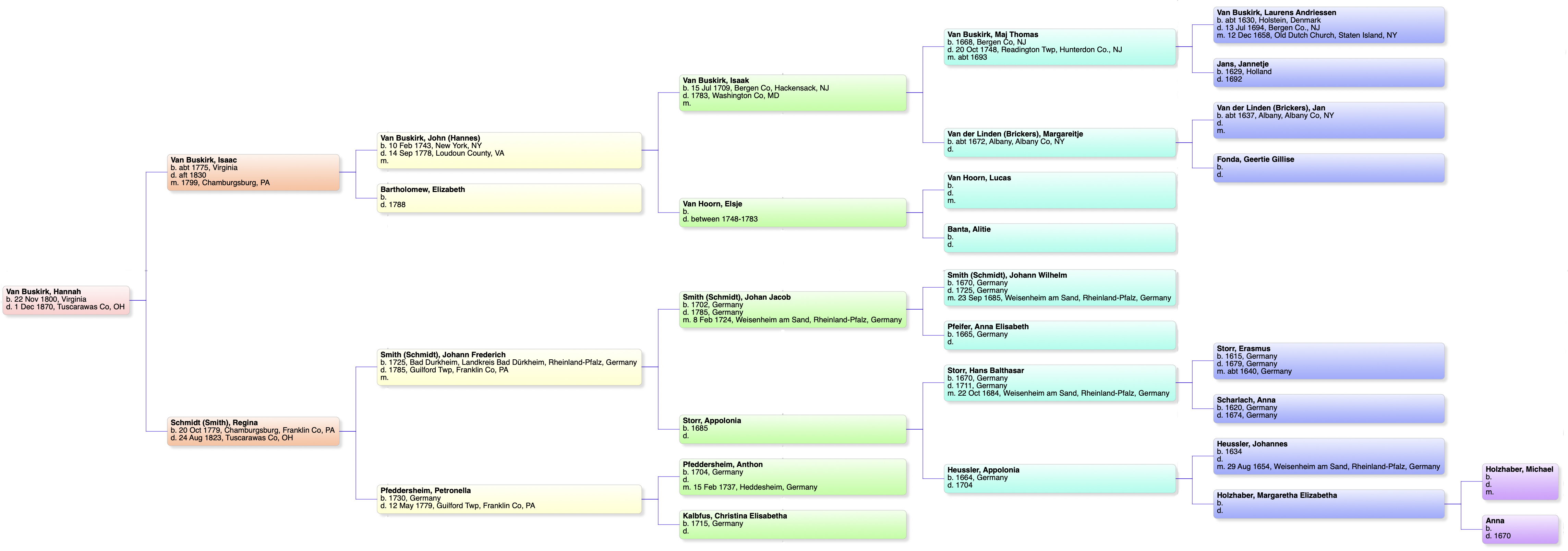
THE FOUNDER OF THE VAN BUSKIRK FAMILY IN AMERICA. By William Nelson, [p159]
LIFE AND TIMES OF REV. JONATHAN ELMER. By A.M. Cory, M. D. (Continued), [p171]
SOME UNPUBLISHED REVOLUTIONARY MANUSCRIPTS. (Continued), [p180]
GENERAL WILLIAN SCUDDER STRYKER, [p185]
NECROLOGY. William Kelby, Byron Sherman, Mrs. Thomas J. Stead, [p189]
NOTES, QUERIES AND REPLIES. Piatt vs. Pratt, 179. Loyalists in New Brunswick, 188; William Burnett, of St. Joseph, Mich., 191; Bethlehem Burying Ground, 191; The Virginia Camps or Kemps, 191; Perth Amboy Newspapers, 192; Nelson-Jay Families,
193; Some of the Society’s Old Maps, 193; “Hank’s” Pond, West Milford, 193; Ship’s Bill of Lading, 194; German Valley Presbyterian Church, 194.
PROCEEDINGS OF THE SOCIETY, 1900, [p195]
MEMBERS OF THE SOCIETY ELECTED IN 1900, [p200]
INDEX, [p201]
BY WILLIAM NELSON.
p159-171
The gathering of these Van Buskirk data was begun to satisfy some queries which had been made of the writer. As the subject was pursued it seemed to present so characteristically the manner and the puzzling difficulties of tracing the story of a settler in New Netherland that the author was led to follow up the theme somewhat exhaustively, bringing together all that could be gleaned from every available source, calculated to throw light on the life and character of the founder of the Van Buskirk family in America. As a further help to those who may wish to undertake similar investigations, the authorities have been cited for every statement of fact.
The progenitor of the American family was known simply by a patronymic-Laurens Andries, or Andriessen; that is, Laurens, son of Andries, or Andrew’s son. According to the record of his marriage, cited hereinafter, he was from Holstein, then an appanage of the kingdom of Denmark, but now attached to the crown of Prussia, as the outcome of the war of 1864, when the latter country entered upon that conquering career which has led to the evolution of Germany as a world-power. Laurens came to this country via Amsterdam, in 1651. After coming here he was occasionally referred to in the Dutch records as van Boskerck. As he came from Holstein, where the Lutheran was the State Church, and the German language was prevalent, we would have expected this designation to have been given a German form, as von Buschkirk; but as a matter of fact, even in the German Evangelical Church records, it always appears as in the Dutch, van Bosckerk, later van Buskirk, pronounced Booskirk. The Philadelphia branch of the family adopted the last-mentioned form nearly two hundred years ago, and ever since have been known as Van Booskirk. The etymology of the Dutch name indicates a reference to a Wood or Woods-Church, Bosch-Kerk, or Church-in-the-Wood, or Church-in-the-Bush, rather than in the forest.1 In the German church records no attempt has been made to translate the name into the German, Busch-Kirche, or Wald-Kirche, but it has been transferred bodily from the Dutch, as above, indicating that it was already regarded as a proper name.
The young Danish-Hollander was a turner by trade, and on coming to America brought with him in the same vessel from Amsterdam, Frederick Arents Bloem, from Swarts Sluis, between Zwolle and Meppel, in the Province of Overyssel, in Holland, Bloem being also a turner, who came over with and under an engagement to Laurens.2
The first mention of Laurens Andriesen that has been found in the records in America is where he appears, December 25, 1654, at the baptism of Marritje, daughter of Albert Pieterszen, Swaerts (i. e., dark, or black), in the Dutch Church. There his name is entered as Laurens de Draijer.
The threatening of an Indian incursion in 1655 led the burgomasters of New Amsterdam to petition Director-General Petrus Stuyvesant and the Council of New Netherland to strengthen the city’s defences by the repair of the plank wall on the north (at Wall street), and to raise the funds therefor by a voluntary contribution from all who were willing to give, and by a summary tax on the rest of the inhabitants. This met the approval of the ruling powers, who sat on October 11, 1655, for the purpose of receiving the “voluntary” tax, and levying an involuntary rate on the reluctant citizens. The Honorable Heer Petrus Stuyvesant set an excellent example, by offering to give 150 florins (about $60), being $50 more than anyone else. The next day Lourens d’ Drayer (one would suppose he had become a Frenchman, from this new form of his name), being absent, was taxed at fl. 15—indicating that he was rated at a tenth as much as the Director-General.3
The Dutch word for “turner” is draijer — drawer, probably referring to the early use of the draw-knife in shaping vessels, shoes and other articles from wood; and hence Laurens was usually spoken of as de Draijer, “the Turner.” In many translations from the Dutch records this designation of his occupation has been simply transferred to the English, without interpretation, and as the name is thus entered also in the indices, the searcher for references to Laurens van Boskerk may easily overlook such allusion.
So much by way of explanation of some extracts about to be given from the old records.
It is probable that Laurens was not a very young man when he came to America, and that he already had accumulated some money. How else can we account for these several real estate transactions in June, 1656? On June 29, Luycas Dircksen Van Bergh conveyed to Lowrens Andriesen van Buskerck
A lot on the east side of the Graft, between the house and lot of Jan Rutgerson on the south, and Jochem Beeckman on the north. Width in front on the street or west side, 2 rods 5 feet, and in the rear or east, & rods 4-1/2 feet. Depth on the south 8 rods 6 feet, and on the north 7 rods 5 feet: being premises conveyed by Harck Syboutsen to said Van Bergh, 22d March, 1656.4
On June 24, 1656, Lourens Andriesen, of Boskerck, conveyed to Jochem Beeckman
A part of his lot about the Graft, in rear of said Beeckman’s lot, abutting on the east lot of Evert Duyckingk, on the west and north Jochem Beeckman, and on the south the said Laurens Andriessen. Width on the west, 5 rods, on the north 5 rods 2-1/2 feet, on the east 5 rods 3 feet, on the south 3 rods 6-1/2 feet; being premises conveyed ty Luycas Dircksen on the date hereof.5
Again, on June 29, 1656, Jochem Beeckman, shoemaker, conveyed to Lourens Andriesen van Boskerck
A part of his lot on the east side of the Graft. on the south side of his, said Beeckman’s house. 6 roe-feet in width in front on the street on the west side, and so far as his lot extends, to said Andriesen’s lot, with the conveyance to him of a way alongside said Beckman’s lot, running in a straight line of the same breadth in front as in rear; being premises conveyed by Abram Rycken to said Beeckman, 15th November, 1652.6
And on the same June 29, 1656, we have this fourth conveyance — Lourens Andriesen Van Boskerck to Jacobus Backer:
A lot on the east side of the Graft, bounded between the lots of Jochem Beeckman on the north, Evert Duyckingh on the east, and Jan Rutgersen on the south. Width front and rear 3 rods 1 foot, depth both sides in a right line from the street to Evert Duyckingh; being premises conveyed on the date hereof by Lucas Dircksen and Jochem Beeckman to said Lourens Andriesen Van Boskerck.7
The contract between Laurens Andriesen and Frederick Arents Bloem proved too irksome for the latter, especially when opposed to the personal attractions of Grietje Pieters, of Breda, and accordingly he broke that agreement with his master, and entered into a more congenial matrimonial alliance with the fair Grietje, on July 20, 1656. In the marriage record he is designated as Fredrick Arentszen, young man, Van Swartensluys.
The aggrieved master promptly brought this delinquency before the Court of New Amsterdam on Tuesday, July 25, 1656, and from the minutes we get some interesting details concerning the two men, and their bargain:
Lourens Andr van Boskerk, turner here, appeared in Court complaining, that Frerick Adryaensen, his man, ran away from him last Sunday morning without either words or reason,8 and he hired him in Amsterdam for three years and he is bound yet for one more year; requests that he be constrained by order of the Court to serve out his time. The petitioner was ordered by the Court to cause the above-named Frederick Arvaensen to be summoned before the Court by next Thursday, then to institute his action against him and exhibit his contract, when further disposition shall be made therein.9
Accordingly, on the following Tuesday, July 27, the parties appeared in Court, with the result stated below:
Lourens Andriessed de Drayer, pltf. vs. Frerick Arentsen, deft. Deft. having been hired by the pltff. left his service before his time was out, and got married; as more fully appears by the demand and answer of the parties, entered in writing. In order to prevent expense and delay in the case the Burgomasters and Schepens refer the matter and parties in dispute to Isaack d’ Foreest and Coenraet Ten Eyck residents here, who are hereby requested and authorized to dispose of the case in question as arbitrators, and if possible, to reconcile parties or in default thereof, to deliver their opinion in writing to the Court.10
From all of which we gather that Laurens Andriesen, having acquired at Holstein the art and mystery of the trade of turner, went up to Amsterdam, there to follow his vocation in turning wooden bowls and dishes and eke shoes for the thrifty Dutch huysvrouwen of that fair city, finally setting up for himself and having an assistant, in the person of the inconstant Frederick Arentsen. With dreams of increasing his business and so bettering their fortunes he turned him westward from Old Amsterdam to the Nieuw Amsterdam, where he speedily acquired such fame for the excellence of his work that he was commonly known by way of preeminence as de Draaijer — the Turner, of the little town.11
We again find mention of Laurens de Drayer under date of October 23, 1656, when he was a witness in court, in regard to a slander of Geurt d’ Carmans’ wife on Madame Beeckman.12
The lawsuit brought by Laurens against his quandam “man” led to another a few months later, November 13, 1656, when their relations as plaintiff and defendant were reversed, Frerick Arentsen bringing his action against Lourens Andrs Van Boskerck.13 As there is no further reference to the case the probabilities are that it was settled out of court.
The indications are that master and man were never on good terms thereafter. Neither was ever present as witness at the baptism of a child of the other.
For the next two years the records of New Amsterdam are silent regarding Laurens Andriesen. Considering his prominence during his first two years in the colony this seems to require an explanation. What is it? Had he sought a new field for the practice of his craft, or for the exercise of his undoubted business talent? Had he ventured to the comparatively unworked region on the Delaware, so recently wrested from the Swedes by the Dutch, and whither adventurous spirits from Holland and from New Amsterdam and other settlements along the Hudson river were occasionally wending? The next mention of him in the records suggests that such may have been his experience. This is from the marriage registry of the Reformed Dutch church in New Amsterdam:
1658, Dec. 12. Laurens Andries, Uijt Holsteijn, en Jannetje Jans, Wede Van Christaen Barents.
This marriage — apparently his first, tho the record omits to say whether he was a “young man,” that is, previously unmarried, or a widower — had important consequences for the bridegroom, as we shall see by the proceedings of the Orphan Masters of New Amsterdam, whose function it was to look after estates, particularly in the interest of those bereft of either parent.
Christiaen Barents, or Barentsen, a carpenter, came from Hoorn, in North Holland. with his wife. Jannetje Jans, and one child, it is supposed, in or perhaps previous to the year 1653. On August 3, of that year, he had a child, Cornelis, baptized in the New York Dutch church. Another son, Jan, was baptized in the same church, March 18, 1657. Christaen Barentzen was admitted, April 17, 1657, to the Small Burgher right of New Amsterdam.14 He bought a plot of ground, February 17, 1654, on the west side of Broadway, opposite Wall street, to which he added another tract, July 30, 1657, by purchase from Lubbertus van Dincklage, having a frontage on Broadway of 12 rods 6 feet 7 inches, with a like width in the rear, and a depth of 8 rods 7 feet 7 inches on the north side, and 7 rods 7 feet 9 inches on the south side. These two tracts apparently comprised a goodly portion of the present Trinity church yard. Christiaen sold the premises, or a part thereof, Nov. 17, 1657, to Cornelis Pluvier, for 1616 guilders 13 stivers in cash, and a mortgage for 1233 guilders 7 stivers, or about $1,140. The plot sold was thus described :
A house and lot on the west side of the broad highway, bounded east and north by said highway and the city wall; westerly by Dominie Drisius; and southerly by house and lot of Jacob Vis and the [West India] Company’s garden. Width on east side 3 rods 4 feet 5 inches; depth north and south 7 rods 5 feet; on the vest side 8 rods 6 feet, on which breadth the length on north side, which is the wall, is 8 rods 1 foot 7 inches; on the south side, 7 rods 7 feet 9 inches, being further wide in the rear, the west side, 8 rods 1 foot.15
He bought another tract from Lubbertus van Dincklage, July 30, 1657, on the east side of Broadway, and on both sides of Wall street, having a frontage of 12 rods 6 feet 7 inches, and a depth of 8. rods 7 feet 7 inches on the north side, and 7 rods 7 feet 9 inches on the south side. To this was added a small tract by patent from the Director General and Council, August 1, 1657. He sold the combined plots, May 30, 1658, to Hendrick Hendricksen [Kip], tailor, for 600 guilders in cash, and a mortgage for 500 guilders, the deed describing them in these rather indefinite terms:
A house and lot in the Heere [wegh] by the land gate. Width on the west side, which is the Heere wegh. 3 rods 8 feet 4 inches, and on east side 1 rod 6 feet 4 inches; depth on north side, Il rods 2 feet 8 inches. and on south side 11 rods 1 foot 9 inches. Being premises patented to said Barents, August, 1657.16
Barents seems to have been drawn toward the South River (the Delaware), soon after coming to America, or perhaps he was employed by the authorities to go thither to follow his trade. When Director-General Petrus Stuyvesant sailed, September 5, 1655, from New Amsterdam with the expedition equipped for the purpose of conquering the Swedish settlements and forts on the Delaware,17 Barents was one of the artisans in the company. He must have returned very soon, for we find him appointed fire warden in New Amsterdam, January 18, 1656.18 His sales of land, November 17, 1657, and May 30, 1658, were probably with a view to settling permanently on the Delaware, whither he appears to have removed in the latter year, and presently we find him engaged in building a mill in the City of Amsterdam’s unhappy Colony of Nieuw Amstel. Before he could complete the work he was seized with the fatal malady which swept like a besom of destruction through the settlement that summer, and from which he died July 26, 1658. Jacob Alrichs, Vice Director of the Colony, sent word of the death to the Orphan Masters at New Amsterdam, with an inventory of the estate, and the request that his widow might be assisted, this letter being laid before those officials August 28, 1658.19 The requisite assistance,” it will be observed, was promptly furnished by our friend Laurens Andriesen, who married the fair and not inconsolable young widow four months and a half after her sad bereavement. A petition presented by her to the Director-General and Council in relation to the estate of her deceased husband was by them referred to the Orphan Masters,20 the order bearing date the day of her marriage to Laurens. Was this merely a coincidence? The Orphan Masters thereupon, in behalf of the children, took these proceedings, December 18, 1658:
Before the Board appeared Burgomaster Olof Stevensen Cortlandt, who is informed by the Orphan masters of the inventory of the property of Cristiaen Barens, who died at the South River, and of the inventory of his property here, made by the widow, wherein differences appearing, with which they do not know what to do, the widow of said Cristiaen Barens, called Jannetje Jans, is called and asked, whether the payment for the house near the Landgate21 had been received. She answers: Yes, by Hendrick van Dyck, who had power of attorney from her husband. Asked about the payment for the house where Hendrick Hendricksen, the tailor, lives, she says not to have received it, but still due and charged.
Jannetje Jans is ordered to send to the South River the last inventory, made here, as they have the case in hand. She says, she has asked the people on the South River to have the proceeds of the goods there forwarded to her, which was promised to her, if she can give bail or security. She is therefore advised to write to the South River that she will give security for the money, and offers as such a house.
It was nearly seven months later, or on July 8, 1659, that the matter again came up in the form of a letter from the New Amsterdam Orphanmasters to the authorities at South River:
At the request of Lauwerens Andriesen Draijer, who has married the widow of Christiaen Barens, deceased at the South River last year, we inform you herewith, that there are deposited in your Orphans’ Court the goods, belonging to his children as paternal inheritance, while the children are here in this city, and we request, that following the usages of other places, said goods may be sent to the Orphans’ Court here. You will find us in similar cases willing to reciprocate.
Another year and a half dragged slowly by, ere the desired accounting was received from the South River. That it was a disappointing one is clearly shown in the statement to the Orphanmasters, on January 30, 1660:
Lauwerens Andriezen appearing declares, not to have received more from the estate, left by Cristiaen Barens, deceased, his wife’s former husband, than 574 fl. from Salomon Hanzen. He also says, that there are still outstanding at the South about 13 or 14 hundred florins, heavy money at the rate of 10 beads or wampum for one stuyver, and shows an account of the estate with what it owes and what is due to it. The Orphanmasters reply, that a copy of the account shall be made by Secretary Nevius and the original shall be returned to him: they further order him to bring to the next session the statement and inventory shown to the Director General and Council, with their marginal order thereon.22
In the mean time we find in the records frequent indications that Laurens was a man of some consequence in the busy little Dutch town. On one occasion he seems to have bargained with Margriet Herms to have a certain work performed. She in turn employed Jacob vanden Bos in its execution. He brought suit against her for fl. 19 (about $7.60), and the matter came to a hearing before the Court, September 2, 1659. The Vrouw Herms offered a double defense — that the work was not done, and if it were. it had been so long delayed that Lauwerens Andriesen would not accept it now. The Court evinced a fine confidence in his fairness, by leaving it to him to judge if Jacob had earned his money or not.23
Two weeks later Lauwerens appeared in court again, this time as plaintiff in a suit against Cornelis van Giesel. He declared that he had an assignment from Mr. Alricx (Jacob Alrichs, the Vice Director of the South River Colony, above mentioned) on Aaltje Baltes, and that van Giesel had tried to collect the money already so assigned; he therefore demanded the money, and he was not at all particular whether van Giesel paid it, or Aaltje, who really owed it. The defendant made the somewhat plausible explanation that the case had been recommended to him, and with that view he had spoken to the woman, seeking to induce her to pay, but she gave for answer she would accept the assignment, but would not pay the whole until her husband came home; and that as she was bound to pay Jacob Jansen Huys and Jacob Jans and the plaintiff, it was none of his business. and that was all the thanks he got for interfering. The further proceedings are thus detailed:
Aaltje Baltes, Lauwerens Andriesen and Corn van Gesel appear in Court; Aaltje Baltes declaring, she represented to those who first spoke to her, that she would pay half down, and the remainder when her husband came home, and that van Gezel would have the whole; she signed her hand, that she would pay the whole when her husband came home; and the assignment belongs to Lauwerens Andriesen. The Court decide, that Aaltje Baltes shall pay to Lauwerens Andriesen the half of the assignment and endorse the same on the back of it; and the remainder when her husband returns. The same being stated to her, she declares she is content with it.24
His willingness to agree to anything in reason in settlement of a dispute was again manifested two months subsequently, or on November 18, 1659, when the Court heard a sequel to the case just cited:
Skipper Jacob Nanzen and Lauwerens Andriesen, plaintiffs, vs. Salomon Hanzen, defendant. Pltff. Jacob Janzen demands from defendant three hundred guilders, balance of an obligation dated 20th August, 1659. Deft. says he designs to pay, provided he were away from the Colonie Nieuwer Amstel; saying, he has no money, but only goods. Pitf. Lauwerens Andriesen to whom the monies must he paid says he is content therewith, on condition of the goods being delivered at prices current. The Court ordered deft. according to his last promise made before the Court on September 16 laast, to pay according to obligation, or in goods on a valuation of appraizers to be selected on both sides.25
Lauwerens was sued, August 24, 1660, by Grietje Dircks, who demanded of him thirteen beavers (pelts, then current as money) on an obligation dated November 4, 1659, due May 1, 1660. The Court ordered him to deposit the money or the beavers with the Clerk of the city.26
He came before the magistrates again, October 5, 1660, to prosecute two suits, one against Barent Cruitdorp, and the other against Paulus Heimans. As nothing further is said about them, it is probable that his demands were amicably adjusted out of court.27
His next appearance in Court was in connection with the purchase, October 13, 1660, of a plot of land, on the northern end of the old Dutch churchyard, extending from the Heere straat (now Broadway) to the North River, having a width of forty-three feet, front and rear, and a depth of fifteen rods Dutch, or one hundred and ninety-five feet. This churchyard was south of Morris street, and the church authorities sold it off in building plots, regardless of the interments. His neighbor on the north was Mr. Paulus Van der Grist, who had a house on his lot. This purchase was effected from Nicasius De Sille, Supreme Councilor and Fiscal, and Hendrick Jansen Van der Vin, churchwarden.28 Laurens started to build on the lot, but neglected to pay for the land, and accordingly Govert Lookermans, one of the church-wardens, brought suit against him, in behalf of the church. In his declaration, filed May 3, 1661, he demanded 200 guilders (say $80) for the lot (surely not an excessive price, from the 1906 standpoint), deducting what had been already paid on account, according to the tenor of the church-book. Laurens acknowledged the justice of the claim, but requested until harvest-time to pay, and it was so ordered.29 Probably he had a goodly crop of cabbages set out among the graves on his plot, and hoped to realize enough from them to make good his debt.
The business on the South River was still unfinished, and Jacob Alrichs having died, Laurens petitioned the Director-General and Council of New Netherland for an attachment against his property, in the matter of the suit against Cornelis van Gesel, mentioned above. His application, however, was refused.30
[To be continued.]
__________
1 Bosch-Kapelle, or Woods-Chapel, is the name of a village of 1,000 inhabitants in Zeeland, Holland. No account has been found of any town or village in Holland called Bosch-Kerk.
2 Riker’s History of Harlem, New York, 1881, p. 143, n.
3 The Records of New Amsterdam, from 1653 to 1674, edited by Berthold Fernow, New York, 1897, Vol. I, 371. [Herinafter cited as “New Amsterdam Records.”]
4 On the east side of Broad street, south of Beaver street. See Valentine’s Manual, 1861, p. 586.
5 On Beaver street, east of Broad street. See Valentine’s Manual. 1861, p. 596.
6 East side of Broad street, near Beaver street. See Valentine’s Manual, 1861, p. 586.
7 East side of Broad street, south of Beaver street. See Valentine’s Manual, 1861, p. 586.
8 “Without reason,” forsooth! Wasn’t the buxom Grietfe “reason” enough, in all conscience?
9 New Amsterdam Records, II., 144.
10 Ibid.. II.. 148.
11 In George Scot’s “Model of the Government of the Province of East-New-Jersey in America,” Edinburgh, 1685, there is a mention (p. 140) of “Lawrence the Draper, a Dutchman” (Whitehead’s “East Jersey under the Proprietors,” 1st edition., 276; 2d ed., 407), whence Mr. Winfield has hastily concluded that Lawrence had changed his occupation from turner, to draper, and that in a thinly settled neighborhood where every family spun its own wool and wove its own cloth! The word draper is manifestly a typographical error for draijer, or drawer, i.e., turner, dish-turner.
12 New Amsterdam Records., 194.
13 Ibid., II., 227.
14 New Netherlands Register, by E.B. O’Callaghan, Albany, 1865, p. 181; N.Y. Hist. Soc. Collections, 1885, p. 23; New Amsterdam Records, VII., 152.
15 Valentine’s Manual, 1861, pp. 596-7.
16 Valentine’s Manual. 1857, p. 511; N.Y. Hist. MSS., I., 384; Valentine’s Manual, 1861, pp. 378, 593, 599.
17 O’Callaghan’s Hist. of New Netherlands, II., 286.
18 N.Y. Hist. MSS., I., 158: O’Callaghan’s New Netherlands Register, 113.
19 N.Y. Col. Docs., XII., 225.
20 N.Y. Hist., MSS., I., 204.
21 The plot sold by him, May 30, 1658, as already related.
22 Minutes of the Orphan Masters of New Amsterdam, New York, 1902, pp. 44, 58, 102, 129; N.Y. Hist. MSS., I., 204.
23 New Amsterdam Records, III., 36.
24I bid., III., 48.
25 New Amsterdam Records, III., 77.
26 Ibid., III., 191, 195.
27 Ibid., III., 227.
28 Valentine’s New York Common Council Manual. 1865, p. 676.
29 New Amsterdam Records, III., 290.
30 N.Y. Hist MSS., I., 216.
THIRD SERIES, Vol IV
1901-1905, 1906, 1907
A MAGAZINE OF HISTORY, BIOGRAPHY AND GENEALOGY.
•
THIRD SERIES.
VOLUME IV.
1901-1905.
PATERSON, N. J.:
PRESS PRINTING AND PUBLISHING COMPANY, 269 MAIN STREET.
1907.
_____
CONTENTS.
OCTOBER, 1906.
_____
SOME NEGLECTED ASPECTS OF COLONIAL HISTORY. By Professor Charles M. Andrews [p1]
THE NEWARK ACADEMY. By the Rev. Franklin B. Dwight. (Continued from Vol. III, p. 159.) [p19]
THE FOUNDER OF THE VAN BUSKIRK FAMILY IN AMERICA. By William Nelson. (Continued from Vol. III., p. 171.) [p24]
SAMUEL H. PENNINGTON. By William Nelson. [p34]
LIFE AND TIMES OF REV. JONATHAN ELMER. By A. M. Cory, M. D. (Continued from Vol. III., p. 179) [41]
NECROLOGY: Augustus Sample Barber, Sr.; Augustus Sample Barber, Jr.; Sinnickson Chew; Alfred B. Coe. [p50-55]
NOTES, QUERIES AND REPLIES: Musconetcong Valley Presbyterian Church, 18 ; Bethlehem Ferry, 23; Pewter Communion Platter, 33; Ash Swamp, 40; New Jersey Sailor Captives, 1782, 40; Bloomfield Letters, 49; DeHart’s “Notes on Elizabeth,”
49; Manning, 55 ; Henderson Portraits, 55; Bergen County Historical Society, 55; Quick Family, 56; Witherspoon on Slavery, 56
PROCEEDINGS OF THE SOCIETY, 1901; First Meeting in the Society’s New Home. [p57]
MEMBERS OF THE Society elected in 1900-1901. [p62]
JANUARY-APRIL, 1907.
_____
AN EXAMINATION OF OLD MAPS OF NORTHERN NEW JERSEY, WITH REFERENCE TO THE IDENTIFICATION OF THE NUTLEY AREA AND WASHINGTON’S ROUTE ACROSS IT, AND TO THE BOUNDARY DISPUTE BETWEEN NEWARK AND ACQUACKANONE. By Elizabeth Stow Brown, [p65]
THE FOUNDER OF THE VAN BUSKIRK FAMILY IN AMERICA. By William Nelson. (Continued from page 33.) [p75]
SLAVERY IN NEW JERSEY. By A. Q. Keasbey. [90]
NECROLOGY: Catherine L. Burnett, 97; Dr. Abraham Clark, 97; Henry Congar, 98; Elisha Bird Gaddis, 99; Rev. Charles T. Haley, D. D., 99; Henry Harrington Hall, 100; Henry Hayes, 102; Howard W. Hayes, 102; Andrew W. Hedges, 103; Randolph Manning, 103; Ferdinand Wakeman Hubbell, 104; Justin S. Morrell, 105; Villiam Potter Ross, 106; Charles Holbert Voorbees, M. D., 106; James Sterling Yard, 107.
NOTES, QUERIES AND REPLIES: Hornblower Family, 71; Indian Reservation, 89; Witherspoon’s Druid Papers, 108; A Faithful Apprentice, 109; Dr. Thomas Cadwallader, 109; Carteret Portraits, 109; Papers of Daniel T. Clark, 109; Marriage Certificate, 1740, 110; “The Graves of the Household,” at Kearny, 111; Mountain Family, 111; A “Dutch Doctor” at Evesham, 1758, 112; New Jersey’s Great Seal, 113; Stivers Family, 113;
Tombstone Inscriptions in the Lutheran Gravyard, New Bridge, Bergen County, 114; Portraits of Captains of Washington’s Life Guard, 114; Westfield Marriage Records, 115;
White Family of Monmouth County, etc., 115; Carlstadt Tombstone Inscriptions, 128; Letter from Major Samuel Hayes, of Newark, 1782, 128.
PROCEEDINGS OF THE SOCIETY, 1902, [p116]
PROCEEDINGS OF THE SOCIETY, 1903, [p121]
MEMBERS OF THE SOCIETY elected in 1901-1902, [p120]
Members deceased in 1902, [p121]
MEMBERS OF THE SOCIETY elected in 1903, and Members deceased
in 1903, [p127]
MAY-OCTOBER, 1907.
_____
HENDRICK FISHER. By the Rev. T. E. Davis, [p129]
SLAVERY IN NEW JERSEY. (Continued from p. 96). By A. Q. Keasbey, [p147]
NECROLOGY: Jeremiah Baker, 155; John I. Blair, 155; Samuel H. Grey, 156 ; Frederick Wolcott Jackson, 158; Andrew Kirkpatrick, 160; Rev. Obadiah M. Johnson, 162; Theodore Andruss Lathrop, 163; Herman Leblbach, 163; James H. Nixon, 164; James Douglas Orton, 165; Dr. William Rankin, Jr., 166; Sylvester Strong Battin, 167; Dr. Clarence Willard Butler, 168.
NOTES, QUERIES AND REPLIES; Colonel Richard Townley, 146; Colonel Daniel Coxe, 169; Colonial Church Charters, 169; Old Barracks in Trenton, 169; Kinney ancestry, 169; Sword of General Z. M. Pike, 170; the Woodbridge edition of the Stamp Act, 170; Jacobus family, 170; Earl family of Burlington County, 170; Carteret’s Arms, 170; Proprietors of East Jersey and of West Jersey, 171; William Bott, 171; Peacock family, 172; Road returns of Bergen, Essex and Passaic Counties, 172 ; Cummins family, 172; Early Militia Act, 173; The “Caledonia”, 173; Dutch Christian Names, 173; Pioneers of Old Hopewell, 174; the Law of Descent in New Jersey, 174 ; G. A. R. Portraits, 174; Communion Pewter, 175; the Early Iron Industry in Northern New Jersey, 184.
PROCEEDINGS OF THE SOCIETY, 1904, [p176]
MEMBERS ELECTED, 1904, [p183]
MEMBERS DECEASED, 1903-4, [p184]
PROCEEDINGS OF THE SOCIETY, 1905, [p185]
MEMBERS DECEASED, 1905, [p195]
MEMBERS ELECTED, 1905, [p196]
BOOK NOTICES, [p197]
BY WILLIAM NELSON.
[Continued from Proceedings, Vol. III., p. 171.]
Pages 24-33
After this date Laurens Andriessen appears no more as a resident of New Amsterdam. It is probable that he removed to the west shore of the Hudson river about this time, and that in 1662 he purchased a tract of 170 acres at Mingackwa. The lands in question were originally patented to Barent Jansen. After his death they were patented, May 25, 1647, to Claas Carstensen, the Norman (sometimes called Van Sant), a soldier in the service of the West India Company. The tract then contained 50 morgens, or 100 acres.1 He sold it, January 19, 1655, to Jan Vinge, who in turn conveyed it to the ” Virtuous Annetje Dircksen,” widow of Peter Cock, who owned it in 1662. It was probably from her that Laurens Andriessen bought. He added 18 morgens, or 36 acres.2 After the English conquest the inhabitants received from Governor Philip Carteret patents confirming the titles to their lands. That to Lawrence Andriessen was dated March 26, 1667, and described the tract as ” a Parcell of Land lying at Mingackqua

Beginning at a Stake on the Northwest side of Hudson’s River or York Bay (from which Stake the most Easterly Corner of Jacob Van Wagenen’s House bears South Seventy Six Degrees and forty Minutes West Seven Chains and eighty Eight Links) And from the said Stake runs North twenty seven Degrees and thirty Minutes West Eighty two Chains and fifty Links to New Ark Bay. Then up along said New Ark Bay until it comes to the Mouth of a small Creek (that parts this Land from Meadow patented to Barnt Christian which
INSERT MAP pg 25
page 26 (con’t from page 24)
is mark’d on the Map No. 122) Then up said Creek North forty Seven Degrees and fifty Minutes East four Chains and fifty four Links, Then South eighty nine Degrees East three Chains & eighty five Links, Then South thirty two Degrees East five chains and thirty six Links Then North eighty three Degrees and thirty Minutes East nine Chains and ninety Seven Links to a stake standing in the said Creek (where it is called a swampy Creek) And from the said Stake South twenty Seven Degrees and thirty Minutes East ninety three Chains and ninety four Links to the Mouth of Straatamakers Creek on said Hudson’s River or York Bay; Then Southwesterly along said Bay or River to the Place of Beginning.3
This tract was on Bergen Neck, between Cavan Point and Constable’s Hook, and extended northwest and southeast from Hudson’s River to Newark Bay, being a mile in length, on the northwesterly side, and a mile and a half on the southeasterly side, and half a mile in breadth. The locality was called by the Indian name Mingackwe, with an infinite variety of spelling. In 1863 it was incorporated as Greenville township, which in 1873 was annexed to Jersey City. Here Lourens built and for some years occupied a house on the shore of New York Bay, near the present Greenville station on the Central Railroad of New Jersey. Lot No. 122, thirty acres, adjoining Lourens to the north, was patented, March 26, 1667, to Barrant Christian, of Minkaque, planter, one of the stepsons of Lourens Andriessen.4 It was subsequently acquired by the latter, and from his well known occupation was called “the Draaijer’s Point,” and on the map made for the commissioners partioning the Bergen Commons, in 1764, it was designed as “Droyer’s Point.”5
But the ownership of a patent carried with it an interest in the common lands, and we learn from the report of the commissioners for dividing those lands in 1764 that Laurens Andriessen’s share on that account was designated by them as Lot No. 266, on their map, and described as follows:
Beginning at a Stake, (being the Southerly Corner of a Lot of Common Land allotted to Lubert Gilbertse’s Patent) mark’d on the Map No. 267, which Stake stands South thirty nine Degrees West sixty three Chains and ninety seven Links from a Stone mark’d B planted in the Westermost Court of Common Land (allotted to Barnt Christian’s Patent) mark’d on the Map No. 277; And from said Stake (the Place of Beginning) runs North fifty-one Degrees West forty Chains to New Ark Bay, Then returning to the first mentioned Stake; and from thence runs South thirty nine Degrees West seventeen Chains and eighty eight Links to a Stake in the Line of a Tract of Land set apart for sale mark’d on the Map No 172, Thence along the Line thereof North eighty five Degrees West thirteen Chains and thirty seven Links to a Stake (being a Corner of said Land set apart for Sale), Then along the Line thereof North fifty one Degrees West thirty Chains to said New Ark Bay, Then along said Bay Northeasterly as the same runs ’til it meets the first mentioned Line containing about one hundred Acres.6
This tract seems to have been allotted to Claas Carstensen, the Norman, by Director-General William Kieft, with his patent of March 25, 1647, for the Mingackwa Lot No. 19.
Andriessen appears also to have taken up or acquired a lot in the town of Bergen, as we find by a reference in a patent of May 12, 1668, from Governor Philip Carteret, for Lord Berkley and Sir George Carteret. Proprietors of New Jersey, in which it is described as
A certaine prcell of Land & Meadow about the town of Bergen formerly belonging to Lawrence Andrissen viz a piece in the olde Mais Land betweene Ian Lubersen & Adrian Post 36 rods in breadth 16o rods in length upon an ESE. Lyne Is 9 Morgen 360 rods duth7 measure

Item a piece of meadow over a small Creeke joyning to Gerret Gerretsen stretching from sd Gerretson to the Creke or River contayning 6 morgen dutch measure he to pay on every 5th [? 25th] of March one half penny for every acre. The first payment to be made March 5 1670.8
INSERT MAP pg 28
Page 29
No record has been found showing how or when Andriessen parted with this tract. Many of the grantees of lots within the town having neglected to occupy the same, or to keep thereon a man fit to bear arms, the New Netherland government adopted an ordinance November 15, 1663, providing that all lot-owners should within twenty-four hours after service of a copy of such ordinance ” furnish and continually maintain for each Lot one man able to bear arms, and to keep watch and ward, on pain of having the Lots with the Lands thereunto appertaining, as surveyed by the Surveyors, immediately given and granted in propriety to others.”9 It is possible that Andriessen forfeited his lot in preference to going to the expense of furnishing and maintaining a man-at-arms to help protect the town. No doubt his heirs regret his economy at this day. The tract in question was described by the Partition Commissioners in 1764 as Lot No. 34:
Beginning at a Stake (standing in the Road that leads from the Town of Bergen to the English Neighbourhood, which Stake is the Easterly Corner of the Lott of Mark Noble and Samuel Moore mark’d on the Map No. 39) And from said Stake runs along said Road North thirty one Degrees East seven Chains to a Stake thence North seventy five Degrees and fifty Minutes West thirty one Chains and eighty four Links to a Stake by the Middle Road, Thence South four Degrees West Six Chains and Seventy nine Links to the Northerly Corner Noble and Moore, Thence South Seventy five Degrees and fifty Minutes East twenty eight Chains and sixty Six Links (along the Northerly Bounds of the Lott of said Noble and Moore) to the Place of Beginning.10
This Lot No. 34 was on Bergen Heights, on Bergen Wood avenue, near Newark avenue, and directly opposite the Court House square, in one of the most desirable sections of the present Jersey City. Its location is shown on the accompanying map.

Upon removing to the west side of the Hudson River, about 1660-1662, Lourens speedily took a leading part in the affairs of the region of his new home. The Schepens of Bergen in
INSERT MAP pg 30
Page 31
1662 petitioned the Director-General and Council of New Netherland to “have a God fearing man and preacher, to be an example to and teach the fear of God in the community of Bergen and its jurisdiction.” They submitted a list of the inhabitants who were willing to contribute to this end, with the sum promised by each, and the names of nine others who were agreeable, but preferred to give according to their discretion, among the latter being Lourens Andries.11
A few weeks later the inhabitants of Bergen and Gemoenepa represented “To the Noble, Very Worshipful their Honor the Director-General and Council of New Netherland,” that several of their neighbors were fencing in the common lands at the south end of the village, that the Minckaghoue people were fencing in their land, and that another neighbor was said to desire a piece of highland north of the village, and back of Hoboocken, which, if done, “would tend to the ruin and destruction of Bergen, as the inhabitants would be deprived of an outlet for their cattle.” Of the twenty-one signers, Laurens Andriessen was fourth; he was one of fourteen who did not make their marks. The petitioners or a committee of them were ordered, December 18, 1662, to appear before the Director-General and Council a week later, with the parties said to be intending to fence in the commons, when measures were taken to have the matter satisfactorily arranged.12
The community of Bergen having unanimously decided to erect a blockhouse at each gate of the village, for its necessary protection, the Court authorized and directed seven of the principal men, among them Lourens Andriesen, “to promote each in his quarter the work as much as possible and to take good care of it.” The committee ordered that the men who absented themselves from the work should pay part of the expenses, besides a fine of six guilders for each day they failed to report for duty. This action being submitted to the Director-General and Council of the Colony, received their hearty “approval, praise and consent,” February 21, 1664.
These fortifications were no doubt planned for protection against the Indians.13 As it turned out, a new and more formidable foe was at this very time threatening the Dutch possessions on the Hudson River. England had concluded a treaty of peace and alliance with Holland September 4, 1662. Nevertheless, Charles II., on March 12, 1663-4, coolly gave to his avaricious brother, James, Duke of York, the territory known as New Netherland, then in the peaceful possession of his ally. The Duke lost no time in sending out an armed expedition to conquer his new domain, and on September 8, 1664, the Dutch garrison at New Amsterdam surrendered, and the English flag was hoisted.14 The inhabitants of Bergen were not disturbed in their possessions, and of course submitted to the new government. Before they were fairly accustomed to it, however, they found themselves transferred from the control of the Duke of York to the rule of his two favorites, Lord John Berkley and Sir George Carteret, to whom he had conveyed New Jersey several months before he had acquired actual possession thereof. On the arrival of Gov. Phillip Carteret, the appointee of the new Lords Proprietors, the people of the several settlements in New Jersey were summoned to swear allegiance to the English King and his successors, and to the government of the Province. Lawrence Andries was one of the freeholders and inhabitants of Bergen who took this oath.15 It will be observed that under the influence of English domination his name had already undergone a change.
The sloop Indeavor, of Salsbery, in the county of Norfolk, England, William Hackett, master, unloaded at Woodbridge, early in 1671, the master failing to give an inventory of the goods and loading within the time specified by act of Parliament. Governor Carteret therefore, on May 15, 1671, ordered the vessel to be seized, and a jury to be impaneled to try the issue. The jurors, nearly all from Elizabethtown, and neighbors of the parties, failed to agree, and a new jury was summoned, on which were five men from Bergen, among them Mr Lawrence Andreas. This second jury found for the plaintiff, and declared the vessel with her furniture forfeit. The Governor, however, generously returned two-thirds of the sloop to the use of the employers and owners, they paying £26.13.4.16
Andries was again summoned as a juror, Feb. 28, 1671-2, at a special court held at Elizabethtown, by commission from the Governor, to try eight citizens of that town, charged with rioting, on June 20, 1671, in pulling down the fence of Richard Michell. He had received a patent from the Governor for a lot, in the name of the Lords Proprietors, whereas the Elizabethtown people claimed title under a patent granted by Governor Richard Nicolls, of New York, before the coming of Carteret, and at a town meeting held June 19, 1671, “It was agreed by the Major vote that Richard Michell should not injoy his lot given him by the Governor . . . and that there should some go the next morning and pull up [his] fence.” The case was tried March 8, and the jury brought in a sealed verdict, of guilty.17
[To be continued.]
BY WILLIAM NELSON.
[Continued from Proceedings, Vol. III., p. 171.]
Pages 75-89
A distinguished honor befel the subject of this sketch in the following March, 1671-2, when he was selected by Governor Carteret to serve on his Council, the upper branch of the Provincial Legislature. The record briefly says:
A Comission bearing date the Eighteenth day of March Anno Dom 1671 to Mr. Lawrence Andreson of Bergen Esqr to be one of the Councill.18
As we shall see hereafter, he was a member of the Council so late as 1684, and apparently of considerable weight in that body.
He had the distinction, also, of being the first person to act as Coroner, in Bergen County, so far as the records show. His powers and duties were thus set forth :
Lawrence Andressen Commissioned to take with him 12 serious men of ye township & Corporation of Bergen in this province and view the body of a child of Iudith Aphet, which was lately born in Bergen These Iurymen to examine the sd Iudith and the women who were present when the Child was born, and ascertain whether any wrong had been done to the Child, &c.
To Mr Laurence Andresen
of the town & Corporation of
Bergen in ye Province of New Jersey
Signed & Sealed by ye Governor19
This document is entered March 21, 1671-2.
That he was a staunch supporter of the Governor and the Proprietary party is evident from his course as a member of the Council, at the session, May-July, 1672, and in June, 1673.
The Dutch having reconquered New Netherland, in August, 1673, the inhabitants of the several villages in New Jersey were ordered to send delegates to meet the Dutch Admirals and Council of War, to treat for the surrender of the several towns, on August 18, at ” the City of New Orange,” as New York had been re-named. On that day
Captain John Berry, William Sandfort. Samuell Edsall and Lourens Andriesen, appearing before the Council request that they and their plantations may be confirmed in the privileges which they obtained from their previous Patroons, and furthermore possess unobstructed their houses, lands and goods, and to enjoy such further privileges as are granted and accorded to all other the inhabitants of Achter Coll, lately called New Jersey.20
The Council curtly ordered:
The Petitioners shall enjoy their lawfully acquired houses, lands and goods, together with such privileges as are granted and accorded to their neighboring towns of Achter Coll. What regards the privileges obtained from their previous Patroons, the same is denied the Petitioners.21
When the people in the vicinity of Bergen wanted anything from the new Dutch rulers, they selected Andriessen to represent them. Thus, at a Council held in Fort Willem Hendrick (New York), June 15, 1674:
On petition of Lourens Andriese, Samuel Edsal and Dirck Claesen, agents of some hamlets dependent on the town of Bergen, requesting that the Schout and
Schepens23 of said towns be ordered to leave the Petitioners undisturbed, respecting a certain fence in dispute between them, or to cause the Petitioners to be summoned, and to institute their action in this case, before the Governor, &c.
Petitioners are again ordered pursuant to the previous instruction, to deliver into Court within 14 days, their objections in writing to the award given by the arbitrators, on pain of discontinuance without being heard any more in the premises.
On petition of Lourens Andries and Joost van der Linde, agents for the inhabitants of Mingagque and Pemrepogh, requesting to be excused from contributing to the support of the schoolmaster at Bergen, &c.
Ordered:
Copy hereof to be furnished the Magistrates of the town of Bergen, to answer the same.
On July 7, 1674, the Governor and Council decided and ordered, “that the inhabitants of Pemrepogh and Mingagquy, shall promptly pay their share for the support [of the School-master] aforesaid, on pain of proceeding against them with immediate execution.”
After the Dutch had again relinquished New Netherland to the English, Governor Philip Carteret, who had sailed for England in 1672, returned to New Jersey, with a new commission, as Governor of East Jersey (the Western half of the Province having been sold by Lord John Berkeley), arriving here about November 6, 1674, and took prompt measures to set in motion the English rule once more, appointing sessions of the courts, etc.24 Among these orders was one, the substance of which is thus recorded, under date of February 24, 1674-5:
By advice of the Council a special Commission for a Court of Oyer and determiner to be held at Elizabeth towne the 9th day of March next ensueing
John Berry Esqr. President of the Court;
Capt. John Bishop
Mr. Samuel Edsall
Mr. John Bishop
Mr. Laurence Andrissen
or any 3 of them with the President or fouer without the president to be a Court to call before you all such person or persons charged with crime
Given at Elizabeth towne Feb. 24-167425
A very interesting document is the following, constituting one of the earliest County Courts in New Jersey of which we have any account:
By the Govr.
A Comission for the County Court of Bergen — Capt John Berry Prsident of the said Courts for this prsent yeare and Mr. Samuel Edsall Mr. Laurence Andrisson Mr.
Ellas Michelson and Engelbert Steenhuis to be Assistants or any two of them with the prsident to be a Coreham and in case the said Captn Berry be absent then Mr.
Samuel Edsall Mr. Laurence Andrissen or Eyther of them to sett as Prsident and to meet together &c.Vt Supra In fol 123 dated the 13th March 167526-76
A year later this order was made:
By Philip Carterett Esqr — &c.
Corporation of Bergen and the Plantations adjacent are a County and by Act of Assembly 2 Courts of Session be held Yearely viz on 1st Tuesday In March and last Tuesday in 7temr
I constitute and appoint you
Capto John Berry Prsident of sd Court for this prsent yeare
Mr. Saml Edsall
Mr. Laurence Andrisson Assistants
Mr. Elias Michelson
Mr. Engelbert Steenhuis
three of them without the president to be a Choram.
Signed Feb. 16-1676.27
A similar commission was issued by the Governor, February 18, 1679-80, in which Laurence Andrissen, Justice of the Peace, was named as one of the Assistants.28 He was constituted President of the County Court, August 31, 1681, the abstract of the commission being in this language:
A Commission for the County Court of Bergen and the plantation adjacent to be held the first tuesday in March And the last tuesday in stembr Mr. Laurence Andrissen president Mr. Samuel Edsall Mr. Enoch Michilson & Mr. Garret Garretson Assistants &c. vt Supra29
The “Mr.” was only used by the English in those days as a mark of distinction.
His prominence was recognized by Governor Edmund Andros, of New York, when he was attempting to exercise dominion also over New Jersey, and in pursuance thereof issued a special warrant, April 30, 1680, summoning Capt. John Berry, Deputy Governor of New Jersey, to appear before him in New York. A like summons was sent at the same time to Capt. William Sandford and Laurens Andriesen, doubtless as two of the staunchest supporters of the independence of New Jersey from her sister Province, and of the title derived from the Lords Proprietors.30
Capt. Christopher Billop, formerly of the British navy, who owned a place on Staten Island, opposite Perth Amboy,31 having some controversy apparently with certain inhabitants of the mainland, the Governor issued a commission at his request, Nov. 26, 1681, for a special Court of Oyer and Terminer, to be held at Woodbridge, and Lawrence Andrissen was named as one of the magistrates to compose the same.32
As a member of the Governor’s Council he was appointed a Justice of the Peace and one of the quorum of the County Courts of each of the four counties in East Jersey — Essex, Middlesex, Monmouth and Bergen, such appointment being made March 24, 1682-3, and being durante bene placito.33
A number of French Huguenots in New York and Harlem planned to effect a settlement together in the Hackensack Valley, in the latter part of the seventeenth century, and in pursuance of the agreement David Desmaret purchased from the Indians, June 8, 1677, a tract of several square miles, extending from the Hackensack river easterly to the Palisades, and from the vicinity of the New Bridge about six miles. This tract is sometimes referred to in the early deeds as “the land of the Company,” or “the land of the French Company.” Here were settled three generations of Demarests before the year 1700, besides many other French families, forming a distinctive community of their own, with their own church (disbanded two centuries ago), and their own graveyard, still known as “the French Burying Ground,” tho long since abandoned.34 To the south this tract was bounded by lands of Laurens Andriessen, as appears by the Indian deed just cited. He was at this time in possession by virtue of a conveyance from the savages (not on record), but this gave him no valid title, as against the Proprietors, and accordingly he secured a patent, dated April 10, 1682, executed “By the Right Honnrble Phillip Carterett, Esgr Govr of the Province of East N. J. By Lady Elizabeth Carterett,” and in favor of “Mr. Laurence Anderson of Bergin Gent,” for
A tract of land on a new plantation upon Hackingsack River now called Ould Hackingsack — 1076 acres. Begins at a stake planted at a small Brooke that pts David Demurryes land from this — thence running as the Brooke runs 40 Chains to a black oake tree marked on 4 sides standing by a spring — thence E. Northerly 98 chains on the edge of a great swamp to a white oake tree — marked on 4 sides — thence running as Swamp runneth to Wm Dougles Lyne to a red oake marked on 4 sides — thence
W. 136 chains to Hackingsack river, thence N. N. E. as the river runs 78 chains to a stake to the beginning. Bounded on the N E part by John Domurry’s and part by a small creeke S. E. by sd greate swampe and the Brooke of the West Branch of Overpecke’s Creeke, S. W. by highway and N. W. by Hackingsack river. Allowance for Barron land and highways to remayne for goo acres.
Hen Greenland
Philip Carterett
Sam. Edsall
Robert Vauquellin
Robert Vicars Secretar
For this splendid domain Laurens was to pay the Proprietors of East Jersey “yearly on every 25th day of March one half peny for every acre.”35 There must be a pretty penny of arrears of quit-rents due on this estate by this time, for probably none have been paid in more than a century and a half, and reckoning the rental at $4.50 per acre, at five per cent, compound interest the rental would total up something like $9,000 in one hundred and sixty years.36 But considering that this tract would extend from Old Bridge to New Bridge, or for half a mile above Hackensack, and easterly to Englewood, taking in sundry entire villages and boroughs, with a population of thousands, and a valuation of millions, the descendants of Laurens Andriesen would gladly pay up the quit-rents in full could they be established at this late day in the ownership of that princely estate. The spring referred to was sufficiently remarkable to be taken as a corner in the boundary. In a patent, January 29, 1695-6, to John Demarie for 296 acres, it is noted that a 216-acre parcel of the whole tract is “bounded Northeast by Lawrence Drawer at the Fountain Spring.”37 It was no doubt a boiling spring, such as were common in a new country, and had for centuries been a favorite resort of the savages and the deer and other wild creatures of wood, and swamp and meadow. A patent issued May 10, 1688, to James Emott, of Amboy Perth, for 300 acres, describes it as bounded.on the West by “the West branch of Overpeck’s Creek, which is also the bounds of Lawrence the drawer and [the French] Company’s land, called New Hackensack, Southeast and East unappropriated land.”38 So we learn by these musty old records that notwithstanding all the honors which had to come to Laurens with his growing years, altho he was a Justice of the Peace, a Judge, a member of the Governor’s Council, often called “Mr.,” and occasionally “Gent,” yet when he pluckily, even in his advanced years, cast in his lot with the settlement at New Hackensack, he apparently followed his old vocation of turner, and was still known as the Draaijer, or Lawrence Drawer, or Laurens the turner. The “French Company,” led by the Demarests, had of course selected the best land; those who followed picked out the best that was left, and still there remained extensive tracts of “unappropriated” land, that is, not taken up, or purchased from the Proprietors of the Province.
Some mention has been made of various offices to which Laurens Andriessen had been appointed from time to time, but the list is by no means exhausted. We have seen that he was commissioned a member of Governor Philip Carteret’s Council March 18, 1671-2, and indeed is mentioned as such in 1670. When the Governor was about to sail for England, in July, 1672, Laurens was one of the signers (June 15) of an address by the Council, expressing confidence in the Governor, and protesting against the pretensions of Capt. Carteret to the government of the Province. With the other members of the Council he affixed his signature (July 1) to the commission of Samuel Moore to represent the Council in England, whither he was bound to accompany and support the Governor. On the same day he also signed a letter addressed by the Council to the Lords Proprietors in behalf of Governor Carteret and against James Carteret.39 He appears to have been continued on the Council during the whole of Carteret’s administration, as we find him thus referred to in November, 1674, and he was again commissioned July 2, 1681.40
In addition to this honor the records show that he was appointed to the positions following:
1670, April 6 — Recorder and brander of horses, Bergen.41
1674-5, Feb. 15 — Justice of the Peace for Bergen.42
1675, June 4 — Judge of a Court of Oyer and Terminer for Elizabeth.43
1675, June 28 — Judge of a Court of Oyer and Terminer for Woodbridge.44
1675-6, March 13 — Assistant Judge, County Court at Bergen.45
1676, March 31 — Assistant Judge, Special Court of Oyer and Terminer at Woodbridge.46
1676, October 18 — Ranger General.47
1676-7, Feb. 16 — Assistant Judge, Court of Bergen County and adjacent plantations.48
1679-80, Feb. 18 —Assistant Judge, Bergen County Court.49
1681, July 2 —Justice of the Peace of the Quorum, Bergen county.50
Lord John Berkeley having sold (March 18, 1673-4) his equal undivided one-half of New Jersey to John Fenwick and others, after the recession of New Netherland the Duke of York gave a new grant (July 28-29, 1674) to Sir George Carteret for East Jersey alone, Fenwick and associates retaining West Jersey. The division line between the two tracts or Provinces was agreed upon by the several grantees by a quintipartite deed, July 1, 1676. Upon the death of Carteret his interest in East Jersey was put up at auction by his executors and trustees, and sold to a company of speculators,51 mostly Londoners, who became known as the East Jersey Proprietors, whose successors and assigns are to this day the owners in fee simple of so much of the soil of East Jersey (except lands under tide-water) as is still undisposed of.
The administration of Governor Philip Carteret terminated upon the arrival at Elizabeth Town, November 13, 1682, of Thomas Rudyard, the new Deputy Governor appointed by the East Jersey Proprietors. One of his first acts was to name a new Council, on December 10, 1682, Lawrence Anderson being one of the two from Bergen county.52 It was not until the twelfth of February following that the Councillors met and took the oaths of allegiance to the King and “to bee true and faithfull to the Interest of the Lords Proprietors of the said Province.”53 The minutes of the Council show that Laurens was regular in his attendance and faithful in his devotion to the public business. His importance in that body appears from the fact that he was frequently named on committees to confer with the lower house of the Legislature.54 The Council also constituted the Court of Common Right of the Province (a trace whereof remains in the “six judges specially appointed” of the Court of Errors and Appeals of our State), and Laurens sat therein as a Judge, when occasion demanded. According to custom, also, he and the other Councillors were appointed, March 24, 1682-3, Justices of the Peace of the Quorum, for each of the four counties — Bergen, Essex, Middlesex and Monmouth — of the Province, and he was commissioned a Judge of the Court of Common Right.55 He was also named as Justice of the Peace for the town of Bergen, February 4, 1682-3,56 and was designated by act of the Legislature passed the same year to serve as Highway Commissioner of the county of Bergen.57
Notwithstanding these indications of the zealous service of Laurens as a member of the Council, and of his apparent good standing with the appointing power, it may be easily conjectured that a man who had been acceptable to the easy-going young Governor, Philip Carteret, would be apt to find less favor in the eyes of the thrifty, profit-seeking Thomas Rudyard, the Deputy Governor of the company of absentee Proprietors, who were mainly concerned in exploiting East Jersey for their own gain. Nevertheless, Andries sided with the Proprietors on at least two important occasions. Captain James Bollen, of Elizabethtown, former Secretary of the Province, and a man of many and varied functions, having died, Andries was mentioned as administrator, but at a meeting of the Council, sitting as the Court of Common Right, on May 9, 1683, at Elizabeth Town, Samuel Moore and Nathaniel Fitzrandolph applied for administration on Bollen’s estate as guardians of his children. “And Lawrence Andresse the late prtended Administrator to the said Estate Declareing that he dus absolutely renounce all p’tence and Claime to the Administracon thereof,” the application was granted.58 Again, on August 15, 1683, he gave important evidence in behalf of the Proprietors, as to the tenancy of the Government House (for a century or more thereafter known as “the White House”), at Elizabethtown, which had been erected for the use of the Governors, and which was then in the occupancy of Governor Rudyard.59
After August 16, 1683, Andries failed to attend the meetings of the Council. When Gawen Lawrie superseded Rudyard as Governor, he selected his own Council, and on the plea that Lawrence Andress was “mostly absent,” omitted his name from the new commission, dated February 28, 1683-4.60 He sat for the last time as a member of the Council at Elizabeth Town, February 29, 1683-4. The increasing influence of the Scottish and New England settlers in Middlesex and Monmouth counties doubtless had weight in thus depriving Bergen county of one of its representatives, and giving Elizabethtown two. Nevertheless, he still had sufficient influence with the administration to secure his reappointment nine months later (November 28, 1684), as Justice of the Peace for Bergen county61 — his final commission to any public office that is entered on the records. When Lord Neill Campbell assumed the office of Governor, October 5, 1686, he gave still further concessions to the central and southern parts of the Province of East Jersey in the constitution of his Council, Andries being again omitted from that body. With the increase in population of East Jersey, and the change of the government, there was more and more friction between the Proprietors and the people. This led to a positive riot in Bergen county, as a result of which the Sheriff of that county haled eight of his constituents before the Governor and Council at Perth Amboy, on October 23, 1686. Among the prisoners were two sons and two stepsons of Andries. Moreover, on the same day, the Governor and Council
Agreed and ordered that Major John Berry issue out his warrt to the sheriffe of the County of Bergen to take into his Custody the boddy of Lawrence Andress of Bergen and him safely keepe soe that hee may have his boddy at the next Court of Common Right to bee held att Amboy the second Tuesday in the Month of April next to Answer to such Articles and things as shall bee objected agt him vpon the prt and behalfe of our Lord the King &c.62
The Journal of the Governor and Council contains no further reference to this occurrence, neither in their legislative capacity, nor when sitting as the Court of Common Right. Probably upon further examination the honest settlers in the Hackensack valley were found to have substantial equity on their side, or perhaps whatever differences may have existed were satisfactorily adjusted. The indications are that the controversy arose from some question as to the validity of the title of Andriesens and his neighbors.
Thus have we traced the history of this sturdy pioneer settler in New Amsterdam, in Bergen, in Mingachque, and finally in the fertile valley of New Hackensack, so far as the accessible records enable us to chronicle his career. Considering all the vicissitudes to which books and papers are liable, it is remarkable how much information there was to be gleaned concerning one not specially prominent in the affairs of his country at large. We have seen that he was industrious and successful in his pursuit as a “drawer” or wood-turner, and we can readily imagine that his wooden dishes and bowls were turned with a precision, smoothness and grace that commended them to the critical Dutch housewives of his time, whether in New Amsterdam or on the west side of the Hudson. The public records show beyond question that he enjoyed the confidence of his fellow citizens, who so often selected him to represent them in matters requiring a clear head, a sound judgment, and the ability and tact to present their cause; and that he likewise possessed the respect of the appointing power, whether Dutch or English, and that in all positions in which he was called to act he acquitted himself with credit. The lack of family records, after a lapse of more than two hundred years, leaves much to be conjectured regarding the private life of Lawrence Andriessen. There is cause for surprise, also, and varied conjecture, in the fact that he seems to have held no office in the church, either in New York or in New Jersey. But that may be accounted for by the fact that though he attended the Dutch church he was in reality a Lutheran, and the records of the latter church are quite imperfect. That he was in good religious standing is evidenced by the fact that all his children were promptly baptized in church, and that he was frequently called upon by his neighbors to act as sponsor at the baptism of their offspring. If the will executed by him and his wife jointly be any criterion, they must be viewed as an extremely pious couple, for although pious expressions were a regular formula in wills of those days, in this instrument there are special indications of sincerity and originality such as a mere scrivener would hardly write into it without the instructions of the testators. This will was executed at the house of the testators, at Minchachquee, on August 29, 1679, and evidently when both were very ill and probably in expectation that one or both was likely to die. The scrivener, William Douglas, ‘Clark,” was a man of some prominence in Bergen county, and is particularly noted as the first and only person to be expelled from the New Jersey Assembly on the ground of his alleged “papacy,” a term often applied in the seventeenth century to persons who were suspected of having a preference for the House of Stuart to the House of Nassau, regardless of actual religious allegiance. The testators firstly set forth that the said “Clerk & after mentioned witnesses being very well satisfied of our sickly bodies being in perfect understanding & memory according to outward appearance & intend no other wayes but to declare their reall intent & knowing that there is nothing more sure than death & nothing more uncertain than the hour when therefore we take our leave of this temporall world, wee doe dispose ffirst they recommend their immortall soules whenever it goes out of our mortall bodies to the infinite mercy of God & our mortall bodies to the earth in a christian buriall.” The will then goes on to provide that the whole estate shall go to the ” longest liver” of the two, “without giving any reckoning or any account to any of the heires saving what he or she the longest liver” shall think fit; but in case the survivor should marry again, the estate was to be inventoried, and should be enjoyed by the survivor for life, without diminution or waste, and with no power to alienate the same. Each of the children, both those of Jannetje by her former husband, Christian Barents, and those by Laurens Andries, were to have a marriage portion of ” four hundred gulden wampum value so soon as any of them come to full age,” the “longest liver” to have power to disinherit any disobedient child. Peter and Thomas Lawrence, the two youngest sons, were given the farm upon Minchackquee, they to make good any excess of its value above their proper share of the estate, and to receive from the estate any surplus over the value of the farm. Each child was to have a lot of land upon Hackensack seventy rods broad, to be valued by the neighbors. One half of the whole estate of the joint testators was devised to their seven children — Barent, Cornelius and Johannes Christiance, sons of Christian Barents, and Andries, Lawrence, Peter and Thomas Lawrence, sons of Lawrence Andries. The will was written in Dutch and then translated by William Lawrence and Thomas Pauson, which accounts for its involved language. Its execution was witnessed by Enoch Michielsen and Claes Arentse Toers, of Bergen. The very kindly relations existing then and always between the half-brothers is evidenced by the fact that this will, made in 1679, apparently under the impression of serious illness and perhaps expected death of one or both of the testators, was allowed to remain unchanged during the rest of their lives, or for nearly fourteen years. The will was proved, March 19, 1692-3, by the two witnesses before Hans Didericks, Justice of the Peace at Bergen.63/sup> The occasion of this action was probably the death of Jannetje Jans, leaving Lawrence the “longest liver,” for on July 13, 1694, letters of administration were granted to Andries Lawrence.64 He was the eldest son of Lawrence, and as such was entitled to take out letters on his estate. Had Jannetje Jans been the ‘longest liver” her eldest son, Barent Christiance, would have been entled to the administration.
For nearly forty years the ambitious and enterprising young immigrant from Holstein had pursued the even tenor of his way in the new country, first under the vigorous and somewhat arbitrary rule of the Dutch in New Amsterdam; for seven years under the feeble government of Philip Carteret; again for a year or so with the flag of the United Netherlands flying aloft above his broad acres, and finally, for twenty years, under England’s ensign. Under whatever flag, he was a good citizen, submitting with what grace he might to the powers that were, and in all things doing his duty to his adopted country, to his neighbors, and to his God. Surely a record of which his descendants have every reason to be proud, and one they may proudly seek to emulate.
ADDENDA.
The estimate of the amount of quitrents in arrears on the Van Buskirk tract at “New Hackensack,” at the foot of page 80, hardly comes up to the mark. At 88 per acre, for one hundred and sixty years. it would come to something like half a million dollars. Of course, it would be impracticable for the East Jersey Proprietors to collect this arrearage at this late day, the statute of limitations being an insuperable barrier. Yet they induced the municipal authorities of Jersey City to pay $5.000, twenty or thirty years ago, to settle all claims for quitrents on the Bergen and Secaucus common lands, although no rents had been paid for a century or more.
The cause of the controversy mentioned on page 85 has been suggested on page
86. Andriessen’s patent for his New Hackensack purchase bears date April 10, 1682, and was issued in the name of the Lady Elizabeth Carteret, Lady Proprietrix of East Jersey. But that good lady, as widow of Sir George Carteret, and his trustees had sold all of Sir George’s interest in the Province, on the first day of the preceding February, or more than two months before the date of the patent issued by Governor Philip Carteret in the name of his Lady Proprietrix. The purchasers of the Province at public vendue obviously had good ground to quarrel with Andriessen over his title, and he had every reason to object to being ousted from bis lands on the Hackensack, which he held for several years before the East Jersey Proprietors became known in the Province. He probably set up the fact that the East Jersey Proprietors did not take possession of their new purchase until the November following the date of his patent, and that the conveyance to him had been made in good faith by Governor Carteret, as the authorized agent of the Lady Proprietrix, and without knowledge of the previous sale of the Province by her. It was no wonder that the attempt of the East Jersey Proprietors to oust her grantees should have stirred up a riot in that peaceful valley.
__________
1 N.Y. Col. Docs., XIII., 21.
2 Winfield’s Hudson County Land Titles, 60.
3 History of Land Titles of Hudson County, N.J., 1609-1871, by Charles H. Winfield. New York, 1872, p. 60. See map on next-preceding page.
4 Ibid., 72; N.J. Archives, XXI., 16.
5 Winfield’s Land Titles, Vol. II (Maps).
6 Winfield’s Hudson County Land Titles, 9, 16, 165. See map on next page.
7 Dutch.
8 New Jersey Deeds in Secretary of State’s office, Liber No. 1. f. 22.
9 Laws and Ordinances of New Netherlands, 449.
10 Winfield’s Hudson County Land Titles, 78.
11 N.Y. Col. Docs., XIII, 233.
12 Ibid., 234, 235.
13 See N.Y. Col. Docs., XIII., 361-366, 371-384.
14 O’Callaghan’s Hist. New Netherlands, II, 515-536.
15 N.J. Archives, I., 49.
16 N.J. Archives, I., 66-71.
17 N.J. Archives, I., 82-98; Hatfield’s Hist. of Elizabeth, 137-139, 142-5, 181, 186.
18 New Jersey Deeds. Liber No. 3, f, 52.
19 New Jersey Deeds. Liber No. 3, f, 52.
20 N.J. Archives, I., 89, 91, 92, 94, 97, 110.
21 N.Y. Col. Docs., II., 576; N.J. Archives, I., 125.
22 The local authorities.
23 N.Y. Col. Docs., II., 720, 730; N.J. Archives, I., 146, 151.
24 N.J. Archives, XXI., 36, 37.
25 New Jersey Deeds. Liber No. 3, f, 108.
26 New Jersey Deeds, Liber No. 3, f, 126. The date is 1676, according to the present reckoning.
27 New Jersey Deeds, Liber No. 3, fol. 130.
28 Ibid., 165.
29 Ibid. 171.
30 N.Y. Col. Docs., XIII., 544.
31 Whitehead’s Hist. of Perth Amboy, 94, note.
32 N.J. Archives, XXI., 45.
33 N.J. Archives, XIII., 39-41.
34 Riker’s New Harlem, 392, note: “The Huguenots on the Hackensack,” by the Rev. David D. Demarest, D.D., New Brunswick, 1886, pp. 6-9; East Jersey Deeds Liber No. 1, fol. 85; History Bergen and Passaic Counties, 44.
35 East Jersey Deeds, Liber No. 4, folio 6.
36 See note on p. 89.
37 N.J. Archives, XXI., 241.
38 Ibid., 139.
39 N.J. Archives, I., 88, 91, 92, 97, 110.
40 East Jersey Deeds, Liber 3, f. 167.
41 Ibid., 34.
42 Ibid., 109.
43 Ibid., 113.
44 Ibid., 114; N.J. Archives, XXI., 37.
45 N.J. Archives, XXI., 39.
46 Ibid., 39; E.J. Deeds, Liber 3, f. 126.
47 E.J. Deeds, Liber 3, f. 128.
48 Ibid., f. 130; N.J. Archives, XXI., 40.
49 N.J. Archives, XXI., 44.
50 E.J. Deeds, Liber 3, f. 167.
51 East Jersey Deeds, Liber A. f. 4.
52 Ibid, Liber C. f. 5.
53 N.J. Archives, XIII., 3, 43; East Jersey under the Proprietary Governments, by William A. Whitehead, 2d ed., 1875, p. 126.
54 N.J. Archives, XIII., passim.
55 Ibid., 40, 49; E.J. Deeds, Liber C, ff. 19, 20, 21.
56 E.J. Deeds, Liber C. f. 9.
57 Leaming and Spicer, 257.
58 N.J. Archives, XIII., 50; XXI., 54; XXIII., 44.
59 N.J. Archives, XIII., 99. Also see p. 100 also.
60 Ibid., 120, 121, 123.
61 E.J. Deeds, Liber C, f. 90.
62 N.J. Archives, XIII., 166.
63 E.J. Deeds and Patents, Liber D, f. 366. The original will is in Unrecorded Wills, Vol. I., ff. 137, 138, the last sheet having been misplaced.
64 E.J. Deeds, Liber E, f. 41.
Third Series, Vol V
1906-1907, 1908
A MAGAZINE OF HISTORY, BIOGRAPHY AND GENEALOGY.
•
THIRD SERIES.
VOLUME V.
1906-1907.
PATERSON, N. J.:
PRESS PRINTING AND PUBLISHING COMPANY, 269 MAIN STREET.
1909.
CONTENTS
JANUARY, 1908.
_____
NEW JERSEY GLEANINGS IN ENGLAND. By Lothrop Withington
(Will of Sir George Carteret, 1; Will of Phillip Kearny, 1770, 4; Administration on estates of John Watson, John Freeman. Benjamin Burt, James Gould, James Lee, 8-9.)
A SKETCH OF WILLIAM FRANCIS OAKEY
SLAVERY IN NEW JERSEY. (Continued from Proceedings, Vol. IV, p. 154) By A. Q Keasbey.
THE FIRST NEW JERSEY NOVEL.
NECROLOGY: Andrew Albright, 30; William R. Alling, 31; Monsignor George Hobart Doane, 31; Luther Spencer Goble, 33; Dr. Edwin J. Howe, 34; John P. Jube, 34; John Whitehead, 35.
NOTES, QUERIES AND REPLIES: American Prisoners at Charleston. S. C., in 1780, 36; Dey Famıly, 37; Magazine of History, 37; Rosters of Hessian Soldiers in the Revolution, 37; Suydam Van Siclen, 38; John Lindsley, 38; Cowell Notes, 38; Holland Topography and Geography, 39; Judge John Fell, 39; William Neilson, of New York, 39.
BOOK NOTICES: New Jersey Archives. Vol. XXVI, 40; Personal Names of Indians of New Jersey, 41; Handbook of Princeton, 42; In the Olden Days, 43; Almanac and Year Book, First National Bank, Woodstown, 43.
PROCEEDINGS OF THE SOCIETY, 1906, 44; Report of Trustees, 45; Report of Woman’s Branch, 47; Report of the Corresponding Secretary, 49; Report of Treasurer, 59; Report of Library Committee, 60; Donors to the Library, 61.
MEMBERS DECEASED, 1905-6.
MEMBERS ELECTED, 1905-6.
CONTENTS
APRIL, 1908.
_____
JOHN ROBERTSON BURNET. The Story of a deaf and dumb poet and scholar. By Caroline L. Burnet,
Reminiscences of Mr. Burnet. By Betbuel L. Dodd, M. D.
SLAVERY IN NEW JERSEY. (Continued from Proceedings, Vol. V., p. 20.) By A. Q. Keasbey.
A SKETCH OF PROFESSOR JAMES HAMILTON.
NECROLOGY: Robert F. Ballantine, 93; Frederick Harvey Lum, 94; Bloomfield J. Miller, 95; James Madison Seymour, 95; Francis M. Tichenor, 96.
NOTES, QUERIES AND REPLIES: Morris Genealogy, 99; A Fireproof Repository for the State Records, 100; Ellis Cook, of Morris County, 100; Jouet Family of Elizabeth, 101; New Members, 1907 (additional), 101.
BOOK NOTICES: New Jersey Archives, Vol. XXVII, 102; The King’s Highway, and the Pensauken Graveyard, by A. M. Stackhouse, 103; Historical and Genealogical Miscellany, Data relating to the Settlement and Settlers of New York and New Jersey, by John E. Stillwell, M. D., 103; the Poems of Phillip Freneau, Poet of the American Revolution, edited by Fred Lewis Pattee, 104; Colonial and Old Houses of Greenwich, New Jersey, 105; Fitz Randolph Traditions, 106.
PROCEEDINGS OF THE SOCIETY, 1907,
Report of Trustees, 108; Report of Woman’s Brauch 109; Report of Corresponding Secretary for 1906-7, 110; Report of Treasurer, 122; Report of Library Committee, 123;
Donors to the Library, 123.
MEMBERS DECEASED, 1907.
MEMBERS ELECTED, 1907,
JULY-OCTOBER, 1908.
_____
HOWARD W. HAYES COLLECTION.
THE VAN BUSKIRK FAMILY. (Continued from Proceedings, Vol. IV, p. 89) By William Nelson.
TWO EARLY PISCATAWAY FAMILIES. By O. B. Leonard.
WHEN THE TWENTY-SIXTH REGIMENT WAS AT PERTH AMBOY, 1767, from the original draft of minutes.
GENERAL JOSHUA BLACKWOOD HOWELL.
NECROLOGY: Edward H. Duryee, 168; Rev. Aaron Lloyd, 169; Joseph Merrill, Jr., 170; Major William Wallace Morris, 171; William H. Murpby, 172.
BOOK NOTICES: The Ogden Family in America, Elizabethtown Branch and their ancestry, compiled by William Ogden Wheeler, edited by Lawrence Van Alstyne and Rev. Charles Burr Ogden, 173; Philosophia Ultima, or Science of Sciences, by the late Charles Woodruff Shields, D. D., LL D., 174; Two Wars, an Autobiography of General Samuel G. Frenet, 175; Memoirs and Reminiscences, together with Sketches of the Early History of Sussex County, by Rev. Casper Schaeffer, M. D., with Notes and Genealogical Record of the Schaeffer, Shaver or Shafer Family, compiled by William M. Johnson, 176 ; Ancestors of Rev. William Howe Whittemore, compiled by William Plumb Bacon, 177; An Authentic History of Donegal (Pa) Presbyterian Church, by J. L. Ziegler, A.M., M. D., 177; New Jersey and the American Revolution: Patriotic Poems of New Jersey, chosen and annotated by William Clinton Armstrong. 178; A Short History of Newark, by Frank Urguhart, 178.
Index.
BY WILLIAM NELSON.
[Continued from Proceedings, Vol. IV., p. 89.]
Pages 140-160
Second Generation.
Lourens1 Andriessen and Jannetje Jans had issue:
2. i. Andries,2 bap. in the Dutch church in New York, March 3, 1659.
3 ii. Lourens.
4. iii. Pieter, b. Jan. 1, 1666.
5. iv. Thomas.
2. Andries2 Lourens1 Andriessen Van Buskirk, bap. March 3, 1659, in the N. Y. Dutch church; m. 1st, Jannetje Van der Linde, bap. Dec. 16, 1663, dau. of Joost Van der Linde and Fytje Van Gelder; 2d, Anna Grevenraedt, April 2, 1720. He d. in April, 1732. In 1686 there occurred a small ” riot” in Bergen county, in which the Lourensens, their brother-in-law Roelof Van der Linde, two of their half-brothers — Cornelis Christiansen and Hans Christiansen — and two of their Banta neighbors — Eptkey Jacobs (Banta) and Wiert Eptkey (Banta) — were participants. No particulars of this affair have come down to us, but in all probability it arose out of a dispute concerning land, and the refusal to obey some writ of subpœna issued in pursuance of a lawsuit based thereon.1 All that we know about it is related in the following proceedings of the Governor and Council of East Jersey, at Perth Amboy, under date of October 23, 1686:
The High Sheriffe of the County of Bergen brought here the boddyes of Rowleof Vanderlinde Andresse Lawrenson, Lawrence Lawrenson, Dericke Eptkeyes Cornelius Christiansen Hans Christiansen Eptkey Jacobs and Weart Eptkey — pursuant to a proclamacon issued out to the sd High Sheriffe for a Riote by them Comitted in the sd County and for Re-fuseing to obey the Kings Authority there, and sundry Depositions being here Read, and also sundry warrts and the Sheriffes Retorne therevpon, wherein appeares the great insolency of the sd p’sons in breach of the Kings peace and Contempt of the Lawes of this province — the prmisses being duely Considered and vpon mature Consideracon, It’s vnanimously agreed and ordered that the abovesd prsons and every of them stand Close Comitted to ye Comon Gaole of Woodbridge there to Remaine vntill they shall give good and sufficient security and that in the sume of Each of them one Hundred pounds before some Justice of peace of this County for their prsonall appearance att the next Court of Comon Right to bee held att the Towne of Amboy Perth the second Tuesday in the month of Aprill now next ensueing to Answer the prmisses, and that in the meane tyme to bee of the good behaviour &c; — and also that Imediately bee Comitted to the hands and Custody of the High Sheriffe of middx who is hereby required in the Kings name to take the said prsons into his Custody and them safely keepe untill the[y] shall give such security as above or bee Discharged by due Course of Law —2
Andries Louwerense Van Boskerk was a witness at the baptism of Dirck, son of Cornelis Christiansen (his half brother), at Hackensack, Feb. 14, 1697. He conveyed to his half-brother, Barent Christiansen, April 26, 1697, a tract of 26 acres of meadow between Constable’s Hook and Pembrepock, and received from Barent, in exchange, the same day, a tract of 30 acres of meadow on the north side of the Kill van Kull. — N. J. Archives, 21: 283. He and his brother Lourens resided at Saddle River before the death of their father, according to Winfield, who, however, cites no authority for the statement. He was one of nine men who bought from Tepgaw and other Indians, May 1, 1701, a “Tract in Essex County on the East side of Passaic River to the hills.” — N. J. Archives, 15: 533. This was the Horse Neck purchase. When the East Jersey Proprietors set up their claim to the land, no patent having been obtained from them, there was endless trouble for the purchasers under the Indian title. Andries Laurence was receiver (or collector) of the Provincial revenues for Bergen county, in 1705 and 1706. — N. J. Archives, 3: 351. He was elected a member of the Fifth Provincial Assembly, from Bergen county, in 1709, and reelected to the Sixth Assembly, in 1710, continuing therein until the election of the Seventh Assembly, in 1716. — Assembly Minutes, passim; N. J. Archives, 13:426, 504. At a meeting of the Governor and Council, December 22, 1713:
The Petision of Andreas Van Buskirk in behalfe of himself and the inhabitants of the township of Bergen &c Read and Granted and ordered that a Warrant be drawne to Mr Attorney Genrall to prepare a pattent according to the prayer of the said Petision.
This was for a new charter or patent of incorporation. A bill having been prepared it was introduced in the Assembly, and passed, and brought up to the Council by Mr. Sharp and Mr. Van Boskerk on January 22, 1713-14, for the concurrence of that body, which it received, with some amendments, and the bill was assented to by the Governor, March 17, 1713-14. — Journal of the Governor and Council, N. J. Archives, 13:491, 504, 508, 552. The new charter is given in Winfeld’s History of Hudson County, p. 130. He was commissioned a coroner for Bergen county, Feb. 14, 1710-11, and a justice of the peace, August 21, 1725.- Book 3 A of Commissions, f. I31; Book C 2, f. 66. By deed dated October 12, 1713, Andries bought from Jeremiah Langhorn, of Middletown, Bucks county, Pa., a tract of 1150 acres of land in that county.3 In this deed he is described as “of Bergen County in the Eastern Division of the Province of New Jersey.” He also bought a tract of more than 400 acres, located in Philadelphia county, from John Swift, of that county, glazier, according to recitals in a deed in 1721 conveying part of the land to his son Joost.— Philadelphia Deeds, G 12, p. 508. And see Penn. Archives, Second Series, 19: 259, 278, 436. These purchases were doubtless made as a speculation, and it is probable that he never saw either tract, as that part of Bucks county was not then settled. It may be, however, that he bought these lands for his children, to two of whom he subsequently conveyed them, as will appear hereafter. Andries Van Boskirk conveyed to Michael Andriessen, of Communipaw, March 12, 1718, a small lot adjoining Gerrit G. Van Wagenen, — Winfield’s Land Titles, 60. He was appointed by act of the Legislature, approved March 28, 1719, one of the commissioners to enforce the oyster laws, — N. J. Archives, 14: 113. By deed dated March 1, 1721-2, Andries Van Boskerck, of the Province of New Jersey, Gentleman, and Anna his wife, conveyed to his son Joost Van Boskerck, of the County of Philadelphia in the Province of Pennsylvania, yeoman, two tracts of land, the one in Philadelphia county, and the other a part of the Bucks county purchase mentioned above. This deed is recorded at Philadelphia. The record is endorsed: “Andries Van Boskerck to Joost Van Boskerck, his 3d son by a former venter.”4 It is probable that at the same time he conveyed the rest of the lands in question to a son Johannes, who lived adjoining Joost. Andries Van Boskerck seems to have resided most of, if not all, his life at Pembrepoch or Pamrapo, in the present Hudson county. By deed dated Oct. 14, 1723, Andries released to his brother Lourens, for the consideration of £1200, N. J. money, his interest in their father’s farm, “as the same now is or lately was in the Tenure and Occupation of the said Andries and Lourens van Boskerk.” The deed contains full covenants, including one for further assurances, “provided he the said Andries van Boskerk be not compelled or compellable to travel from his habitation or usual place of abode upwards of three English miles for the execution thereof.” — Liber F 2 of Deeds, p. 173, Secretary of State’s office, Trenton. Andries Van Boskerk, of Bergen county, ‘being in perfect health,” made his will, April 1, 1732. He gives his wife Anna all the linnen, woolen, silk, gold, and silver, belonging to her body,” and “a reasonable consideration out of my estate in lieu of a suit of mourning,” and “she shall continue in possession of such parts of my dwelling-house where I now live as she shall see cause to make choice of, for one year;” and “I have, with the consent of my said wife, caused my son, Lawrence Van Boskerk, to give a bond for £40 in lieu of dower;” and in pursuance of certain ante-nuptial promises between them he gives her a negro woman aged about 15 years; also the rents of his two tenements and lots lying in Pearl street in the city of New York, and the rents of the least of his houses in John street, and also all the goods and movables that were properly hers at the time of her marriage, she to pay his executors £145. To daughter Fitie the least of his houses in John street after his wife’s death. “Whereas I have taken sufficient care during my life to provide for all my children by distributing among them all my real estate, my sons, John and Joost, are to pay to my daughter Helena, £3.15s yearly during my wife’s life. And my son Lawrence and my daughter Fitie shall pay to my daughter Anna, £3.15s during my wife’s life. All the rest of my personal estate I leave to my son, Lawrence Van Buskirk. The amount which my wife is to pay I leave one half to my three daughters, Fitie, wife of Jacob De Groot, Anna, wife of Gerardus Johanes Schutt, and Helena, wife of David Thomas, and one-half to my son Lawrence, and I make him executor.” Witnesses — John Baldwin, Joseph Day and Josiah Beek. Notwithstanding the assertion that the testator was “in perfect health” at the time of making this will, he was evidently on his death-bed, for the will was proved only sixteen days later, or on April 17, 1732, — N. Y. County Wills, Liber No. 12, p. 10; N. Y. Hist. Soc. Coll. for 1894, p. 107. Issue (all by his first wife) :
6. i. Lourens.3
ii. (prob ) Andries. No trace; if there was such a son he probably d. young, or at least before his father’s death, as he is not mentioned in the latter’s will.
7. iii. Joost.
8. iv. Johannes.
v. Fitfe, m. Jacob Janse DeGroot. Child: Jannetie, bap. Mar. 6, 1720, in the Hackensack Dutch church.
vi. Anna, bap. Aug. 18, 1700, in the N. Y. Dutch church. Tryntje Van Boskirk, wife of Pieter Van Boskirk, was one of the witnesses at the baptism. Antie Andriese Van Boskerke was herself a witness at the baptism, March 6, 1720, of Jannetie, dau. of her sister Feytie Andriese Van Boskerk and Jacob Janse De Groot, just mentioned. A letter for Hannah Van Buskirk of Shaminy, was advertised as in the Trenton post office, June 25, 1756, — N. J. Archives, 20: 50. It is quite probable that she made her home with her brothers, Joost and Johannes, or with one of them, in Bucks county, Pennsylvania, at Neshaminy. From a reference in her father’s will it appears that she married Geradus Johannes Schutt.
vii. Helena, b. 1707, at Pembreboech; bap. March 23, 1707, in the Lutheran church, in N. Y.; m. David Thomas, June 8, 1728, at Andries Van Boskerken’s, with license, by the Lutheran pastor; David Thomas was probably of Elizabethtown.
3. Lourens2 Lourens1 Andriessen Van Buskirk m. Hendricktje Van der Linde; she was bap. July 24, 1667, dau. of Joost Van der Linde and Fytje Van Gelder. No record has been found of Lourens’s marriage, but Hendricktje is mentioned as his wife in the baptismal records, and in his will. Winfield says (Hist. Hudson County, p. 489) that he and his brother Andries resided at Saddle River (in the present Bergen County) before their father’s death, but there is nothing to confirm this statement. For the consideration of £1200 N. J. money he bought from his brother Andries and Anna his wife a deed for “all that certain tract or parcel of land and farm lying in the county of Bergen as the same now is and lately was in the Tenure and Occupation of the said Andries and Lourens Van Buskirk according to the several patents, deeds,” etc. This deed is dated October 4, 1723; it was proved April 7,1731, — Liber F2 of Deeds. p. 173, in the office of the Secretary of State, Trenton. He was a witness to the will of Volkert Hansen of New Barbadoes, Bergen county, dated Nov. 18. 1695, and was named as one of the executors also. — N. J. Archives, 23: 283. (Hansen was from Long Island, and had bought from Major John Berry a tract of land extending from the Hackensack to Saddle River, by agreement April 29, 1682.) Lourens obtained a patent, Sept. 29, 1697, for 240 acres on the Hackensack river and Overpeck creek, adjoining lands of his brothers Pieter and Thomas, and of his half-brother, Barent Christianse. — N. J. Archives, 21: 274. He was elected to the Fifth Provincial Assembly, in 1709, he and his brother Andries representing Bergen county, but was not re-elected in 1710. The will of Lawrence Van Boskirk or Boskerck, of Hackingsack, yeoman, dated May 8, 1722, was proved June 4, 1724. He appoints wife Hendricktje sole executrix, but in case of her marriage or death, his brothers, Andrew and Peter van Boskerck, both of Pembrebogh (Pamrapo), Bergen county, to be executors. He gives his wife his whole estate during her widowhood, with remainder as follows: To son Joost Van booskerk the farm and plantation “whereon he now liveth,” for the value of £126, he to pay, after the deduction of his inheritance, the remaining sum to his ” Brethern and Sisters,” viz.: Andrew, John, Jacobus, Lawrence, Benjamin, Fytie and Jannetie. Joost was also to have one horse with saddle and furniture, etc., as a “Recognition and Recompense of his birth right.” To son Andrew Van boskerk he gives the farm “whereupon he now liveth, at Scharlenbrugh” (Schraalenburgh), for the value of £60, he to pay the balance after deduction of his inheritance, to his brothers and sisters, as above. He gives to his “Three welbeloved Youngest Sons” the farm “whereupon I now live,” with the buildings, out-houses, ” Brew-house, Kettle and all his furniture,” at the value of £150, they paying balance, after deduction of their inheritance to their brothers and sisters; after the decease of the surviving executor of testator, said farm and plantation was to return to the possession of the aforesaid three youngest sons — Jacobus, Lawrence and Benjamin, neither of whom should sell his right therein except to a brother. The residue of the estate was to be equally divided among the children; those who had an estate in lands “shall not be superiour to them who only have to share the payments.” He then sets forth the names of his children by his wife Hendrickje, “and now living,” as follows: Vytie, Joost, Andrew, John, Jacob, Jannetie, Lawrence and Benjamin Van Boskerk. Signed, L. Van Boskerck. Witnesses — Casper Jansze Humpolitsky, Jims Christiansz (James Christie), Albert Stevenson van Vorhees.— N. J. Archives, 23: 475; Liber A of Wills, ff. 322-6. Issue :
i. Fytje3, bap. — ; m. Arie Sibesse Banta, y. m., born and living at Hackensack, where she also was b. and lived; they were m. Aug. 19, 1711, in the Lutheran church at Ackinsack, after three proclamations in the same church in N.Y. Children: 1. Sibba, bap. June 29, 1712 ; d. in infancy; 2. Laurens, b. September 21,
1714; 3. Maritie, bap. Nov. 25, 1716; d. in inf.; 4. Abraham, b. Sept. 23, 1721, at Hack-ensack, bap. there Oct. 21, 1721, in the Lutheran church; 5. Siba, bap July 5, 1724, in said church; m. Catelyntie Demarest, Sept. 7, 1744 ; she was bap. Nov. 2, 1725; she was dau. of Simon Samuel Demarest and Vroutie Cornelise Haring; 6. Maritie, b. April 15, 1733.
9. ii. Joost, bap. [? Aug.] 7, 1695, in the Dutch church at Hackensack.
10. iii. Andries.
11. iv. Jan, bap. Feb. 26, 1699, in the Dutch church at Hackensack. Witnesses — Rutgert Van Hoorn and Neeltje his wife.
12. v. Jacobus, bap Dec. 26, 1700, in the Dutch church at Hackensack. The mother’s name is erroneously given as Margritie Brickers, who was the wife of Lourens’s brother Thomas. Witnesses — Jacob Zaborisko and Antie his wife.
vi. Jannetje, m. Johannes Van Hoorn. Child : Lauwrens, bap. January 24, 1728; witnesses — Henderkje Van Boskerk (the grandmother) and Jacobus Van Boskerk (the mother’s brother); he m. Maria Hallenbeck, y. d., Nov. 30, 1750. Jannetje Van Boskerck d. Jan. 10, 1792, according to Winfield’s “Land Titles of Hudson County,” p. 412. But was she the same?
vii. Laurens, bap. Feb. 27, 1704, by the Lutheran minister “at Hackingsack, at Nova Cæsarea, after the morning service, in the barn of Cornelius Van Boschkerck. Witnesses — Martin Meyer and Margareta Jansen.”
viii. Benjamin, “b. at Hackensack in the week before the 20th Sunday after Trinity, October, 1705: bap. there Oct. 28, 1705,” in the house of Cornelius Van Hoorn, by the Lutheran minister. Witness — the father.
ix. Abraham, b. at Hackensack, 1707; bap. July 20, 1707, in the Lutheran church, at N. Y. Witnesses — Laurens Van Boschkerck, Jr., and Margareta Roest. He doubtless d. in childhood, as he is not named in his father’s will.
4. Pieter2 Lourens1 Andriessen Van Buskirk, b. January 1, 1666, in the Dutch church at Bergen, N. J.; m. Trintie Hanse, dau. of Hans Harmense and Willemtje Warnaers, of Long Island, the latter being the widow of Harmen Van Borckeloo. Harmensen removed to Constable’s Hook, and pursuant to the provisions of the East Jersey Concessions, presented a claim for lands, under date of July 30, 1681, (“lately come from Long Island,”) for himself, his wife, his wife’s sons by her first husband — Reynier, Harman, John and William; two daughters of his own, aged nine and seven (for whom he was not allowed grants), and one maid servant, Trintje. – N. J. Archives, 21: 47. By deed dated Feb. 20, 1695, Samuel Edsell, of Queens county, Long Island, conveyed to Hans Harmans, of Constable’s Hook, a tract of 500 acres at that place, which had been granted by Governor Richard Nicolls, of New York, October 26, 1664, to Edsell and Nicholas Johnson (Claas Jansen, de Backer, or the baker), having been acquired by Edsell, November 2, 1670, at public sale, for 4620 guilders, wampum value — Ibid., 262; Winfield’s Land Titles, 74. Hanse and wife Willemtje made a joint will, Nov. 12, 1694, in which they provide for her children by her first husband, and for their own children, Tryntje and Annetje Hans, to whom the Hook was devised as tenants in common. A codicil, dated Oct. 19, 1700, was signed only by Hans, indicating that Willemtje had died, and the inventory of the estate of the survivor was made Nov. 12, 1700, from which it would appear that he survived her but briefly. The will was proved Oct. 6, 1701, and letters of administration on the estate were granted, Dec. 3, 1701, to the testator’s daughter Tryntie and her husband, Peter Lauwranson. The inventory was made for the purpose of partitioning the estate between Pieter Van Buskirk as husband and guardian of Tryntje Hans as heiress, and Jan Harmense van Borckeloo and Daniel Sadwell (Shotwell) as administrators and guardians for Hartman Claessen, heir of Annetje Hans.5 The estate was appraised at 11043 florins, or £4417.20 — N. J. Archives, 21: 145; 23: 211. His wife’s nephew, Hartman Claasen Vreeland, the owner of the other half, sold his share to his uncle, Dec. 17, 1730. Trintje conveyed the other half, inherited from her father, to David Provoost, with the consent of her husband, by deed dated November 27, 1735, and Provoost two days later conveyed to Pieter, who thus become vested of the whole estate, — E. J. Deeds, A 3, 431, 432. These and other Van Buskirk deeds were recorded November 8, 1764. We have no record of Pieter’s marriage; it probably occurred about 1690. Soon after, according to family tradition, he built a stone house, fashioned after the style of architecture affected by the Dutch families of that day, on the southern slope of Van Buskirk’s Point, fronting on New

INSERT ILLUSTRATION pg 150 — The Van Buskirk Homestead, Constable’s Hook, Erected About 1690.
York Bay, and lived there with his wife the rest of his days. The residence was enlarged from time to time, as the sturdy and thrifty owner’s family and possessions increased. It was a quaint old structure, and in 1904 it was perhaps the oldest residence in Northern New Jersey. In that year it was thus described :
A solid foundation of stone masonry rises about five feet above the ground, on which rests a frame and brick superstructure with massive joists and timbers and antique siding of shingles in regular old Dutch colony style. A quaint old fireplace and high mantel, with curious carvings and fancy tile decorations, alongside of which is an old Spanish closet, have all been features in the interior of this old homestead. A secret underground closet is located in a north room of the house. This was used to conceal persons and effects whenever inquisitive visitors approached the place. British troops were quartered in this house during the Revolution. In the little schoolroom. children were taught their lessons. The quaint old graveyard in the rear of the house was laid out by Pieter and his relatives. Here some of the pioneer settlers were buried. It was a beautiful spot in those days, with its green grass and flowers, and shady trees.6
But alas! the ruthless march of ” improvement” demanded the removal of this historic home, about which clustered so many memories and family traditions, and even the graveyard, hallowed by the remains of the early settlers for two hundred years, was swept away, and where once lingered the ancient tombstones now tower aloft the huge, unsightly tanks of the Standard Oil Company. Not a sign of the dwelling, not a stone of the graveyard, remains to tell the passer-by that here for two centuries was a home for the living, and a resting-place for the dead, made sacred by the loving memories of all those years. We have but few mentions of Pieter in the records. He utilized a stream flowing through his lands, by damming it up, to create a mill-pond, which yielded sufficient power to run a grist mill and a saw mill, for the accommodation of his neighbors, whence the vicinage was known for many years as “Van Buskirk’s Mills.” Moreover, he provided himself with a brass kettle of sufficiently ample dimensions to produce beer wherewith to satisfy the thirst of the hamlet. His place is mentioned in the church books as the scene of so many baptisms, that it is possible that he kept a house of public entertainment for the wayfarer. A tattered fragment of the old Bergen Town-book describes the “ear-mark” which Pieter used to distinguish his cattle from his neighbors’, when turning

INSERT ILLUSTRATION pg 152 – Headstones
them out to pasture: Pieter Boskerch syn merk Een half maentie onder uyt het slinken oor” — a half-moon cut from the under side of the left ear. — Winfield’s Hist. Hudson County, 135. He took out a patent, Sept. 29, 1697, for a tract of 356 acres of land, having the Hackensack river on the northwest, the Overpeck creek on the southeast, and his brother Lourens on the southwest. — N. J. Archives, 21: 274. The Rev. Justus Falckner, minister of the Lutheran church at New York, appointed Pieter Van Boskerk, of Constable’s Hook, one of the executors of his will, which bore date Sept. 9, 1723. — N. Y. County Wills, N. Y. Hist. Soc. Coll., 1893, p. 569. Pieter Van Boskerk d. July 20, 1738; his wife d. October 13, 1736, aged 65 years; they were both laid away in the family burying ground back of their dwelling house. His will was dated January 20, 1735-6; proved Sept. 8, 1738. He devised to his wife Tryntje his whole estate, real and personal, for life; at her decease to be disposed of in this manner: to his son Lawrence one half of tract of 600 acres at New Hackensack, being the northeast half, bounded on Peter Demarie, southeast by Tenecks Path and part by land “sold by me to my son Johannes”; southwest by Jacobus Van Boskerk, and northwest by the road, containing 300 acres; to dau. Jannetje, wife of Cornelis Corson, £75; to son, Johannes Van Boskerk, the southeast half of 600 acres at New Hackensack, abovesaid, bounded southwest on Benjamin Van Buskirk; northwest by Tenecks Path; northeast by David De Marie; southeast by Overpecks Creek, being 300 acres in all; to dau. Willemtje, wife of Abraham Shotwell, £75; to son Andries, 60 acres of land and meadow, “part of the estate where I live, in Bergen county”: beginning at a small white oak standing by the side of the meadow at the head of the mill pond; thence northwest crossing the head of the mill pond to another white oak; thence north to a walnut standing on the hill; thence northeast with a direct line crossing the middle of a small pond lying in the meadow, and so with a direct course to the Bay; bounded southwest by the mill creek: northwest by the marked trees and the pond; northeast by the Bay, and southeast by the Kill van Kull, containing sixty acres, with the mills, &c.; to Antje, wife of Peter Tramelje, £100; to Rachel, wife of William Daniel, £150; to son Jacobus “the rest of my plantation where I dwell situate in Bergin County.” (The four sons agreed in writing, Nov. 30, 1736, directly after their mother’s death, to divide the estate according to their father’s will, and executed deeds to that end August 12, and August 24, 1738, recorded Nov. 9, 1764) Executors — son Andries Boskerk, and son-in-law Cornelis Corson. Witnesses — Nicholas Veghte, Denis Van Tuyl, Abraham Van Tuyl. By a codicil, January 21, 1735-6, he gave each of his daughters “a slave woman,” and to his sons Andries and Jacobus an equal share in his ” Brew Kittle.” — Book C, of Wills, f. 208, in Secretary of State’s Office, Trenton. Issue:
15 i. Lowerens.3
ii. Jannetie, b. ___. Jannitge Pietersse Van Bosskerck and Andreas Pietersen Van Boskerk were witnesses at the baptism of a child (b. Oct. I) of Laurens Pietersse Van Bosskerck and wile Rahel, Oct. 21, 1721, at Hackensack. She m. Cornelis Corson. He was of Staten Island, and their children were all baptized there, as follows: 1. Maria, bap. Nov. 24, 1723, m. Carel Mackleen; 2. Pieter, bap. Aug. 13, 1725; 3. Christiaan, bap. Feb. 26, 1726-7; 4. Cornelius, bap. Feb. 23, 1728-9, d. in inf.: 5. Cornelius, bap. Feb. 21, 1730-31; 6. Jacobus, bap. Oct. 22, 1732; 7. Daniel, bap. March 9, 1734-5 ; 8. Catharina, bap. Sept. 19, 1736; 9. Antje, Sept. 23, 1738. The will of Cornelius Corsen, of Staten Island, dated Feb. 2, 1755, proved May 1, 1755, names children — Peter, Cornelius, Daniel, Jacobus, Mary, Catharine, Ann, Jannettie.— N. Y. Wills, N. Y. Hist. Soc. Coll., 1896, p. 60.
16. iii. Hans (Johannes), bap. Aug. 9, 1696, in the Hackensack Dutch church. Witnesses — Louwerense2 Louwerense1 Van Boskerk and Hendrictje Vander Linde his wife.
17. iv. Andries.
v. Antie, b. Dec. 26, 1703, at Constapel’s Hook; bap. April 17, 1704, in the Lutheran church in N. Y.; she probably died in childhood, as she is not mentioned in her father’s will.
18. vi. Jacobus, b. Dec. __, 1705, bap. Feb. 21, 1706, at Constable’s Hook, by the pastor of the Lutheran church of N. Y. and Hackensack.
vii. Rahel (Rachel), b. at Constable’s Hook, Sept. 13, 1708; bap. there, Oct. 3, 1708. Witnesses — Laurens Van Boschkerck, Jr., and sister Feitje. She m. at Constable’s Hook, with license, Jacob Freeland (Vreeland), May 4, 1727. In her father’s will she is referred to as the wife of William Daniel.
viii. Anna, b. at Constable’s Hook, March 15, 1711; bap. in the Lutheran church in N. Y., May 21. 1711. Witnesses — Laurens Van Boschkerck, “the child’s oldest brother,” and Magdalena Beekmans. Annatje Van Boskerken m. the Rev. Michael Christian Knoll, pastor of the Lutheran church, April 11, 1733. In her father’s will she is spoken of as the wife of Peter Tramelje. Peter Tremler and Annatje _____ had a child Tryntje, b. Jan. 18, bap. June 5, 1731, in the Lutheran Church at N. Y. Witnesses — Pieter and Tryntje Van Boskerk, grandparents.
ix. Willemptie, bap. __; m. Oct. 11, 1716, at Pieter V. Boskerk’s, at Constable’s Hook, Willemge Van Boskerk and Jan Jansen Halenbeek. (Her brother Laurens was m. at the same time and place to Rahel Halenbeek.) Children: 1. Catharina, b. Nov. 5, 1717, at Kockshagki (Coxsacki) in Albany, bap. Dec. 2, 1717, at the house of Jan Casperse (Halenbeek). Witnesses — Jan Casperse (Halenbeek) and wife Rahel. 2. Rahel, b. Aug. 8 at Kockshagki at Albany, bap. at N. Y. Oct. 2, 1719. Witnesses — Pieter Van Boschkerk and wife Trintge. 3. Jannitge, b. June __, 1721, in Albany at Kockshagki, bap. Sept. 24, 1721, at N. Y. Witnesses — Andreas Pietersse Van Boschkerck and Jannitge Van Boschkerck. (The father’s name is given as Jan Casperse Halenbeeck, apparently an error.) In her father’s will, made in 1735-6, she is referred to as the wife of Abraham Shotwell, indicating that she was m. a second time.
5. Tomas2 Lourens1 Andriesse Van Buskirk m. Ist, Margritie Brickers; 2d, May 18, 1720, Volckge or Volkertie Colier, y. d., on the Flatts at Lonenburg, now Athens, Greene county, N. Y. The entry in the records of the Zion Lutheran church at the latter place reads (translation):
1720 May 18
Thomas v. Boskerk of Hackensack, wid. Volkje Colliers of Vlakte, Loonenburg.
In the records of the Lutheran church at New York the marriage is entered under the dates May 15 and May 1S, as follows;
At Lonenburg: Thomas Van Boschkerck, widower, at Hackinsack, and Volckge Collier, Y. D., on the Flats, Lonenburg.
He seems to have been a man of some prominence in his neighborhood. He was appointed a justice of the peace and an associate judge of the court of common pleas of Bergen county, January 21, 1714-15; he was again appointed a justice of the peace for the same county, August 25, 1725. Moreover, he figured in military circles, being referred to in 1724 as colonel. He seems to have become interested in Hunterdon county lands at an early date, which led to his ultimately removing thither. He was also concerned in the opening up of Morris county to settlement, as appears from this advertisement, in The American Weekly Mercury, of Philadelphia, August 20-27, 1724:
To be Sold by Col. Thomas Vanbuskirk of Hackensack and George Ryerson of Pacquenock, both of Bergen county, in New-Jersey, a certain Tract of Land (commonly call’d or nam’d Bolens Lot;) containing about 1500 Acres Scituate in New-Jersey in the county of Hunterdon, lying on both sides of a Branch of Pesayuck River, called Rockeway River about two miles above Humphrey Dewenports consisting of more than half low Land (fit for raising Wheat) with good Meadows; and the rest generally good high Land, well Timber’d. Those that are inclined to Purchase the same may Treat, and Agree, with the Persons above mentioned, they being in Power to Sell the same.
The land in question must have been located about Montville, Morris (then Hunterdon) county. — N. J. Archives, 11: 82. He bought from John Johnston, of New York City, by deed dated June 3, 1718, for the consideration of £220, he being then of Bergen county, a tract of land on Saddle river, Bergen county. — West Jersey Deeds, Liber E, f. 128. He was again appointed a justice of the peace for Bergen county, August 23, 1725. It must have been later than that date that he took up his residence in Hunterdon county. On the occasion of the baptism of two of his children, in the Lutheran church, Col. Abram de Peyster and wife Catharina, acted as witnesses or sponsors, by proxy. Col. de Peyster was a prominent merchant in New York, and also figured largely in the military and political events of the time. The fact that he and his wife were willing to appear as sponsors for Thomas’s children, indicates a certain degree of friendship between the two families, perhaps founded on faithful service rendered by Thomas in the employ of de Peyster, or perhaps on notable military gallantry displayed by him under the doughty Colonel in some of the Colonial wars. In his will (which is without date), he describes himself as of Riding (Reading) township. The will was proved October 20, 1748, at Trenton. He gives to his wife an equal share with his sons, of his real and personal estate. He names children — John, the eldest; Janetie, wife of Peter Van Orden, to have a trunk that belonged to her mother; Gertruy, wife of Wiert Banta, to have ten shillings; Andries, Laurens, Abraham, Pieter, Isaac, Michael and John to have the rest of his estate; Margaret, wife of John Church, and Fitie, wife of Andries Amack, to have the share of a son divided (between them). Executors — sons Laurens, Abraham and Michael Vanboskerk. Witnesses — Jacobus Swart, Joost Schamp, Nicholas Wyckoff. — N. J. Wills, Liber 5, 539.
Issue:
By his first wife, Margrietie Brickers :
19. i. Johannis, bap. July 1, 1694.
20. ii. Andries. No record has been found of his baptism.
21. iii. Laurens. No record has been found of his baptism.
22. iv. Abram, bap. May 25, 1700, in the Hackensack Dutch church. Witnesses — Teunis Slingerlandt, Heendrikte Vander Linde.
23. v. Pieter, bap. Sept. 6, 1702, in the Hackensack Dutch church. Witnesses — Cornelis Christianse (Van Hoorn), Geertruy Brickers.
vi. Jacob, b. Sept __, bap. Oct. 29, 1704, at Hackensack, in his father’s house. Witnesses — Laurens Van Boschkerck, Jr., in place of Abraham Beyster (de Peyster), Col. in N.Y., and Janje van Hoorn, in place of Catharina Beysters, wife of Col. Beyster. Jacob probably died young, as he is not mentioned in his father’s will.
vii. Janje, Johanna, bap. Nov’r 17, 1706. Bap. “at the parents’ house in Hackensack, b. there in this year, Janje or Johanna, y. d. of Thomas Van Boschkerk. Witnesses — I, the pastor Justus Falckner (and in my place stood Laurens Van Boschkerk) and Henrickje, wife of Laurens Van B_____.” Thus the record of the Lutheran church at New York. She was probably the Janetie mentioned in her father’s will. She m. Pieter Van Norden, probably at Hackensack, April 18, 1734.
24. viii. Isaac, bap. Aug. 7, 1709, “at our meeting (i.e., Lutheran) at Hackinsack, b. at Hackinsack July 15, 1709, Isaac, s. of Thomas Van Boschkeerck and wife Margaretta. Witnesses: Johannes Slingerland, in place of Col. Abraham de Peysters, and Vitje Laurensen van Boschkerck in place of Catherina de Pysters.”
ix. Geertru, bap. 1715; the date of the next-preceeding entry in the Hackensack Dutch church record is March 7, which may be intended for that of Geertru also. She m. Wiert Banta, with license, Nov. 25, 1732, both b. and living at Hackensack, says the marriage record of the same church. He was b. about 1710, son of Wiert Banta and Marietie Demarest; he was elected one of the wardens of the Hackensack church in 1757. Issue: 1. Wiert, bap. March 23, 1735, d. in inf.; 2. Wiert, bap. March 6, 1737; 3. Thomas, bap. Oct. 1, 1738, d. in inf.; 4. Thomas, bap. April 13, 1740, m. Gerritie Terhune; 5. Margrietje, bap. January 23, 1743, m. Jacob Valentine: 6. David, bap. Oct. 4, 1747; 7. Maria, bap. January 26, 1752.
By his second wife, Volkertie Collier:
25. x. Michael, b. March __, 1721; bap. June 11, 1721, in the Hackensack Lutheran church. Witnesses — Michael Collier and Titye Collier, and in their absence Jost Van Boschkerck and Henrickge Van Boschkerck.
xi. Margrietie, bap. Feb. 17, 1723, in the Hackensack Dutch church. Witnesses — Jan Halenbeck and Willemtie his wife. She accompanied her father on his removal to Hunterdon county, and there m. John Church.
xii. Titie (Fytje), b. Feb. 6, 1727, bap. Oct. 10, 1727, “on Tuesday in the Lutheran church at Hakingsack.” She is mentioned in her father’s will as the wife of Andries Amack.
xiii. Cathryne, bap. June 21, 1730, being three weeks old at the time, at Hakkinsack; sponsors — Hannes Pietersen Van Boskerk and wife Else. The father is called Major Thomas Van Boskerk, whereas in 1724 he had been styled Colonel. She probably d. young, as she is not mentioned in her father’s will.
xiv. Thomas, “born a week ago, bap. June 27, 1733, during a trip through the country at Gerrit Halenbeek’s.” He prob. d. young, as he is not mentioned in his father’s will.
__________
1 See p. 79, ante.
2 N.J. Archives, 13: pp 165-166.
3 Philadelphia (Pa.) Deeds. Book G 5, 542. The deed recites that Jeremiah Langhorn inherited a tract of 500 acres in Hillton, Bucks county, from his father, Thomas Langhorn, who got it from William Penn in 1682. The additional 650 acres were bought by Jeremiah from James Logan. See also Penn. Archives, Second Series. 19: 569. A patent was issued to Andreas Van Buskirk for this 1150 acres, October 7, 1713. See ibid., 570.
4 Exemplification Records, Recorder of Deeds Office, Philadelphia County, Liber G. xii, p. 508.
5 Annetje Harmensen (Hans) m. Class Hartmanse (Vreeland), May 24, 1697; she d. Dec. ___, 1698, leaving this child, Hartman Classen (Vreeland).
6 First History of Bayonne, New Jersey, by Royden Page Whitcomb. Bayonne, N.J., 1904, p. 33. The accompanying illustrations are from the same work, by the courtesy of the author.
1836
Letter from Isaac Van Buskirk to his daughter, Jane Allison
Simco County, Ohio Desemer the 23 1836
At the Clos of Another year I take the opertunity to inform you that threw the marcy of god I am stil sparet and in good health thanks Be to god and I sinssearly hope this liens may fient you in the same stat of helth I left Saskanawason [Tuscarawas Co, OH] on the 9 of septemer in order to go to Canada I only got to Dover to a qurterly meating and then got the feaver and lay there too weaks then got on A Boat and Came to Huron I staiet with Betey a few Days I stil was poorly I than went on to Bedfort [possibly Bedford Co, PA] to see Ciezaan Bart She is gone to natgees a Bout three thouthent miels from thiss place she lennt the miliner tract in pansvill [Pennsylvania] wher ther wos a young man his nem I hav not lernt that had hired himself for one year at 300 Dollers to keap Books she worket a wiel in Cuyahoga Falls and then in Bedfort and then at the Cross Roads she has reseavead leters and munny from this young man But never tolt no one or shoed her leters only to Calesty Skinner so it Apers his year was up and the hat lost gone a few days afor I got ther him I have given you all I no About it I then went on to glevelland [Cleveland] to get steam boat being stil poorly and lo in spirit I diclint going and tornt my cors West and came to sentdusky [Sandusky, OH] I stayet awile with mania when I lay sick I then thoght to go to the ____ and cross ther and so com down on the Cannada side I only came sixteen miels when I tok sick agan then I gav up going I hav bin hear aversins in the Blake Swamp at this siem it may be collec the —– swamp This is Chife of my histerry I shal giv you at this time of intent now in a few days to go bak to saskanowas [Tuscarawas Co, OH] agan god only knos weather I shal be permitet Aver to see you agean so far as I kon the the rest —— I hav not stopt with nancy I wos informet she had the cunsumtion may the lord hav mercy on her remembe your sister at the thron of graces I fear she is not long for this world amits all my Aflictions I fiend god is my comfort and my all I rejoice to think that my erthly pilgemech is com near to a clos then I shal explor the havenly Beaings and ener in to the new Jarasalam the Citty of god wher I hop to meat you all agan pray much pray allways pray for me God Bles you Pray til you get to heven nogh I say onto you all nogh giv my Best Respect to Brother Bundland famly Brother Dick —- and famly sister Betey frank sister marget mak worry sister an Benet sister nancy hadgers as to —– to nem them all But giv my best Respect to all my Dinglas I hop to meat them all in heven in my fathers Bosom ther will be wogh a knight at Brother longs tomorrow knight and low feast the next Day I stil fiend gods Children wher Aver I go may the lord Bles them I feal as tho ______ if you wright agan Direct your letter to Betey at Cuyahoga fals I saw my sisters son from pinselvenneo John hikman the Aer all well John Bader is ded he wos diging a wal and the Damp strok him I must com to A Clos may god bles you my Dier Chile I remen your afecitionet father I.V. Buskirk
letter addressed to:
Jane V. Buskirk
4 Concession District
Thornhill Post Office
Toronto
Jany 11
Postmark: Queenston Jan 17, 1837
del2/2
transcribed and emailed to me November 2000 by Jeffrey M. Johnstone
Telephone: (716) 473-0404